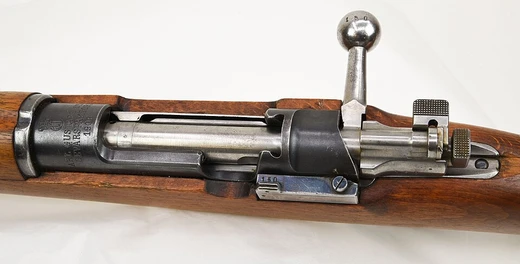
KO-8,2 (hunting rifle)
Soviet hunting carbine converted from the M1891/30 military rifle.

The KO-8,2 is a Soviet bolt-action hunting rifle derived from the 7.62mm M1891/30 military rifle. It was developed in the early 1930s as a large-caliber hunting weapon using an expanding bullet, initially produced as the NK-8,2 by the Tula Arms Plant from 1932 until 1941. After World War II, production resumed under the name KO-8,2, continuing until it was discontinued following the introduction of newer hunting rifles such as the Bars, Los, and Medved.
Quick Facts
- Origin
- USSR
- Is Ranged
- yes
- Designer
- D. M. Kochetov
- Design Date
- 1931
- Manufacturer
- Tula Arms Plant / Izhevsk Machine-Building Plant
- Production Date
- 1932 - 1941 / 1946 - 1965
- Weight
- 3.6 kg (KO-8,2) / 3.0 kg (KO-8,2M)
- Length
- 1020 (KO-8,2) / 1000 mm (KO-8,2M)
- Part Length
- 500mm - 520mm
- Cartridge
- 8.2×66mmR / 9×53mmR (KO-9)
- Rate
- variable
- Feed
- 5-round magazine, loaded individually
Facts from the source article.
Lore & Background
The KO-8,2 originated from a Soviet decision in the early 1930s to create a large-caliber hunting cartridge with an expanding bullet, paired with a rifle based on the standard military design. The Tula Arms Plant began serial production of the NK-8,2 in 1932, which continued until 1941. After World War II, production resumed with the weapon renamed KO-8,2, though the design remained unchanged.
The rifle is essentially a standard M1891/30 military rifle without a bayonet, fitted with a new 8.2mm barrel and a new bolt. It features a birch stock and fore-end. A small number of rifles were equipped with a detachable folding bipod. A later variant, the KO-8,2M introduced in August 1961, had a 500mm barrel with four right grooves and a 320mm twist rate, a new wooden gunstock, and a detachable scope base for the ТО-4 optical sight.
A 9mm version, the KO-9, was built as a single test prototype, featuring a 600mm barrel with a muzzle brake, a different wooden stock with a recoil pad, and a detachable scope base. In 2005, the Vyatskiye Polyany Machine-Building Plant announced production of the VPO-103, a surplus 7.62mm M1944 carbine converted to fire 9×53mmR ammunition.
Reader's Guide
The KO-8,2 represents a notable adaptation of a military bolt-action rifle for civilian hunting use in the Soviet Union. Its development from the M1891/30 platform provided a reliable and familiar action for hunters, chambered in a purpose-designed large-caliber cartridge with an expanding bullet. The rifle saw continuous production from the 1930s through the post-war period, indicating sustained demand despite the interruption of World War II.
The eventual discontinuation of the KO-8,2 and its 8.2×66mm cartridge came with the introduction of newer dedicated hunting rifles such as the Bars, Los, and Medved, which likely offered improved features or performance. The later KO-8,2M variant updated the design with a shorter barrel and scope mounting capability, reflecting evolving hunter preferences. The single KO-9 prototype suggests an attempt to adapt the design to a different cartridge, though it did not enter production. The 2005 announcement of the VPO-103 shows continued interest in converting surplus military carbines for hunting, albeit in a different caliber. Ten examples of the rifle are preserved in the Tula State Arms Museum.
Did You Know?
- The KO-8,2 was originally produced as the NK-8,2 from 1932 to 1941 by the Tula Arms Plant.
- A small number of NK-8,2 and KO-8,2 rifles were equipped with a detachable folding bipod.
- The KO-8,2M variant, introduced in August 1961, had a 500mm barrel with a 320mm twist rate.
- At least several NK-8,2 rifles were sold to Mongolia as civilian hunting weapons.
More in Bolt-Action Rifles, Part 4 1-24
Spotted an error? Know more?
Reader corrections go straight into our review queue. Suggest an edit · How this site is sourced