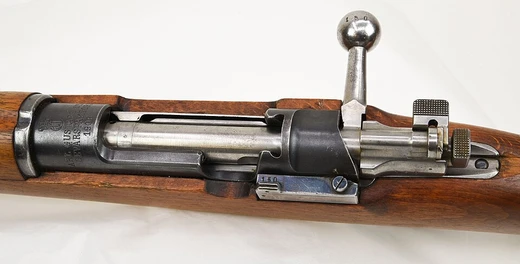
FR8
Spanish conversion of the large-ring Mauser 98K to 7.62×51mm NATO.

The FR8 is a bolt-action rifle that Spain adopted during the 1950s. It was rebuilt from the Model 1943 short rifle, which itself used the large-ring Mauser System 98 action, the same type found in the Karabiner 98k. Because the rifle is light, has a short barrel, and fires the 7.62×51mm NATO cartridge, it produces notably heavy recoil and muzzle blast. The flash hider doubles as a launcher for 22 mm NATO rifle grenades and includes notches for cutting wire when a round is fired. The tube under the barrel, which looks like a gas cylinder on automatic weapons, actually holds a bayonet mount and stores cleaning gear. The rear sight is a rotary type adjustable for elevation, with apertures for 200, 300, and 400 meters, plus an open V-notch for 100 meters. The front sight can be adjusted for elevation using a special tool. The rifle operates identically to a standard Mauser.
Quick Facts
- Origin
- Spain
- Is Ranged
- yes
- Service
- 1950s–1970s
- Manufacturer
- bolt system: Mauser, barrel: CETME or H&K, refitting: Fabrica De Armas La Coruña
- Variants
- FR 7, FR 8
- Weight
- ca. 3700 g
- Length
- 960 mm
- Part Length
- 470 mm
- Cartridge
- 7.62×51mm NATO (FR7), 7.62×51mm NATO (FR8), k bullet
- Caliber
- .308 (7.62 mm)
- Action
- Bolt action
- Feed
- 5-round internal magazine
Facts from the source article.
Lore & Background
The FR8 was introduced in the 1950s when the Spanish military was already implementing the CETME automatic rifle, but did not yet have sufficient inventory to equip and train all troops. The rifle was made from existing stockpiles of Mauser bolt-action rifles, specifically rebuilt from the Model 1943 short rifle, which was based on the large ring Model 1898 Carbine Mauser action (98K). The FR8 was modified to fire 7.62×51mm NATO. It was used well into the 1970s by mounted Guardia Civil units in the Sierra Nevada.
The flash hider was designed to also function as a rifle grenade launcher, compatible with NATO-standard 22 mm rifle grenades. It also has notches in it so that wire could be cut with it by firing a round. The under-barrel tube, which resembles the gas cylinder found on automatic weapons, actually serves as the bayonet mount and as storage for cleaning gear. The rear sight is an elevation-adjustable rotary type with apertures for 200 m, 300 m and 400 m, as well as an open V notch for 100 m. The front sight is elevation-adjustable via a special tool. Operation is identical to the standard Mauser design.
Reader's Guide
The FR8 represents a transitional period in Spanish military small arms, bridging the gap between the Mauser bolt-action era and the adoption of the CETME automatic rifle. Its conversion from existing Model 1943 short rifles allowed Spain to field a modern-calibre rifle in 7.62×51mm NATO without the expense of new production, while the CETME was being phased in. The rifle's notable features—such as the flash hider that doubles as a grenade launcher and wire cutter, and the under-barrel tube for bayonet mounting and cleaning kit storage—reflect a practical, multi-role design philosophy. The FR8 saw extended service with mounted Guardia Civil units in the Sierra Nevada into the 1970s, indicating its reliability in rugged terrain. Its legacy lies in being a well-regarded conversion that combined the proven Mauser 98 action with a more modern cartridge, though its light weight and short barrel produced heavy recoil and muzzle blast.
More in Bolt-Action Rifles, Part 4 1-24
Spotted an error? Know more?
Reader corrections go straight into our review queue. Suggest an edit · How this site is sourced