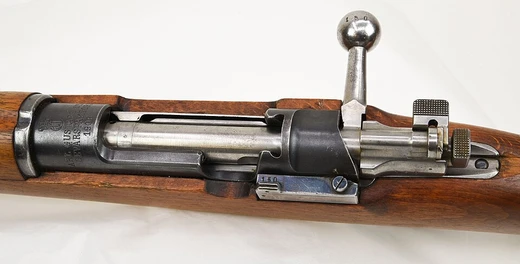
De Lisle carbine
A suppressed British bolt-action carbine used by commandos in WWII.

The De Lisle carbine, or De Lisle commando carbine, is a British bolt-action firearm from World War II that features a built-in suppressor. Because it fires subsonic ammunition, it is exceptionally quiet—often described as one of the quietest firearms ever made. Only a small number were produced, since it was intended for specialist military units.
The weapon was a private project of William Godfray de Lisle, an Air Ministry engineer. He built the first prototype in .22 calibre and tested it by shooting small game near his home on the Berkshire Downs. In 1943, he showed it to Major Sir Malcolm Campbell of Combined Operations. An informal test involved firing the weapon into the River Thames from the roof of the New Adelphi building in London; people on the street below did not hear the shots. De Lisle filed a patent (number 579,168) on May 8.
Combined Operations officials were impressed and asked for a 9 mm version, but that attempt failed. A third prototype, using the .45 ACP cartridge that de Lisle preferred, worked much better. Tests showed it had acceptable accuracy, no visible muzzle flash, and was inaudible at 50 yards. Official firing tests recorded the De Lisle at 85.5 dB. For comparison, modern handguns produce 156–168 dB without a suppressor and 117–140 dB with one. The De Lisle’s quietness was similar to the British Welrod pistol, but the Welrod was only useful at very short range and used fabric and rubber suppressor parts that needed replacing after a few shots. The De Lisle could fire hundreds of rounds before the suppressor needed cleaning.
Combined Operations ordered a small production run. An initial batch of 17 was hand-made by Ford Dagenham, with de Lisle released from his Air Ministry duties to work full-time. These were immediately used by British Commandos. In 1944, the Sterling Armaments Company received an order for 500 carbines but only produced about 130. The Sterling version had several differences from the earlier Ford Dagenham model. Two prototypes with folding stocks, similar to those on Sterling submachine guns, were made for airborne forces. De Lisle’s original .22 prototype was given to the National Army Museum in London but later lost; its current location is unknown.
During the rest of World War II, the De Lisle was mainly used by commandos, with some use by the Special Operations Executive (SOE). E.
Quick Facts
- Origin
- United Kingdom
- Is Ranged
- yes
- Service
- 1943–1965
- Wars
- World War II / Korean War / Malayan Emergency
- Designer
- William G. De Lisle
- Design Date
- 1942
- Manufacturer
- Ford Dagenham (17 prototypes) / Sterling Armaments Company
- Production Date
- 1942–1945
- Number
- 129
- Variants
- Ford Dagenham Prototypes / Folding stock parachute carbine, only one example produced
- Weight
- 7 lb 8 oz (3.74 kg), unloaded
- Part Length
- 8.25 in
Facts from the source article.
Lore & Background
The weapon was designed as a private venture by William Godfray de Lisle, an engineer who worked for the Air Ministry. He made the first prototype in .22 calibre, testing it by shooting rabbits near his home on the Berkshire Downs. In 1943, he approached Major Sir Malcolm Campbell of Combined Operations; the prototype was informally tested by firing it into the River Thames from the roof of the New Adelphi building in London to see if people in the street below heard it—they did not. A patent was filed on May 8. Combined Operations requested a 9 mm version, which was a failure, but a third prototype using .45 ACP was much more successful. Tests showed acceptable accuracy, no visible muzzle flash, and inaudibility at 50 yd. Official tests recorded 85.5 dB of noise; modern handguns without suppressors produce 156–168 dB, and with suppressors 117–140 dB. The De Lisle's quietness was comparable to the British Welrod pistol, but the Welrod was useful only at very short range and required suppressor component replacement after a few shots, whereas the De Lisle could fire hundreds of rounds before cleaning.
Combined Operations requested a small production run; an initial batch of 17 were hand-made by Ford Dagenham, with de Lisle released from Air Ministry duties to work full-time. This batch was immediately used by British Commandos. In 1944, Sterling Armaments Company received an order for 500 but produced around 130, with differences from the Ford Dagenham model. Two prototypes of a version for airborne forces with folding stocks were made. De Lisle's own .22 prototype was given to the National Army Museum in London but was subsequently lost.
The De Lisle was based on a Short Magazine, Lee–Enfield Mk III* converted to .45 ACP. The receiver was modified, the bolt and bolthead altered, and the barrel replaced with a modified Thompson submachine gun barrel (six grooves, right-hand twist). Magazines from the M1911 pistol were used. The silencer reduced the sound to such a degree that working the bolt produced a louder noise than firing. The .45 ACP cartridge was chosen because its muzzle velocity is subsonic for typical barrel lengths, retaining lethality without custom-loaded ammunition. The Thompson barrel was ported to release gas into the silencer before the bullet left the barrel. The silencer, 2 inches in diameter, ran from the back of the barrel to beyond the muzzle, making up half the overall length. The Lee–Enfield bolt was shortened to feed .45 ACP rounds, and the magazine assembly was replaced to hold modified M1911 magazines. The bolt action allowed the shooter to refrain from chambering the next round if absolute silence was required after firing, an advantage over semi-automatic weapons. While silent, the carbine was not very accurate.
Reader's Guide
The De Lisle carbine's significance lies in its extreme quietness, achieved through an integrated suppressor and subsonic ammunition, making it possibly one of the quietest firearms ever made. Its design influenced later suppressed firearms such as the MP5SD and AS Val, which use the same concept of a large suppressor volume. During World War II, it was used by British Commandos and the Special Operations Executive, including a reported assassination of two senior German officers in 1944 by a Jedburgh Team. It saw use in the Burma Campaign to eliminate Japanese sentries, and later in the Korean War and the Malayan Emergency. US Army Special Forces—MACV-SOG used it for many years in the Vietnam War. It has also been claimed that the Special Air Service used it during the Northern Irish Troubles. Its legacy includes modern reproductions: Gary Delsignore built a small number in 1983; Century Arms sold converted No. 4 Enfield rifles; Valkyrie Arms manufactured a reproduction before going out of business; Special Interest Arms produced limited quantities with an improved magazine adapter; and in May 2024, US Armament Manufacturing announced pre-orders for a reproduction, with production started as of September 2025. The De Lisle remains a notable example of a purpose-built suppressed bolt-action carbine for covert operations.
Did You Know?
- The De Lisle carbine produced only 85.5 dB of noise when fired, compared to 156–168 dB for unsuppressed handguns.
- Working the bolt of the De Lisle produced a louder noise than firing a cartridge.
More in Bolt-Action Rifles, Part 4 1-24
Spotted an error? Know more?
Reader corrections go straight into our review queue. Suggest an edit · How this site is sourced