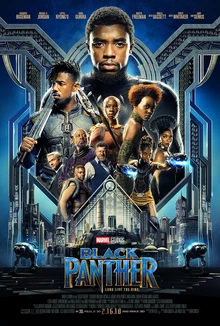
Black Panther: Who is the Black Panther?
A 2017 prose adaptation of the 2005–2006 comic storyline 'Who Is the Black Panther?'.

José Luiz · CC BY-SA 4.0
Jesse Holland’s 2017 novel *Black Panther: Who is the Black Panther?* is a prose adaptation of the 2005–2006 comic storyline 'Who Is the Black Panther?', created by Reginald Hudlin and John Romita Jr. The book tells the origin story of T’Challa, the king and protector of the fictional African nation of Wakanda, and is not set in the Marvel Cinematic Universe. Holland, a longtime fan of the comics, wrote the novel as a standalone adaptation, not as a companion to the 2018 film. He later edited the short story collection *Black Panther: Tales of Wakanda*. The book earned positive reviews, with NBC News calling it “richly layered” and an “in-depth page turner,” while Stuart Conover of Sciencefiction.com described it as a “faithful adaptation of the Black Panther’s origin story.”
Quick Facts
- Author
- Jesse Holland
- Genre
- Science fiction · action-adventure · fantasy
- Published
- 2017
- Publisher
- Marvel Entertainment
- Language
- English
- Pages
- 263
- Isbn
- 978-1302902674
Facts from the source article.
Lore & Background
The novel tells the legacy and origin of the Black Panther, also known as T'Challa, as depicted in the 2005–2006 comic storyline 'Who Is the Black Panther?'. He is the king and protector of the African nation known as Wakanda. The book was written by Jesse Holland as a prose adaptation of that comic storyline, not as a companion to the 2018 Black Panther film. Holland agreed to write the novel because he had been a fan of the comic series since childhood. Holland later edited the short story collection Black Panther: Tales of Wakanda.
Reader's Guide
Black Panther: Who is the Black Panther? holds significance as a literary bridge between the character's introduction in Captain America: Civil War and his standalone film. Written by Jesse Holland, the novel adapts the 2005–2010 comic book storyline by Reginald Hudlin and John Romita Jr., providing a prose origin story for T'Challa within the Marvel Cinematic Universe. The book received positive reviews, with NBC News calling it 'richly layered' and an 'in-depth page turner,' while Stuart Conover of Sciencefiction.com praised it as a 'faithful adaptation of the Black Panther's origin story.' Holland's personal connection to the source material, having been a fan since childhood, informed his approach. The novel also led to Holland editing the short story collection Black Panther: Tales of Wakanda. Its legacy lies in expanding the MCU narrative into print and offering fans a deeper exploration of Wakanda and its protector ahead of the blockbuster film.
Did You Know?
- The novel is a prose adaptation of the 2005–2006 comic storyline 'Who Is the Black Panther?', not an MCU-original story or a companion to the 2018 film.
- The plot is adapted from the comic book storyline of the same name by Reginald Hudlin and John Romita Jr. that ran from 2005 until 2006.
Strategic Rationale and the Drive for Self-Reliance
South Korea's decision to pursue a fully indigenous main battle tank was driven by a convergence of strategic, political, and emotional factors. The K1, though produced domestically, remained fundamentally an American design subject to U.S. export controls, creating significant burdens whenever South Korea considered selling or modifying the vehicle. Meanwhile, the aging M48A3K and M48A5K fleets demanded replacement. Perhaps most importantly, the Republic of Korea Army was shifting toward three-dimensional high-speed maneuver warfare built around network-centric command and control—a capability the Army explicitly ranked above firepower, defense, or mobility. There was also a deeply felt sense of national humiliation attached to the K1 program, as it symbolized Korea's earlier dependence on foreign tank technology. Defense-sector consensus across politicians, military leaders, and engineers held that building a world-class MBT from scratch was a matter of pride. Historical precedents of geopolitical disruption cutting off allied logistics in the Middle East and Eastern Europe reinforced the argument for self-reliance, a policy South Korea had long maintained.
A Decade-and-a-Half From Concept to Combat
The K2's path from concept to operational service spanned nearly two decades. System Concept Research ran from July 1995 through December 1997, during which developers analyzed required operational capabilities, functions, performance, logistics, and the underlying technology. Exploratory development followed from November 1998 to December 2002, with private companies joining the Agency for Defense Development to develop core systems. Full Scale Development began in June 2003. By 2008, development of the vehicle excluding the powerpack had concluded after army trials. However, the domestic powerpack proved to be a persistent bottleneck; it kept the tanks from entering service until 2012, when 100 EuroPowerPacks were fitted to the first production batch. The first six K2 Black Panthers finally entered service with the Republic of Korea Army on June 29, 2014. This timeline underscores how the most critical subsystem—power—can delay an otherwise completed platform by several years, and how the program's long gestation allowed Korea to absorb lessons from earlier tank programs while building genuine in-house capability.
Design Philosophy: Network-Centric and Mobility-First
The K2 Black Panther was conceived not merely as a heavier, better-armed successor to the K1, but as a fundamentally different kind of platform. The design philosophy prioritized lower weight, higher mobility, and increased modularity over brute firepower. Extensive integration of Vetronics, advanced sensors, space optimization, and increased automation distinguished it from earlier generations. During exploratory development, engineers tackled the electric gun and turret drive system, a gun autoloader, automatic target detection and tracking, and a cognitive identification capability within the combat control system. A semi-active in-arm suspension unit was developed to dramatically boost mobility performance, while a proximity fuse capable of functioning within seven meters was designed for multi-purpose HEAT munition—enabling the tank to engage helicopters. The Army's explicit instruction that network warfare capability for command and control was the top priority shaped every design decision, making the K2 as much an information node as a fighting vehicle.
Global Expertise and International Interest
Although the K2 was a domestically designed tank, its development was enriched by deliberate international knowledge exchange. During the System Concept Research phase, South Korean developers invited a distinguished panel of tank experts from around the world for a 40-hour seminar. The participants included Sven Berge of the Stridsvagn 103 program, Philip Lett of the M1 Abrams, Israel Tal of the Merkava, Hayashi Iwao of Japan's Type 90, and Richard Ogorkiewicz covering European tanks. Per prior agreement, all presentations were recorded and subsequently used to guide the system development of the new tank. Additionally, seven researchers from the Agency for Defense Development were sent to the United Kingdom for a full year of tank development education. The program's growing reputation also attracted foreign interest: in 2002, Hilmi Özkök, commander of the Turkish Land Forces, visited the research center and observed the simulator capabilities and a physical model of the combat control system, after which Turkey continued to send dignitaries to follow the program's progress.
Gallery


Frequently Asked Questions
What exactly is 'Black Panther: Who is the Black Panther?'?
It is a 2017 prose novel by Jesse Holland that retells the 2005–2006 comic storyline of the same name in book form. It functions as a standalone adaptation rather than a new plot or a tie-in to the 2018 Marvel film.
Who created the original 'Who Is the Black Panther?' comic storyline?
The arc was written by Reginald Hudlin and illustrated by John Romita Jr., published in 2005–2006. Jesse Holland later reimagined that same narrative as his 2017 novel.
Is the novel connected to the MCU or the 2018 Black Panther movie?
No. The story is set squarely in the Marvel comic book universe and follows T'Challa's origin as king of the fictional nation of Wakanda. Holland wrote it as an independent adaptation with no link to any MCU property.
What is the plot of the book?
The novel traces T'Challa's path from young prince in Wakanda to his ultimate assumption of the Black Panther mantle, covering his training, trials, and rise to leadership. It essentially presents the character's foundational origin in continuous prose.
Why is this adaptation notable among Black Panther media?
It was one of the first prose novels to deliver the full Black Panther origin in a single, accessible volume aimed at readers beyond the comics. Holland, a longtime fan of the source material, went on to edit the short-story collection Black Panther: Tales of Wakanda.
More in Black Panther 1-24
Spotted an error? Know more?
Reader corrections go straight into our review queue. Suggest an edit · How this site is sourced