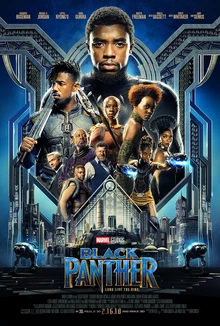
Black Panther (Original Score)
Score blending traditional African music with classical orchestra.

Shota Rustaveli · Public domain
The original score for the 2018 American superhero film Black Panther was composed by Ludwig Göransson. Göransson had worked on all of director Ryan Coogler's previous films and traveled to Africa to research traditional African music for the score, combining these elements with a classical orchestra. The score was released by Hollywood Records on February 16, 2018, and won Best Original Score awards at the Academy Awards and the Grammy Awards.
Quick Facts
- Artist
- Kendrick Lamar and various artists
- Released
- 2018-02-09
- Recorded
- 2017
- Genre
- Hip-hop / gqom / trap / R&B / ATM / pop rap
- Label
- TDE / Aftermath / Interscope
Facts from the source article.
Lore & Background
Ludwig Göransson began work on the Black Panther score as early as possible, much earlier than any other composer on a Marvel Studios film according to producer Nate Moore. After reading the film's script, Göransson traveled to Africa to research traditional African music. He spent a month in Senegal, first touring with Senegalese musician Baaba Maal for a week, then spending several weeks working with local musicians. He also went to South Africa and spent a week at the International Library of African Music in Grahamstown listening to thousands of recordings of music from different African tribes and recording music on hundreds of instruments. Göransson used recordings of talking drums and a tambin for character themes in the film, while Maal sung an original song for the opening of the score. The orchestra was recorded at Abbey Road Studios, along with a choir singing in the Xhosa language.
Reader's Guide
The Black Panther original score is significant for its authentic African elements, a first for a superhero film according to Coogler. Göransson combined traditional African instruments and rhythms with a classical orchestra, using talking drums to represent T'Challa and a tambin performance for Killmonger's theme. The score was praised for being unique among Marvel Cinematic Universe scores due to its authentic African elements and thematic material, though the album presentation was criticized as being too long. It won Best Original Score awards at the Academy Awards and the Grammy Awards, marking a milestone for representation of African music in mainstream film scoring.
Did You Know?
- Göransson traveled to Senegal and South Africa to research traditional African music for the score.
- The talking drum was the first sound Göransson used to represent T'Challa, with six talking drums played together.
- A musician named Amadou Ba performed on a tambin (Fula flute) for Killmonger's theme, including singing, screaming, and laughing into the flute.
A Production Shaped by Loss
When the original Black Panther hit theaters in early 2018, sequel discussions began almost immediately. Ryan Coogler negotiated his return as director within months, and Marvel Studios officially greenlit the project by mid-2019. However, the creative direction shifted dramatically in August 2020, when Chadwick Boseman passed away from colon cancer. Rather than recasting the role of T'Challa, the studio made the deliberate choice to honor his absence, fundamentally altering the story's emotional core. The remaining principal cast was confirmed in November of that year, and the working title Black Panther: Wakanda Forever was unveiled in May 2021. Principal photography kicked off in late June at both Trilith Studios and Tyler Perry Studios in Atlanta, then relocated to Massachusetts in August. Production was interrupted in November so that lead actress Letitia Wright could recover from a filming injury, resuming in mid-January 2022 before wrapping in Puerto Rico in late March.
A Story of Grief, Power, and Reconciliation
The narrative centers on Shuri in the aftermath of her brother T'Challa's death from a terminal illness, which she was unable to cure through her synthetic recreation of the heart-shaped herb. A year later, Wakanda finds itself under international pressure to surrender its vibranium reserves, while a hidden underwater civilization called Talokan, led by the superhuman Namor, emerges from centuries of isolation. Namor, bitter over historical slavery and genocide, demands the scientist behind a vibranium detector or threatens total war. The conflict escalates when Namor's forces attack Wakanda, resulting in the drowning death of Queen Ramonda while she shields a young inventor. Devastated, Shuri reconstructs the herb using a remnant that granted Namor's people their abilities, ingests it, and assumes the Black Panther mantle. Though driven by vengeance, she ultimately chooses peace over destruction after a vision of her mother urges Namor to yield. The film closes with Shuri planting new herbs to secure the mantle's future and visiting her sister Nakia in Haiti, where she finally grieves for T'Challa. A post-credits revelation discloses that Nakia has been secretly raising their son, named T'Challa.
Box Office Triumph and Critical Recognition
Serving as the capstone of the MCU's Phase Four, Black Panther: Wakanda Forever premiered at both the El Capitan Theatre and the Dolby Theatre in Hollywood on October 26, 2022, before its wide U.S. release on November 11. As the 30th installment in the Marvel Cinematic Universe, the film earned generally positive critical reception and accumulated $859.2 million at the global box office, securing its position as the sixth-highest-grossing picture of that year. Its impact extended well beyond the screen: the film and Angela Bassett's portrayal of Queen Ramonda attracted a substantial slate of awards recognition. Among the honors, the production collected five Academy Award nominations, taking home the statuette for Costume Design. It also earned one British Academy Film Award, six Critics' Choice Movie Awards (claiming two of them), two Golden Globe nominations (winning one), and two Screen Actors Guild Award nods. This breadth of recognition underscored the film's cultural weight and the industry's acknowledgment of its artistic and technical achievements across multiple disciplines.
Creative Vision and Expanding Legacy
The film was helmed by Ryan Coogler, who also co-wrote the screenplay alongside Joe Robert Cole, continuing the creative partnership that defined the 2018 original. Produced by Marvel Studios and distributed through Walt Disney Studios Motion Pictures, the project assembled a deep ensemble cast. Letitia Wright anchored the story as Shuri and the new Black Panther, supported by Lupita Nyong'o, Danai Gurira, Winston Duke, Florence Kasumba, Dominique Thorne, Michaela Coel, Mabel Cadena, Tenoch Huerta Mejía, Martin Freeman, Julia Louis-Dreyfus, and Angela Bassett. The film's cultural footprint has continued to grow beyond its theatrical run. A spin-off miniseries centering on Dominique Thorne's character Riri Williams, titled Ironheart, premiered in June 2025, extending the narrative into a new medium. Looking further ahead, a sequel to Wakanda Forever is already scheduled for a December 2028 release, signaling that the story of Wakanda and its heroes remains firmly on the studio's roadmap for years to come.
Gallery


Frequently Asked Questions
Who composed the Black Panther (Original Score)?
Ludwig Göransson wrote the score, having already served as composer on every prior film directed by Ryan Coogler. He traveled to Africa to study traditional musical traditions before crafting the soundtrack.
What instruments and musical styles define the Black Panther (Original Score)?
The soundtrack weaves together traditional African instruments—such as talking drums, the Fula flute (tambin), sabar drums, kora, and vuvuzela—with a full classical orchestra and a choir singing in Xhosa. This fusion of indigenous African sound and Western orchestration is what gives the score its distinctive identity.
When and where was the Black Panther (Original Score) released?
Hollywood Records put the album out on February 16, 2018, just ahead of the film's theatrical debut.
What major awards did the Black Panther (Original Score) win?
Göransson took home the Academy Award for Best Original Score and the Grammy Award for Best Original Score, making it one of the few film soundtracks to sweep both top honors in the same year.
Why is the Black Panther (Original Score) considered significant in film-music history?
It is widely praised for centering authentic African musical traditions—drawn from field research across the continent—rather than relying on generic 'exotic' orchestration. By pairing those traditions with a classical ensemble, it set a new benchmark for how superhero-film scores could honor specific cultural sounds.
More in Black Panther 1-24
Spotted an error? Know more?
Reader corrections go straight into our review queue. Suggest an edit · How this site is sourced