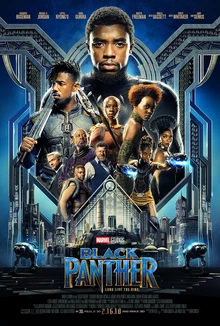
Black Panther: The Album
Curated by Kendrick Lamar for the 2018 film Black Panther.

Black Panther: The Album is the soundtrack album for the 2018 American superhero film Black Panther, produced by Marvel Studios. The album was curated and primarily performed by Kendrick Lamar, who decided to produce a full curated soundtrack rather than just the few songs originally requested by director Ryan Coogler. Released by Interscope Records on February 9, 2018, the album achieved large sales, including the top position on the Billboard 200 chart.
Quick Facts
- Artist
- Kendrick Lamar and various artists
- Released
- 2018-02-09
- Recorded
- 2017
- Genre
- Hip-hop / gqom / trap / R&B / ATM / pop rap
- Label
- TDE / Aftermath / Interscope
Facts from the source article.
Lore & Background
Kendrick Lamar and director Ryan Coogler had previously discussed collaborating, and Lamar agreed to perform several songs for the film after seeing an early version of it. Wanting to match the film in terms of addressing important themes, Lamar decided to produce a full curated soundtrack album rather than just the few songs requested by Coogler. Because of the film's set release schedule, Lamar had less time to work on the album than he usually would. He began work with producer Sounwave while on tour, before completing the individual songs in collaboration with many different artists. One of these collaborators was composer Ludwig Göransson, who worked on one of the songs and included elements from the album in the score. Coogler felt the album became its own piece of art rather than just a tie-in to the film.
Reader's Guide
Black Panther: The Album was praised by many critics as a milestone for film soundtracks due to its ideas and lyrics, but it was considered by some to be weaker than Lamar's solo work. The album's commercial success, including reaching number one on the Billboard 200, demonstrated its broad appeal. The song 'King's Dead' from the album won a Grammy Award. The album's creation involved a tight schedule and collaboration with multiple artists, including Ludwig Göransson, who also composed the film's score. The album was seen by Coogler as a separate piece of art rather than a mere tie-in, reflecting its thematic depth and integration with the film's messages.
Did You Know?
- Lamar began work with producer Sounwave while on tour due to the film's set release schedule.
- Composer Ludwig Göransson worked on one of the album's songs and included elements from the album in the film's score.
A First on Screen: Pioneering the Panthers in Cinema
The 1995 film Panther marked a milestone as the first narrative feature-length movie to portray the Black Panther Party for Self-Defense. Adapted from Melvin Van Peebles's novel of the same name, the project was both produced and directed by his son, Mario Van Peebles. The story compresses the organization's entire arc—from its founding to its eventual decline—into a single dramatic narrative. Rather than a straightforward documentary approach, the film takes a semi-fictionalized route, centering on a Vietnam veteran named Judge (played by Kadeem Hardison) who returns to Oakland and discovers a community ravaged by violence and police discrimination. Through his friend Cy, Judge is introduced to a vigilante group fighting back against law enforcement, led by characters named Bobby (Courtney B. Vance) and Huey (Marcus Chong). Judge's subsequent involvement in the movement and the police pressure he faces to inform against Huey form the dramatic backbone of the story.
Praise, Criticism, and the Authenticity Question
The film's reception was deeply fractured. On Rotten Tomatoes, it sits at a 25 percent approval rating across 12 reviews, averaging 5.2 out of 10. Roger Ebert acknowledged that a compelling study of the Black Panther Party was possible but concluded this was not it. The most pointed criticism came from Bobby Seale himself, a co-founder of the actual Black Panther Party and a major figure in the film. Seale declared the movie "80 percent to 90 percent" untrue and characterized it as "a false-light invasion of my privacy." Kenneth Turan of the Los Angeles Times offered a more nuanced take, calling it a "sincere attempt at celebratory, spirit-raising filmmaking" while simultaneously describing it as "a frustrating amalgam of truth, violence, supposition and inspiration." These conflicting responses highlight the difficulty of translating a real political organization's history into dramatic cinema without satisfying both artistic and historical expectations simultaneously.
The Soundtrack as a Cultural Touchstone
The Panther soundtrack, released on May 2, 1995, by Mercury Records, became one of the defining R&B and hip-hop compilations of the mid-1990s. It reached number 37 on the Billboard 200 and climbed to number 5 on the Top R&B/Hip-Hop Albums chart, earning a gold certification on July 25, 1995. Three singles charted on the Billboard Hot 100: "Head Nod" by Hodge, "The Points" featuring a collaboration of twelve of hip-hop's most prominent artists and groups of the era, and the standout "Freedom (Theme from Panther)." That final track was a massive ensemble piece uniting more than sixty female R&B singers and rappers—including names like Mary J. Blige, Queen Latifah, En Vogue, TLC, and Vanessa Williams—and it peaked at number 45. The tracklist also showcased artists such as Blackstreet, Shanice, Bobby Brown, Tony! Toni! Toné!, and a rendition of the "Star-Spangled Banner" by Brian McKnight and the Boys Choir of Harlem, blending commercial appeal with anthemic messaging.
Box Office and Festival Recognition
Despite its polarizing critical reception, Panther found a modest commercial audience. The film earned $6,834,525 in domestic ticket sales across the United States and Canada, with its worldwide gross reaching approximately $8 million. On the international festival circuit, the film received recognition at the Locarno International Film Festival, where it was awarded the Prize of the Ecumenical Jury and a Special Mention in the form of a Silver Leopard. These accolades suggest that beyond its domestic reception, the film resonated with international audiences and juries who valued its ambition in bringing the Black Panther Party's story to the screen. The accompanying book, Panther: The Pictorial History of the Black Panthers and the Story Behind the Film, authored by Mario Van Peebles, Ura Y. Taylor, J. Tanika Lewis, and Melvin Van Peebles, was published by HarperCollins in 1995, extending the project's reach into print media and providing additional context for the film's creation.
Frequently Asked Questions
What is Black Panther: The Album?
It is the official soundtrack for Marvel Studios' 2018 superhero film Black Panther. Instead of a small collection of licensed songs, it was assembled as a full-length curated musical project woven into the movie's story.
Who created or curated Black Panther: The Album?
Kendrick Lamar served as the album's curator and a featured performer throughout. He chose to build out a complete soundtrack rather than simply supplying the handful of tracks director Ryan Coogler had originally asked for.
When was Black Panther: The Album released and how did it perform on the charts?
Interscope Records put it out on February 9, 2018, and it landed at number one on the Billboard 200. Its sales figures placed it among the top-selling soundtracks of that year.
Did Black Panther: The Album win any major awards?
Yes—the track "King's Dead" picked up a Grammy Award. That win underscored the album's cultural reach well beyond its connection to the film.
Who else contributed to Black Panther: The Album besides Kendrick Lamar?
Producers Sounwave and Ludwig Göransson were central collaborators behind the music. A wider circle of guest artists also added vocals and performances across the various tracks.
More in Black Panther 1-24
Spotted an error? Know more?
Reader corrections go straight into our review queue. Suggest an edit · How this site is sourced