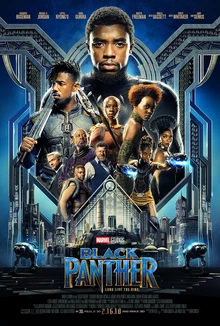
Black Panther: Wakanda Forever (Original Score)
Score rooted in Mayan, Wakandan, and Nigerian musical traditions.

The original score for the 2022 American superhero film Black Panther: Wakanda Forever was composed and produced by Ludwig Göransson. Göransson, who had worked as the composer for director Ryan Coogler's previous films, confirmed his involvement in September 2021. The score album was released by Hollywood Records on November 11, 2022, coinciding with the film's release.
Quick Facts
- Artist
- Various artists
- Released
- 2022-07-25
- Label
- Hollywood · Marvel Music
Facts from the source article.
Lore & Background
The score was heavily influenced by the film's setting in the underwater civilization of Talokan, which is rooted in Mesoamerican culture, as well as Wakandan and Nigerian cultures. Göransson traveled to Mexico City to research and recreate Mayan music, which he felt had been forcibly erased from history. He worked with musical archaeologists and used ancient instruments found in graves, including flutes with multiple components, seashells, turtle shells, clay flutes, and shakers, to produce sounds he had never heard in a film before.
Reader's Guide
The score for Black Panther: Wakanda Forever represents a significant effort to reconstruct and integrate ancient Mayan musical traditions into a major Hollywood film. Göransson's use of instruments such as the seashell for Namor's theme and the death whistle for his action sequences brought unique, otherworldly textures to the soundtrack. The score also adapted T'Challa's theme from the first film and introduced new themes for Shuri and Riri Williams, blending orchestral elements with indigenous sounds. Recording took place simultaneously in Mexico, Lagos, and Los Angeles, reflecting the film's multicultural roots.
Did You Know?
- Göransson used a seashell to play Namor's theme, as the seashell was an integral part of the script.
- The death whistle, a clay flute, was used to represent Namor's action or strength, producing an abrasive, otherworldly sound.
- T'Challa's theme from the first film was altered and integrated into the score, while a new theme was written for Shuri to underscore grief and anger.
- Recording for the score happened simultaneously in Mexico and Lagos, with additional recording in Los Angeles.
A Production Shaped by Loss
When the original Black Panther hit theaters in February 2018, ideas for a follow-up began circulating almost immediately. Ryan Coogler negotiated his return as director within those following months, and Marvel Studios officially greenlit the project by mid-2019. However, the creative direction underwent a profound shift in August 2020, when Chadwick Boseman—the actor who had embodied King T'Challa—passed away from colon cancer. Rather than recast the role, Marvel made the deliberate choice to honor his absence, fundamentally reshaping the story around Shuri's grief and succession. The remaining principal cast was confirmed by November 2020, and the title Black Panther: Wakanda Forever was unveiled in May 2021. Principal photography kicked off in late June in Atlanta, splitting between Trilith Studios and Tyler Perry Studios, before the crew relocated to Massachusetts in August. Production was interrupted in November so that Letitia Wright could recover from an on-set injury, then resumed by mid-January 2022 and concluded in late March on location in Puerto Rico.
Shuri's Journey from Grief to the Mantle
The narrative centers on Shuri in the aftermath of her brother T'Challa's death from a terminal illness. Her desperate attempt to synthetically recreate the heart-shaped herb—destroyed by Killmonger in the first film—ends in failure, leaving her without a path to save him. A year later, as foreign powers pressure Wakanda to surrender its vibranium, Shuri resists Queen Ramonda's call to forge a new Black Panther, convinced the title is no longer necessary. The arrival of Namor and his underwater kingdom of Talokan escalates the crisis, culminating in Ramonda's drowning during an attack on the nation. Only after this devastating loss does Shuri reconstruct the herb using a remnant that once granted the Talokanil their powers. In the Ancestral Plane, Killmonger challenges her to choose between vengeance and honor. She ultimately dons the Black Panther suit, leads a counterattack on Talokan, and—guided by a vision of Ramonda—chooses peace over destruction. The film closes with Shuri planting new herbs for the mantle's future and finally burning her funeral robe to grieve T'Challa, while a mid-credits scene reveals Nakia and T'Challa had a son named Toussaint, secretly raised in Haiti.
Box Office Triumph and Critical Recognition
Black Panther: Wakanda Forever premiered at both the El Capitan Theatre and the Dolby Theatre in Hollywood on October 26, 2022, before its wide U.S. release on November 11 as the final film in Phase Four of the MCU. Critics responded with generally favorable reviews, and audiences rewarded the film with $859.2 million in worldwide box-office receipts, making it the sixth-highest-grossing release of that year. The film's critical prestige was equally notable: it accumulated five Academy Award nominations, ultimately winning for Costume Design, alongside one British Academy Film Award, six Critics' Choice Movie Award nominations (converting two into wins), two Golden Globe nominations (winning one), and two Screen Actors Guild Award nods. Angela Bassett's performance as Queen Ramonda was singled out across multiple categories. The film's cultural momentum continued beyond its theatrical run, spawning a spin-off miniseries centered on Dominique Thorne's Riri Williams, Ironheart, which premiered in June 2025, and securing a sequel slated for December 2028.
An Ensemble Built for the MCU's Milestone
As the thirtieth installment in the Marvel Cinematic Universe and the direct sequel to the 2018 original, Wakanda Forever assembled a cast that blended returning veterans with new voices. Letitia Wright anchored the film as Shuri, the princess who would become Black Panther, supported by Lupita Nyong'o as Nakia, Danai Gurira as Okoye, Winston Duke as M'Baku, and Florence Kasumba as Ayo. Dominique Thorne brought energy as MIT student Riri Williams, while Michaela Coel and Mabel Cadena added depth to the supporting ensemble. Tenoch Huerta Mejía headlined the antagonistic Talokanil as Namor, and the film also featured Martin Freeman, Julia Louis-Dreyfus, and Angela Bassett in pivotal roles. The project was produced by Marvel Studios, distributed through Walt Disney Studios Motion Pictures, and directed by Ryan Coogler, who co-wrote the screenplay with Joe Robert Cole. This collaborative structure—spanning multiple studios, a global cast, and a director with a personal connection to the source material—positioned the film as both a narrative continuation and a cultural statement within the broader superhero landscape.
Frequently Asked Questions
Who composed the Black Panther: Wakanda Forever original score?
Ludwig Göransson wrote and produced the entire soundtrack. He had already served as composer on Ryan Coogler's earlier films, and his return to the role was confirmed in September 2021.
When was the Black Panther: Wakanda Forever score released and by whom?
Hollywood Records issued the album on November 11, 2022, matching the film's theatrical debut. It is catalogued under the film-score genre.
What cultural musical traditions shape the Black Panther: Wakanda Forever score?
Göransson built the soundtrack around Mayan, Wakandan, and Nigerian musical heritage. This multi-tradition approach gives the score a distinctly African and pre-Columbian sonic character beneath its superhero-film structure.
What unusual instruments appear in the Black Panther: Wakanda Forever score?
The recording prominently features seashells, death whistles, clay flutes, and turtle shells. These choices anchor the score in West African and indigenous performance practices rather than a standard orchestral palette.
Why do fans consider the Black Panther: Wakanda Forever score important?
It carries forward the sonic identity of a landmark franchise at a deeply emotional turning point, with Göransson extending the musical language he established in the first film. The deliberate weaving of Mayan, Wakandan, and Nigerian traditions makes it one of the most culturally layered superhero soundtracks in recent memory.
More in Black Panther 1-24
Spotted an error? Know more?
Reader corrections go straight into our review queue. Suggest an edit · How this site is sourced