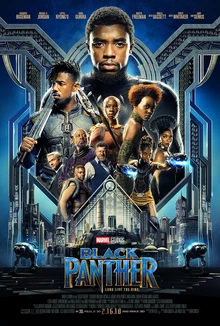
Black Panther (soundtrack)
Two distinct works: a curated album and an African-infused orchestral score.

Pr0pulsion 123 · CC BY-SA 4.0
The soundtrack for the 2018 American superhero film Black Panther consists of an original score composed by Ludwig Göransson and original songs performed or curated by Kendrick Lamar. Göransson worked on all of director Ryan Coogler's previous films, while Lamar and Coogler had previously discussed collaborating and the musician agreed to perform several songs for the film after seeing an early version of it. Lamar decided to produce a full curated soundtrack album rather than just the few songs requested by Coogler, and it was released as Black Panther: The Album by Interscope Records on February 9, 2018.
Quick Facts
- Artist
- Kendrick Lamar and various artists
- Released
- 2018-02-09
- Recorded
- 2017
- Genre
- Hip-hop / gqom / trap / R&B / ATM / pop rap
- Label
- TDE / Aftermath / Interscope
Facts from the source article.
Lore & Background
After reading the film's script, Göransson traveled to Africa to research traditional African music. He went on tour with Senegalese musician Baaba Maal, and recorded performances by Maal and other African musicians for use in the score. Göransson used recordings of talking drums and a tambin for character themes, while Maal sung an original song for the opening of the score. He combined these traditional African elements with the classical orchestra recorded at Abbey Road Studios, along with a choir singing in the Xhosa language.
Wanting to match the film in terms of addressing important themes, Lamar began work with producer Sounwave while on tour, completing the individual songs in collaboration with many different artists. One collaborator was Göransson, who worked on one of the songs and included elements from the album in the score. Coogler felt the album became its own piece of art rather than just a tie-in to the film. Lamar's soundtrack was praised by many critics as a milestone for film soundtracks due to its ideas and lyrics, but was considered by some to be weaker than Lamar's solo work. Göransson's score received praise for being unique among Marvel Cinematic Universe scores due to its authentic African elements and thematic material, though the album presentation was criticized as being too long.
Reader's Guide
The Black Panther soundtrack is significant for its dual approach: a curated album by Kendrick Lamar that became a cultural milestone, and a score by Ludwig Göransson that authentically integrated traditional African music into a superhero film. Göransson's research in Senegal and South Africa, including recordings of talking drums and a tambin, brought unprecedented African musical language to the Marvel Cinematic Universe. Lamar's decision to produce a full album rather than a few songs resulted in a commercially successful and critically praised work, though some critics found it weaker than his solo output. The score won Academy and Grammy awards for Best Original Score, while the song 'King's Dead' also won a Grammy. The soundtrack's legacy lies in its demonstration that a superhero film could support both a commercially viable curated album and a score that respected African musical traditions, influencing how future blockbusters approach music.
Did You Know?
- Göransson traveled to Africa to research traditional African music, recording performances by Baaba Maal and other musicians.
- The score includes talking drums representing T'Challa's theme and a tambin (Fula flute) performance for Killmonger's theme.
- Lamar decided to produce a full curated soundtrack album after seeing an early version of the film, rather than just the few songs Coogler requested.
- Göransson's score won Best Original Score at both the Academy Awards and the Grammy Awards.
A Production Reshaped by Loss
Sequel discussions for the 2018 Black Panther began almost immediately after its February release, with Ryan Coogler negotiating his return as director within months. Marvel Studios officially greenlit the project in mid-2019, and by November of that year, the return of the original cast was confirmed. However, the production's emotional core was permanently altered in August 2020, when Chadwick Boseman—the actor who had embodied King T'Challa—died of colon cancer. Rather than recast the role, Marvel Studios made the deliberate choice to honor his absence, fundamentally shifting the story toward Shuri and the consequences of T'Challa's passing. The title Black Panther: Wakanda Forever was unveiled in May 2021. Principal photography kicked off in late June in Atlanta, split between Trilith Studios and Tyler Perry Studios, before the crew relocated to Massachusetts in August. Filming was temporarily halted in November so that Letitia Wright could recover from an on-set injury. Work resumed by mid-January 2022 and concluded in late March with scenes shot in Puerto Rico.
Shuri's Path to the Mantle
The narrative places Shuri at the center of a grief that never fully resolves. After T'Challa succumbs to his terminal illness—despite her desperate attempts to synthetically recreate the heart-shaped herb—Shuri spends a year refusing to take up the Black Panther mantle, convinced the title is no longer necessary. The death of Queen Ramonda, who drowns while shielding Riri Williams during Namor's retaliatory strike, becomes the catalyst that finally pushes Shuri to act. She reconstructs the herb from a remnant that once granted Namor's people their superhuman powers, ingests it, and enters the Ancestral Plane where the spirit of Killmonger tests whether she will seek vengeance or honor. Donning a new suit, she is accepted by Wakanda's other tribes as the Black Panther. Yet her grief still drives her toward a counterattack on Talokan. Only in the final confrontation, when a vision of Ramonda urges Namor toward peace, does Shuri choose alliance over destruction. In the film's closing moments, she plants additional heart-shaped herbs to secure the mantle's future, and in Haiti she burns her funeral robe at last, completing the private mourning for her brother that Ramonda had urged her to undertake.
Talokan and the Namor Conflict
Beneath the Atlantic waves, the film introduces Talokan, a vibranium-rich underwater kingdom inhabited by blue-skinned, water-breathing superhumans who have been hidden from the surface world for centuries. Their leader, Namor, carries deep bitterness toward the outside world, citing the slavery and genocide his people endured. The conflict ignites when a U.S. expedition team, using a vibranium detector built by MIT student Riri Williams, stumbles upon an underwater deposit. Namor's warriors kill the team, and the CIA immediately suspects Wakanda. Namor then bypasses Wakandan security to deliver an ultimatum to Queen Ramonda and Shuri: surrender the scientist or face total war. After Nakia helps Shuri and Williams escape from Talokan—accidentally killing two guards in the process—Namor launches a devastating attack on Wakanda in which Ramonda loses her life. The final battle sees Shuri trap Namor inside a fighter aircraft, leading to a crash on a desert beach. There, a vision of Ramonda persuades Namor to yield, and he accepts a peaceful alliance that he believes will ultimately strengthen Talokan.
Box Office, Awards, and the Road Ahead
Black Panther: Wakanda Forever opened at the El Capitan Theatre and the Dolby Theatre in Hollywood on October 26, 2022, before its wide U.S. release on November 11, marking it as the concluding entry of the MCU's Phase Four. Critics responded with generally positive reviews, and the film collected $859.2 million at the global box office, placing it as the sixth-highest-grossing release of that year. Its recognition at major award ceremonies was substantial: it earned five Academy Award nominations (taking home the trophy for Costume Design), one BAFTA, six Critics' Choice Movie Award nominations (winning two), two Golden Globe nominations (winning one), and two Screen Actors Guild Award nominations, with Angela Bassett's portrayal of Ramonda drawing particular praise. The film's narrative also set the stage for future storytelling. Dominique Thorne's character Riri Williams was given her own spin-off miniseries, Ironheart, which premiered in June 2025. Looking further ahead, a third Black Panther installment is currently scheduled for a December 2028 theatrical release.
Gallery





Frequently Asked Questions
Who composed and curated the Black Panther soundtrack?
Ludwig Göransson wrote the orchestral score, while Kendrick Lamar performed and curated the songs for the companion album. Göransson had already scored all of Ryan Coogler's prior films, and Lamar stepped in after viewing an early cut of the movie.
What major awards did the Black Panther soundtrack win?
Göransson's score took home the Academy Award for Best Original Score and a Grammy for Best Original Score. The track 'King's Dead' earned its own Grammy as well.
What's the difference between the Black Panther album and the score?
They are two separate works: the score is an African-infused orchestral composition, while the album is a curated collection of songs anchored by Kendrick Lamar. They were even distributed by different labels—Hollywood Records for the score and Interscope for the album.
Why did Kendrick Lamar produce a full album instead of just a few songs?
Coogler initially requested only a handful of tracks, but after seeing an early version of the film, Lamar chose to build out a complete curated album. He and the director had discussed collaborating before production, and the expanded scope became his creative decision.
When was the Black Panther soundtrack released?
The Kendrick Lamar album hit stores on February 9, 2018, through Interscope Records. Göransson's orchestral score followed a week later on February 16 via Hollywood Records.
More in Black Panther 1-24
Spotted an error? Know more?
Reader corrections go straight into our review queue. Suggest an edit · How this site is sourced