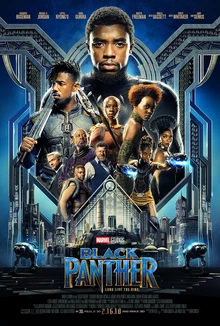
Black Panther III
Sequel to Black Panther: Wakanda Forever; release date and plot unconfirmed.

Black Panther III is a forthcoming American superhero film from Marvel Studios, serving as the sequel to 2022's *Black Panther: Wakanda Forever*. No official release date has been announced by Marvel Studios, and no plot details have been confirmed.
Quick Facts
- Director
- Ryan Coogler
- Producer
- Kevin Feige / Nate Moore
- Screenplay
- Ryan Coogler / Joe Robert Cole
- Based On
- Marvel Comics
- Music
- Ludwig Göransson
- Cinematography
- Autumn Durald Arkapaw
- Editing
- Michael P. Shawver / Kelley Dixon / Jennifer Lame
- Studio
- Marvel Studios
- Distributor
- Walt Disney Studios Motion Pictures
- Released
- 26 October 2022 · Hollywood, Los Angeles · 2022 · 11 · 11 · United States
- Runtime
- 161 minutes
- Country
- United States
Facts from the source article.
Lore & Background
Black Panther III is a planned sequel to Black Panther: Wakanda Forever (2022), which was the 30th film in the Marvel Cinematic Universe and the final film of Phase Four. No release date, plot details, or cast have been officially announced.
Reader's Guide
The significance of Black Panther III lies in its continuation of the Wakandan story following the death of Chadwick Boseman and the transition of the Black Panther mantle to Shuri. The film is part of the Marvel Cinematic Universe's ongoing narrative, building on the events of Wakanda Forever, which introduced new characters such as Riri Williams (Ironheart) and the underwater kingdom of Talokan. The sequel's release in December 2028 marks a continuation of the franchise's exploration of Wakanda's role in the world and its legacy. The film is expected to further develop themes of leadership, grief, and cultural preservation, as established in the previous installments.
Did You Know?
- Black Panther III has no official release date announced by Marvel Studios.
- It is the sequel to Black Panther: Wakanda Forever (2022).
- No plot details or cast have been confirmed.
A Contested Birth: Lee, Kirby, and the Idea
The question of who truly conceived Black Panther has remained unresolved for decades. Both Stan Lee and Jack Kirby have staked their claim, yet neither could point to definitive documentation. Kirby, in a 1990 interview with The Comics Journal, argued that he simply noticed a glaring absence of Black characters in his own work and felt, for what he called "human reasons," that one was needed. Lee, meanwhile, framed the decision as a deliberate editorial choice to expand Marvel's roster with African and African American figures, noting the complete lack of Black superheroes in the medium at the time. Scholar Asher Elbein's research adds a complicating layer, suggesting that by 1966 Kirby was largely plotting Fantastic Four on his own and merely relaying finished stories to Lee. The character debuted in Fantastic Four #52 in July 1966. Lee recalled that the name drew from a pulp-era adventurer who had a panther companion, while Kirby's earliest visual sketches actually depicted a swashbuckling figure he called the "Coal Tiger" before the design was reworked.
The King, the Herb, and the Nation
T'Challa inherits the mantle of Black Panther from his father T'Chaka, becoming both the sovereign ruler and the armed defender of Wakanda, a fictional African nation whose extraordinary technological sophistication is powered by vast reserves of the fictional metal vibranium. His superhuman capabilities stem from a sacred Wakandan ritual in which the wearer ingests the essence of a heart-shaped herb, but the role demands far more than raw power. T'Challa is portrayed as a world-class scientist, a master of his nation's cultural traditions, and a highly disciplined martial artist whose hand-to-hand combat skills are sharpened through rigorous physical training. He also commands access to his country's considerable wealth and cutting-edge technology. In 1968 the character joined the Avengers, and his membership with that team has continued in an intermittent fashion across the decades, placing him alongside Earth's mightiest heroes while he simultaneously governs his own sovereign state.
Writers Who Reshaped a King
The Black Panther comics have been transformed by successive writers who each injected new thematic energy into the title. In the 1970s, Don McGregor's critically praised run introduced T'Challa's most enduring adversary, Erik Killmonger, and wove in urgent social commentary, including the resurgence of the Ku Klux Klan in Georgia and the realities of apartheid in South Africa. By the late 1990s, Christopher Priest undertook a full reinvention, foregrounding Wakanda's identity as a proud, independent, and technologically formidable African nation, and he brought the Dora Milaje—Black Panther's elite female bodyguards—into the story. Reginald Hudlin's subsequent series pushed Black cultural pride to the forefront and delivered stronger commercial results; during his tenure T'Challa married X-Men's Storm, and his sister Shuri briefly assumed the Black Panther role while he lay in a coma. Then in 2016, journalist and essayist Ta-Nehisi Coates took the pen, producing a series whose first issue became the month's best-selling comic. Coates's narrative challenged the very legitimacy of Wakandan monarchy and proposed a more democratic path forward.
From Firsts to the Future: The Panther on Screen
As the first Black superhero to appear in American mainstream comic books, Black Panther also stands as an early embodiment of the Afrofuturist aesthetic, and the character has since crossed into television, animation, and video games. In the Marvel Cinematic Universe, Chadwick Boseman brought T'Challa to life across four Phase Three films: Captain America: Civil War in 2016, the standalone Black Panther in 2018, Avengers: Infinity War in 2018, and Avengers: Endgame in 2019. The 2018 film became a landmark of both critical acclaim and box-office success. After Boseman's passing in 2020, his voice was used for alternate versions of T'Challa in the first season of the animated series What If...? in 2021. Letitia Wright, whose character Shuri had appeared in earlier MCU entries, then inherited the Black Panther mantle in Black Panther: Wakanda Forever (2022). Looking ahead, David Jonsson is set to portray T'Challa II in Black Panther III, scheduled for 2028, continuing the story of a character whose cultural significance extends far beyond the page.
Frequently Asked Questions
What is Black Panther III?
Black Panther III is the upcoming third entry in Marvel Studios' Black Panther film series and serves as the direct sequel to 2022's Black Panther: Wakanda Forever. It is produced by Marvel Studios and distributed through Walt Disney Studios Motion Pictures.
Who is directing Black Panther III?
Ryan Coogler is set to helm the project, continuing the directorial role he held for both the original 2018 Black Panther and its 2022 follow-up.
When will Black Panther III be released?
As of the latest available information, Marvel Studios has not announced a specific release date or year for the film. Fans can only confirm that the project is in development under a TBA timeline.
What is the plot of Black Panther III?
No story details, character arcs, or narrative structure have been officially revealed by Marvel Studios or the production team. Any plot summaries circulating online remain purely speculative until a studio announcement is made.
Why is Black Panther III important to the MCU?
It extends the Wakanda storyline that became a cornerstone of the Marvel Cinematic Universe after the first two films. As a Ryan Coogler-directed sequel, it carries significant cultural weight and is expected to shape the direction of the franchise's next phase.
More in Black Panther 1-24
Spotted an error? Know more?
Reader corrections go straight into our review queue. Suggest an edit · How this site is sourced