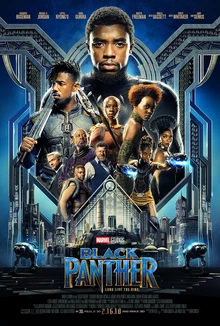
Black Panther: Wakanda Forever – Music from and Inspired By
Soundtrack album for the 2022 superhero film Wakanda Forever.

Black Panther: Wakanda Forever – Music from and Inspired By is a compilation soundtrack album for the 2022 American superhero film Black Panther: Wakanda Forever. Released on November 4, 2022, by Roc Nation, Def Jam Recordings, and Hollywood Records, the album was produced and curated by Ludwig Göransson, who also composed the film's original score. The soundtrack features original songs and collaborations with contemporary artists, indigenous musicians, and singers, reflecting the film's Mesoamerican, Wakandan, and Nigerian cultural roots.
Quick Facts
- Artist
- Various artists
- Released
- 2022-07-25
- Label
- Hollywood · Marvel Music
Facts from the source article.
Lore & Background
The soundtrack album was announced in late October 2022 and released on November 4, 2022, by Roc Nation, Def Jam Recordings, and Hollywood Records. It includes Rihanna's original single 'Lift Me Up,' which was released a week earlier on October 28. Göransson produced most of the songs and served as executive producer, describing the process as seamless, as he recorded the score during the day with Mayan instruments and then recorded songs with contemporary artists, using elements from the score in the songs. The music production began while director Ryan Coogler was filming, with discussions about the script guiding the creation of every note and lyric specifically for the film.
Reader's Guide
The soundtrack album Black Panther: Wakanda Forever – Music from and Inspired By is significant for its integration of the film's cultural themes into popular music. Göransson's work involved recording in Mexico and Lagos, Nigeria, where songs like 'Laayli' kuxa'ano'one' by Mayan rappers and 'No Woman, No Cry' by Tems were created. The album received critical acclaim. Its lead single, 'Lift Me Up,' performed by Rihanna, was a tribute to the late Chadwick Boseman and achieved commercial success, reaching number two on the US Billboard Hot 100 and number three on the UK Official Singles Chart. The album's legacy lies in its fusion of ancient Mayan sounds with contemporary R&B and hip hop, reflecting the film's narrative of grief, heritage, and leadership.
Did You Know?
- Rihanna's single 'Lift Me Up' was released a week before the album, on October 28, 2022.
- Ludwig Göransson produced and co-wrote 'Lift Me Up' with Rihanna, Ryan Coogler, and Tems.
- The song 'Laayli' kuxa'ano'one' by Mayan rappers was recorded during sessions in Mexico.
A Production Forged in Grief
The sequel to the 2018 original had been in the works since shortly after that film's February release, with Ryan Coogler negotiating his return as director in the months that followed. Marvel Studios officially greenlit the project in mid-2019, and the ensemble cast from the first installment was confirmed back in November of 2020. However, the creative direction of the entire film was irrevocably altered in August 2020, when Chadwick Boseman—the actor who had embodied King T'Challa—passed away from colon cancer. Rather than recasting the role, the studio chose to write the character's death into the narrative, making his absence the emotional engine of the story. The title was publicly revealed in May 2021. Principal photography kicked off in late June in Atlanta, splitting time between Trilith Studios and Tyler Perry Studios, before the crew relocated to Massachusetts in August. Production was temporarily halted in November so that Letitia Wright could recover from an on-set injury, then resumed by mid-January 2022 and concluded in late March on location in Puerto Rico.
A Story of Grief, Vengeance, and Reconciliation
At its core, the narrative follows Shuri in the year following her brother T'Challa's death from a terminal illness—a loss she was unable to prevent despite her failed attempts to synthesize the heart-shaped herb. Faced with international pressure to surrender Wakanda's vibranium and a hostile underwater civilization called Talokan, led by the blue-skinned, water-breathing superhuman Namor, Shuri initially refuses to take up the Black Panther mantle. That stance shatters when Namor's retaliatory attack on Wakanda results in the drowning of Queen Ramonda, her mother. Consumed by rage, Shuri reconstructs the herb from a remnant that had once granted Namor's people their abilities, ingests it, and confronts Killmonger in the Ancestral Plane, where he challenges her to choose between vengeance and honor. She dons a new suit and leads a counterattack on Talokan, only to ultimately see a vision of Ramonda urging peace. The film closes with Shuri planting new herbs to secure the mantle's future, visiting Nakia in Haiti to finally grieve, and a mid-credits revelation that T'Challa and Nakia had a secret son named Toussaint, whose Wakandan name is T'Challa.
An Ensemble Built for the MCU's Milestone
As the thirtieth entry in the Marvel Cinematic Universe and the capstone of Phase Four, the film assembles a remarkably diverse cast around Letitia Wright's Shuri. The supporting ensemble includes Lupita Nyong'o as Queen Ramonda, Danai Gurira as Okoye, Winston Duke as M'Baku, Florence Kasumba as Ayo, Dominique Thorne as Riri Williams, Michaela Coel as Aneka, Mabel Cadena as Namora, Tenoch Huerta Mejía as Namor, Martin Freeman as Everett K. Ross, Julia Louis-Dreyfus as Valentina Allegra de Fontaine, and Angela Bassett reprising her role as the elder queen. The film was produced by Marvel Studios and distributed by Walt Disney Studios Motion Pictures, with Coogler co-writing the screenplay alongside Joe Robert Cole. Bassett's portrayal of Ramonda in particular drew significant critical attention, earning her recognition across multiple major award bodies. The production also set the stage for future MCU storytelling, as Thorne's character Riri Williams was given her own spin-off miniseries, Ironheart, which premiered in June 2025.
Box Office, Acclaim, and a Continuing Legacy
The film premiered simultaneously at the El Capitan Theatre and the Dolby Theatre in Hollywood on October 26, 2022, before hitting U.S. screens on November 11. Critics responded with generally favorable reviews, and the picture collected $859.2 million at the global box office, placing it as the sixth-highest-grossing release of that year. Its awards trajectory was equally impressive: the film and its cast accumulated five Academy Award nominations (taking home the trophy for Costume Design), one British Academy Film Award, six Critics' Choice Movie Awards (winning two), two Golden Globe nominations (winning one), and two Screen Actors Guild Award nominations. Beyond the theatrical run, the story's world continues to expand. A sequel has already been scheduled for a December 2028 release, ensuring that Shuri's journey as Black Panther and the political tensions between Wakanda and Talokan remain active threads in the broader Marvel universe. The film thus stands as both a culmination of Phase Four and a springboard for the next chapter.
Frequently Asked Questions
What is Black Panther: Wakanda Forever – Music from and Inspired By?
It is the official compilation soundtrack album for the 2022 Marvel superhero film Black Panther: Wakanda Forever. The collection pairs original songs with artist collaborations that mirror the movie's blend of Wakandan, Mesoamerican, and Nigerian cultural themes.
Who produced and curated the Black Panther: Wakanda Forever soundtrack?
Ludwig Göransson served as both producer and curator of the album while also composing the film's original score. His dual role allowed the contemporary tracks and orchestral elements to feel like a unified musical experience.
When was the Black Panther: Wakanda Forever soundtrack released and by which labels?
The album hit shelves on November 4, 2022, through a joint release by Roc Nation, Def Jam Recordings, and Hollywood Records. Its sound spans R&B, hip hop, world music, and traditional soundtrack scoring.
What is the most notable single from the Black Panther: Wakanda Forever soundtrack?
"Lift Me Up" by Rihanna is the album's standout track. The song resonated deeply with audiences for its themes of legacy and grief, tying directly to the film's emotional core.
Why is the Black Panther: Wakanda Forever soundtrack culturally significant?
The album deliberately features indigenous musicians and singers alongside mainstream artists, reflecting the movie's deep roots in Mesoamerican, Wakandan, and Nigerian traditions. This made the release a celebration of diverse musical heritages rather than a standard Hollywood soundtrack.
More in Black Panther 1-24
Spotted an error? Know more?
Reader corrections go straight into our review queue. Suggest an edit · How this site is sourced