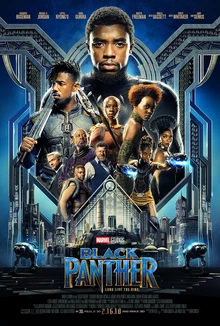
Black Panther (film series)
A saga of Wakanda's king and legacy.

Pr0pulsion 123 · CC BY-SA 4.0
The Black Panther film series is a sub-franchise within the Marvel Cinematic Universe (MCU), centered on the character T'Challa, the king and protector of the fictional African nation of Wakanda. The series began with the 2018 film Black Panther, which was part of Phase Three of the MCU's Infinity Saga, and continued with Black Panther: Wakanda Forever (2022), a Phase Four film in the Multiverse Saga. As of now, no release date has been announced for a third Black Panther film.
Quick Facts
- Producer
- Kevin Feige
- Based On
- Characters published · Marvel Comics
- Distributor
- Paramount Pictures (2008–2011) / Universal Pictures (TIH · The Incredible Hulk; 2008) / Walt Disney Studios Motion Pictures (2012–present) / Sony Pictures (SM; 2017–present)
- Released
- 2008–present
- Country
- United States
- Language
- English
- Budget
- Total (38 films): / $7.464–7.949billion
- Gross
- Total (38 films): / $34.820billion
Facts from the source article.
Lore & Background
The Black Panther film series is part of the Marvel Cinematic Universe, a shared universe of superhero films produced by Marvel Studios. The first film, Black Panther, was released in 2018 as part of Phase Three, which was collectively known as The Infinity Saga. It was followed by Black Panther: Wakanda Forever in 2022, which was part of Phase Four, the first phase of The Multiverse Saga. Both films were produced by Marvel Studios president Kevin Feige, who has produced every MCU film. The series is distributed by Walt Disney Studios Motion Pictures, which began distributing MCU films with Iron Man 2 (2010) under Paramount's distribution deal; the first fully Disney-distributed MCU film was Iron Man 3 (2013).
Reader's Guide
The Black Panther film series holds significance within the MCU as a key narrative and cultural entry. The first film, Black Panther (2018), was part of Phase Three, which MCU director Joe Russo described as the 'deconstruction Phase' leading to the culmination films Avengers: Infinity War (2018) and Avengers: Endgame (2019). The second film, Black Panther: Wakanda Forever (2022), was part of Phase Four, which Feige said would provide clues to the direction of the next saga. A third film, Black Panther III, is scheduled for 2028 as part of the next MCU saga, following an X-Men film and Ghost Rider. The series is one of several MCU franchises that feature ensemble casts and are written and directed by various individuals. The MCU itself is the highest-grossing film franchise of all time, with over $34.9 billion in global box office revenue.
Did You Know?
- Black Panther: Wakanda Forever (2022) was a Phase Four film in the Multiverse Saga.
- All Black Panther films are produced by Marvel Studios president Kevin Feige.
Creative Origins and the Lee-Kirby Dispute
The birth of Black Panther remains one of Marvel's most debated creative stories. Both Stan Lee and Jack Kirby have claimed the impetus for the character, and no definitive documentation settles the question. Kirby, in a 1990 interview with The Comics Journal, insisted he conceived the hero after recognizing the absence of Black characters in his work and the presence of Black readers he had been overlooking. Lee, meanwhile, recalled a mid-1960s desire to feature more African and African American figures in Marvel's lineup, noting the complete lack of Black superheroes—and specifically none who ruled their own African nation. Both creators emphasized humanistic, inclusive motivation rather than direct civil rights politics. Lee credited a pulp adventure hero with a black panther companion as the name's inspiration, while Kirby's early concept art used the working title "Coal Tiger" for a swashbuckler before Lee requested revisions. Research by Asher Elbein suggests that by 1966, Kirby was largely plotting Fantastic Four independently, complicating any single-author narrative. The character debuted in Fantastic Four #52 in July 1966, and Marvel quickly followed with additional Black characters in other titles.
A Decade-by-Decade Evolution in the Comics
Black Panther's comic book history reads like a living document of shifting cultural priorities. In the 1970s, Don McGregor's acclaimed run introduced Erik Killmonger as T'Challa's great nemesis and wove in real-world issues like the KKK's resurgence in Georgia and South African apartheid. Christopher Priest's late-1990s series re-centered Wakanda as a sovereign, technologically advanced African nation and brought in the Dora Milaje, the Panther's elite female bodyguards. Reginald Hudlin's subsequent stories leaned into Black cultural pride, married T'Challa to X-Men's Storm, and even handed the mantle to his sister Shuri during a coma storyline, achieving stronger commercial results. The most commercially explosive period arrived in 2016, when journalist and essayist Ta-Nehisi Coates took the pen. His first issue became the best-selling comic of that month, and his narrative challenged the legitimacy of Wakandan monarchy while articulating a more democratic future for the nation. Each writer left a distinct fingerprint, ensuring the character remained a vehicle for evolving conversations about identity, governance, and representation.
Breaking Barriers and the Afrofuturist Imagination
Black Panther holds a singular place in American comic book history as the first Black superhero in the mainstream medium. Before T'Challa, very few Black heroes existed in comics, and none possessed actual superpowers; precursors included Lothar in Mandrake the Magician, the single-issue All-Negro Comics #1 from 1947, Atlas Comics' Waku Prince of the Bantu, and Dell's Western hero Lobo. What set T'Challa apart was not merely his race but the world he inhabited. Wakanda, sustained by deposits of the fictional metal vibranium, presented an African nation of cutting-edge science and technology rather than the stereotypical village with thatched huts. This vision made the character an early and defining example of the Afrofuturist aesthetic. His enhanced abilities, gained through the ritual of drinking the heart-shaped herb's essence, were paired with rigorous physical training, scientific expertise, and access to advanced Wakandan technology. The character's legacy extends far beyond the page, appearing in television shows, animated films, and video games, cementing his status as a cultural touchstone for representation in popular entertainment.
The MCU Era and the Passing of the Mantle
Chadwick Boseman's portrayal of T'Challa across Marvel Cinematic Universe Phase Three, spanning Captain America: Civil War (2016), Black Panther (2018), Avengers: Infinity War (2018), and Avengers: Endgame (2019), brought the character to a global audience and turned the 2018 solo film into a notable critical and popular success. Boseman also voiced alternate versions of T'Challa in the first season of the animated series What If...? (2021), released after his death in 2020. His passing forced a significant narrative pivot: in Black Panther: Wakanda Forever (2022), Letitia Wright's character Shuri, who had appeared in earlier MCU films, assumed the Black Panther mantle in her brother's absence. Looking ahead, David Jonsson is scheduled to portray T'Challa II in Black Panther III, set for 2028. The transition from Boseman's T'Challa to Shuri's leadership and eventually to a new generation of Panthers mirrors the comic book tradition of passing the mantle, ensuring the character's story continues to evolve while honoring the legacy that made Wakanda a symbol of pride and possibility for audiences worldwide.
Gallery





Frequently Asked Questions
What is the Black Panther film series?
It is a sub-franchise inside the Marvel Cinematic Universe that follows T'Challa, the sovereign and guardian of the fictional African nation Wakanda. The two released films span MCU Phase Three (Infinity Saga) and Phase Four (Multiverse Saga).
How many Black Panther movies exist, and is a third one coming?
Two films are out: the 2018 original and Black Panther: Wakanda Forever (2022). As of now, no release date or official announcement for a third entry has been made.
What does Black Panther: Wakanda Forever focus on?
The sequel pivots away from a single-protagonist structure to center on Shuri and the wider Wakandan people as they grieve T'Challa's death and face a new external adversary. It is framed as a story about the kingdom's collective legacy rather than a direct continuation of the first film's plot.
Who distributes the Black Panther films?
Walt Disney Studios Motion Pictures handles all theatrical and home-media distribution. Disney took over full distribution duties for the Marvel slate beginning with Iron Man 3 in 2013, and the Black Panther entries fall under that arrangement.
Why do fans consider the Black Panther series important in the MCU?
It put a Black-led narrative and an African nation at the heart of a blockbuster superhero franchise, broadening the MCU's cultural scope. The overarching saga of Wakanda's king and the legacy he leaves behind gives the series a thematic identity distinct from other Marvel storylines.
More in Black Panther 1-24
Spotted an error? Know more?
Reader corrections go straight into our review queue. Suggest an edit · How this site is sourced