Three Coins Beer
A Sri Lankan all-malt lager from McCallum Breweries.

Dan arndt · CC BY-SA 4.0
Three Coins is a Sri Lankan lager produced by McCallum Breweries (Ceylon) Ltd, itself a subsidiary of Cargills Ceylon PLC. The brewery behind it, McCallum Brewery Limited, was founded in 1962 by U. K. Edmund in Meegoda, a Colombo suburb. In February 2011, Cargills Ceylon PLC bought McCallum Brewery through its fully owned subsidiary Millers Brewery Ltd for Rs. 1.425 billion. The Cargills Group then invested Rs. 2 billion to upgrade the facility, raising its annual capacity from 50,000 hectolitres to 600,000 hectolitres. By June 2014, Cargills was reportedly preparing to sell Millers Brewery, with potential buyers including Distilleries Company of Sri Lanka PLC and Carson Cumberbatch PLC. In November 2014, Lion Brewery purchased Millers Brewery Limited from Cargills for Rs. 5.15 billion, and began brewing Millers products at its Biyagama plant, while the Meegoda plant’s operations were temporarily halted for further evaluation.
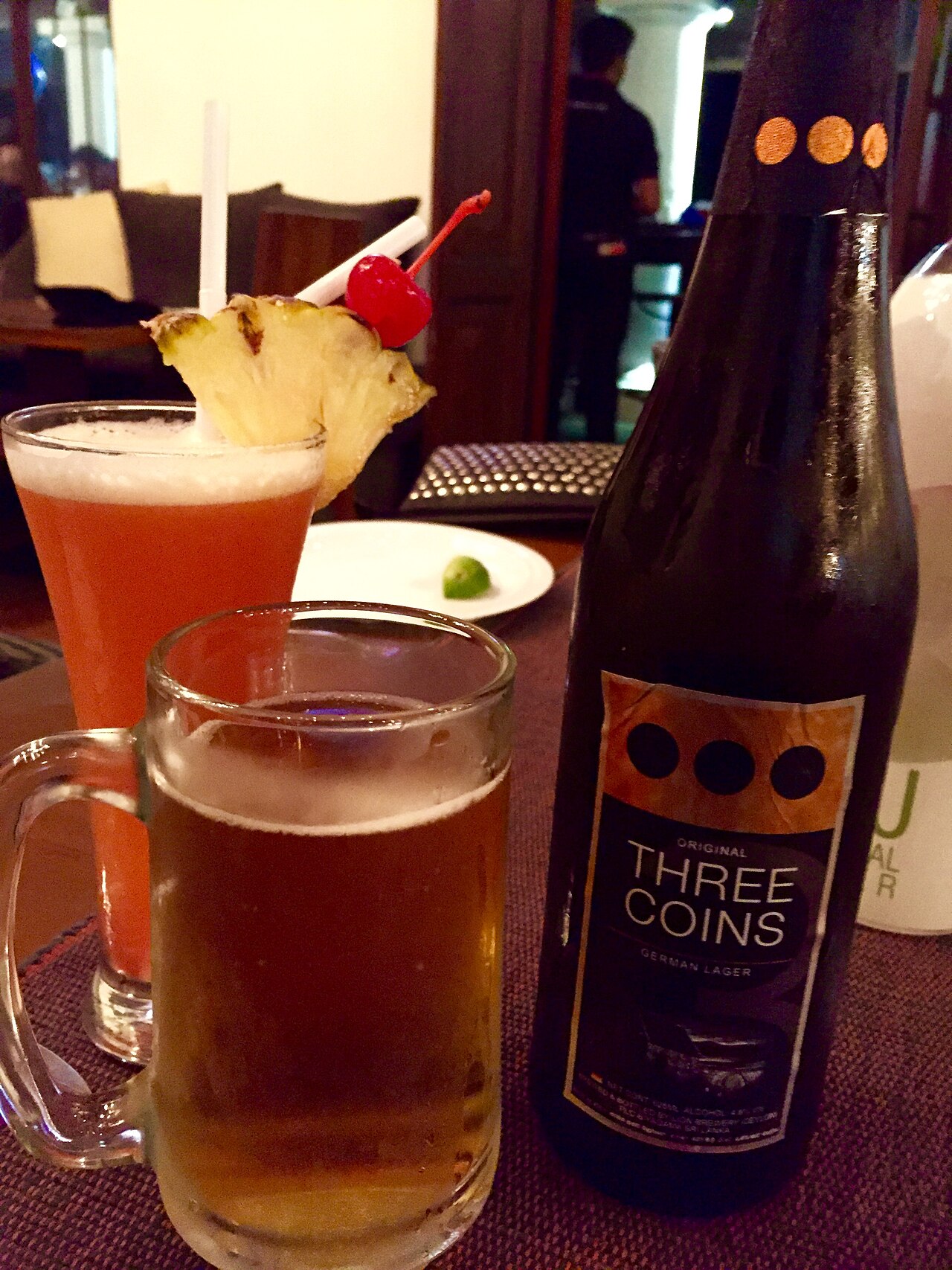
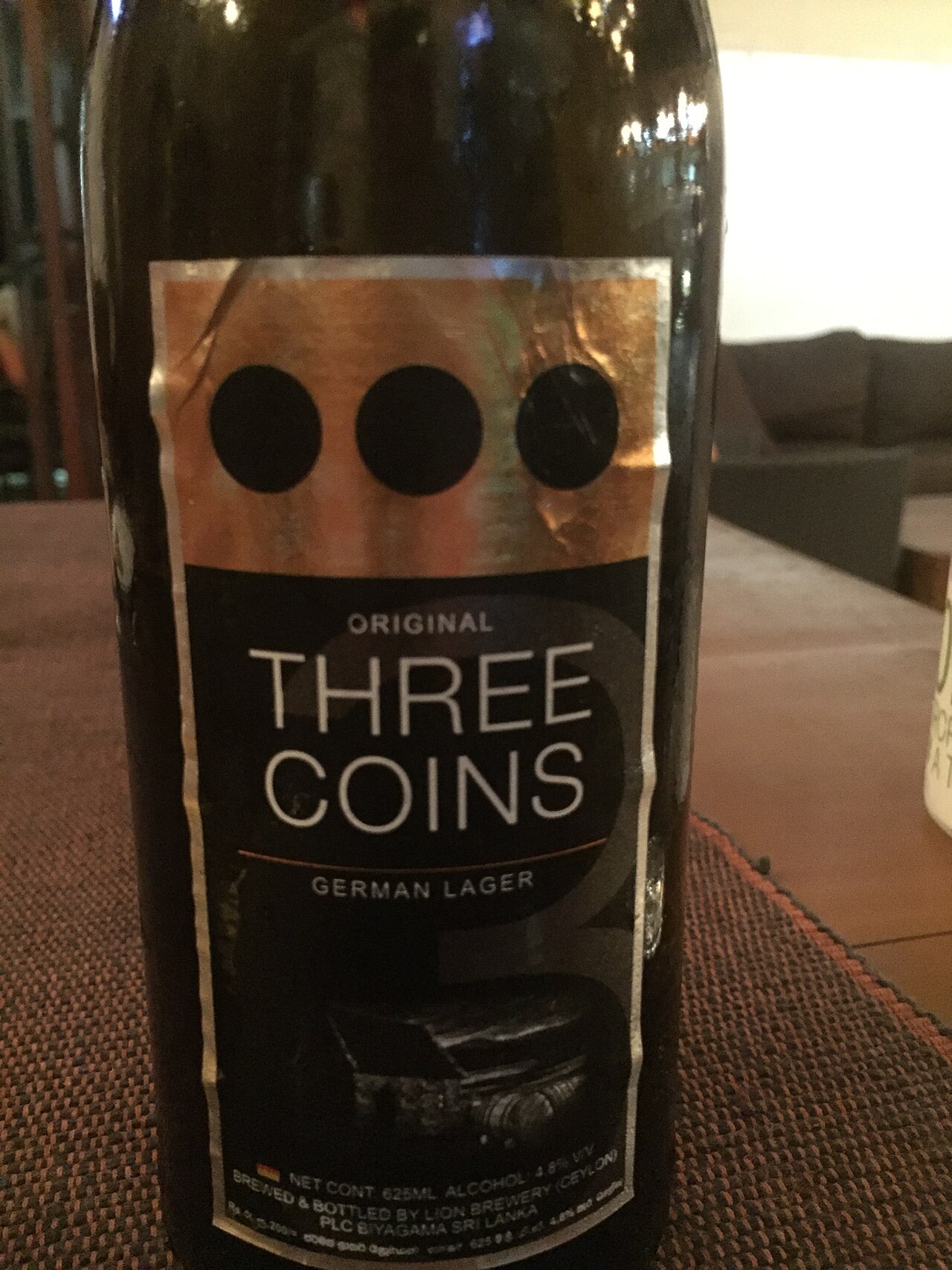
The core Three Coins brand is an all-malt lager at 4.8% ABV. Other varieties produced by the brewery include: Sando Stout (8.8% ABV, made with Danish barley, Scottish malt, and German hops, now discontinued); Three Coins Riva (4.8% ABV, a Belgian-style witbier launched in 2001 as a joint brand with Belgian brewer Riva N.V., and the first wheat beer brewed in Asia); Irish Dark (7.5% ABV, an Irish-style ale, now discontinued); Irish Dark Red Ale (4.5% ABV, an Irish-style ale); Grand Blonde (8.8% ABV, launched in 2009); and Sando Power Strong (8.8% ABV). Additionally, Millers Brewery brews Foster’s under license from Carlton & United Breweries Ltd.
Quick Facts
- Abv
- 4.8%
- Manufacturer
- McCallum Breweries (Ceylon) Ltd
- Origin
- Sri Lanka
- Introduced
- 1962
Facts from the source article.
Lore & Background
Three Coins is brewed by McCallum Breweries (Ceylon) Ltd, a subsidiary of Cargills Ceylon PLC. The brewery was established in 1962 by U. K. Edmund in Meegoda, a suburb of Colombo. In February 2011, Cargills Ceylon PLC acquired the McCallum Brewery via its wholly owned subsidiary Millers Brewery Ltd for Rs. 1.425 billion. The Cargills Group subsequently spent Rs. 2 billion upgrading the brewery, increasing capacity from 50,000 hectoliters per year to 600,000 hectoliters per year. In June 2014, it was reported that Cargills was preparing to sell Millers Brewery, with likely purchasers including Distilleries Company of Sri Lanka PLC and Carson Cumberbatch PLC. In November 2014, it was announced that Lion Brewery had purchased Millers Brewery Limited from Cargills for Rs. 5.15 billion and would commence brewing Millers Brewery products at its facility in Biyagama, with production at the Meegoda plant ceasing temporarily pending further evaluation.
Reader's Guide
Three Coins is notable as a flagship all-malt lager of McCallum Breweries, a brewery that underwent significant expansion under Cargills ownership, with capacity increasing twelvefold. The brand is part of a portfolio that includes other varieties such as Three Coins Riva, a Belgian-style witbier launched in 2001 as a jointly branded product with Belgian brewers Riva N.V., which was the first wheat beer brewed in Asia. The brewery also produced Sando Stout, Irish Dark, Irish Dark Red Ale, Grand Blonde, and Sando Power Strong, though some of these are no longer in production. Millers Brewery also brews Foster's under license from Carlton & United Breweries Ltd. The sale of Millers Brewery to Lion Brewery in November 2014 marked a transition in production location, with brewing moving to Biyagama and the Meegoda plant ceasing temporarily. Three Coins remains a recognizable Sri Lankan lager, reflecting the brewery's history of ownership changes and capacity upgrades.
Did You Know?
- Three Coins is an all-malt lager with 4.8% ABV.
- Cargills Ceylon PLC acquired the brewery in February 2011 for Rs. 1.425 billion.
- Three Coins Riva, launched in 2001, was the first wheat beer brewed in Asia.
From a Farm to a Fortune
The name that would come to define the global diamond trade traces back to two Afrikaner brothers, Diederik and Johannes de Beer, whose family lineage stretched to a Finnish-born soldier who settled in South Africa in 1699. The brothers owned a farm called Vooruitzicht—Dutch for "prospect"—near Zandfontein. When diamonds were found on their land, pressure from the British government forced them to sell to merchant Alfred Johnson Ebden in 1871 for £6,600. That site would later become home to the legendary Big Hole mine. The modern company crystallized in 1888 when Cecil Rhodes, who had started by renting water pumps to miners during the 1869 diamond rush, merged his operations with those of diamond magnate Barney Barnato. Rhodes had secured financing from the Rothschild banking house and Alfred Beit. By the time of the merger, the entity held exclusive ownership of every diamond mining operation in South Africa. The following year, Rhodes struck a deal with the London Diamond Syndicate to purchase fixed quantities at set prices, effectively locking in supply control and price stability—a formula that would sustain the company's dominance for over a century.
The Scarcity Doctrine
Ernest Oppenheimer, a German immigrant who had built Anglo American with backing from J.P. Morgan, first encountered the diamond world through the Oppenheimer brothers' dealings with the Premier Mine near Pretoria. That mine, which yielded the Cullinan Diamond—the largest rough stone ever found in 1905—refused to join the De Beers cartel, instead selling through independent dealers. This threat to the monopoly was initially dismissed by chairman Francis Oats, but production from the new finds soon rivaled all De Beers mines combined. Oppenheimer grasped the underlying logic: in 1910 he articulated that the only path to raising diamond value was making them scarce by reducing production. He rose to mayor of Kimberley within a decade and was elected to the De Beers board in 1926. Taking the chairmanship in 1929, he consolidated the company's grip on global supply until his death in 1957. His tenure was shadowed by accusations of price fixing and trust behavior, and former CIA director Admiral Stansfield Turner alleged that De Beers withheld industrial diamonds from the United States during World War II.
The Long Unraveling
For over a century, De Beers sat atop a near-total stranglehold on rough diamond distribution, controlling between 80 and 85 percent of the global supply from its 1888 founding through the early 2000s. That dominance eroded steadily: by 2000 the company's share had slipped to 63 percent, and by 2021 it had fallen to just 25 percent—a figure now matching that of Russian rival Alrosa. The ownership structure shifted dramatically in 2011 when Anglo American purchased the Oppenheimer family's 40 percent stake for 5.1 billion US dollars, bumping its own holding to 85 percent and ending eight decades of Oppenheimer control. The remaining 15 percent belongs to the Government of Botswana, reflecting the company's deep ties to the country where much of its mining still takes place. Today De Beers operates across 35 nations, with active mines in Botswana, Namibia, South Africa, and Canada, plus an artisanal mining arm called Gemfair working in Sierra Leone. The company's trajectory from absolute monopoly to one player among several marks a fundamental reshaping of the diamond industry's power landscape.
Siege, Scandal, and the Road Ahead
De Beers's history is inseparable from the turbulence of empire. During the Second Boer War, Kimberley was besieged, and Rhodes personally moved into the city to pressure the British government into diverting military resources to relieve the siege. The company's workshops manufactured shells, defensive structures, an armored train, and a gun christened Long Cecil for the defenders. Yet the firm's legacy is equally marked by controversy: accusations of cartel behavior, price manipulation, and wartime hoarding of industrial diamonds have followed it across generations. In May 2024, Anglo American announced its intention to spin off or sell De Beers entirely, signaling a potential end to the corporate structure that has existed in some form since 1888. The company's story—spanning a Dutch-named farm in the Orange Free State, a water-pump entrepreneur's rise, a family's eighty-year stewardship, and a gradual dilution of market power—encapsulates how a single industry's control can be built, defended, and ultimately dispersed over more than a century.
Gallery
Frequently Asked Questions
What is Three Coins Beer?
Three Coins is a Sri Lankan all-malt lager brewed by McCallum Breweries (Ceylon) Ltd, a subsidiary operating under the Cargills Ceylon PLC corporate group.
What is the alcohol content of Three Coins Beer?
The lager carries a 4.8% ABV, sitting squarely in the standard full-strength lager range.
Who owns the Three Coins brand?
The beer is produced by McCallum Breweries (Ceylon) Ltd, which sits under Cargills Ceylon PLC after the parent group purchased the brewery in February 2011.
Where and when did the Three Coins brewery originate?
McCallum Brewery Limited was founded in 1962 by U. K. Edmund in Meegoda, a suburb on the outskirts of Colombo.
What happened to the brewery after Cargills acquired it?
Cargills invested roughly Rs. 2 billion to expand annual output from 50,000 to 600,000 hectolitres, but by mid-2014 reports indicated the group was preparing to divest the Millers Brewery unit.
More in Beer Brands, Part 2 1-24
Spotted an error? Know more?
Reader corrections go straight into our review queue. Suggest an edit · How this site is sourced