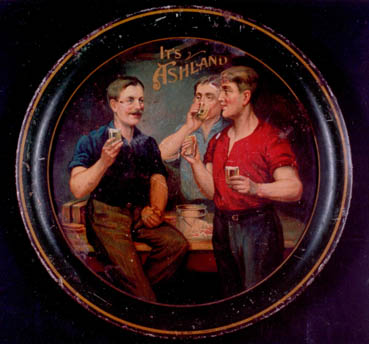
Ashland Brewing Company
A small Wisconsin brewery that closed after Prohibition.

The Ashland Brewing Company, a small regional brewery in Ashland, northern Wisconsin, was founded in 1874. Its facility, the Ashland Union Brewery, stood on 10th Avenue East beside Bay City Creek, near the Ashland Bottling Works. The two-story, wood-frame building measured 34 by 70 feet and was later covered with brick. A 24-by-50-foot ice house stood next door, as modern refrigeration was not yet available.
The brewery was owned by German immigrants Adam and Conrad Goeltz, who arrived in the U.S. in 1847. They first moved to Ashland in 1854, left, and returned in 1863. The Goeltz family also owned the Seventh Avenue Hotel and an ice cream parlor on Seventh Avenue West (now Chapple Avenue). From 1901 to 1937, the brewery was owned by Frederick W. Miller.
Beer was sold in glass bottles and kegs, with delivery to all points around Lake Superior, according to an August 8, 1874 article in the Ashland Press. Products included the flagship Ashland Beer, White Ribbon Beer, and New York State Porter and Ale. The company’s logo was a six-pointed star inside a circle, with the letter A at the center. Known as the Brewer’s Star, it symbolized purity through its six points: water, hops, grain, malt, yeast, and the brewer.
During Prohibition, the brewery produced soft drinks. It survived the era but closed in 1937. Though defunct, it remains part of Wisconsin’s brewing history; unlike surviving northern brands like Rhinelander Beer, Ashland Beer is now only a memory.
Quick Facts
- Hq Location
- Ashland, Wisconsin / United States
- Owner
- Muehler & Goeltz, later by Frederick W. Miller
- Founded
- 1874
- Industry
- Alcoholic beverage
- Products
- Beer
Facts from the source article.
Lore & Background
The Ashland Brewing Company was established by brothers Adam and Conrad Goeltz, who emigrated from Germany in 1847. They first moved to Ashland in 1854, left, and returned in 1863. The brewery was located on 10th Avenue East, next to Bay City Creek and near the Ashland Bottling Works. The building measured 34 by 70 feet, was two stories high, initially built of wood, and later veneered with bricks. Next to it stood a 24 by 50 foot ice house, used because modern refrigeration was unavailable. The Goeltz family also owned the Seventh Avenue Hotel and an ice cream parlor on Seventh Avenue West (now Chapple Avenue).
The brewery's products included Ashland Beer, White Ribbon Beer, and New York State Porter and Ale. Beer was sold in glass bottles and kegs, and the company delivered to all points around Lake Superior. The company's logo was a six-pointed star inside a circle, with the letter A inside the star. This star, known as the Brewer's Star, symbolized purity; its six points represented water, hops, grain, malt, yeast, and the brewer.
During Prohibition, the brewery produced non-alcoholic beverages such as soft drinks. It survived Prohibition (which ended in 1933) but closed in 1937. The company remains part of Wisconsin's brewing history, though Ashland Beer is no longer produced.
Reader's Guide
The Ashland Brewing Company represents a small but notable chapter in Wisconsin's brewing history. Founded in 1874, it was a regional operation with an annual capacity of over 12,500 barrels, serving communities around Lake Superior. The brewery's survival through Prohibition by switching to soft drinks demonstrates the adaptability of many small breweries of the era. However, like many such businesses, it closed in 1937, shortly after Prohibition ended. Its flagship brand, Ashland Beer, along with White Ribbon Beer and New York State Porter and Ale, were advertised locally and regionally. The brewery's logo—the Brewer's Star—reflected a commitment to purity in brewing, a common theme among German-influenced breweries. Today, Ashland Beer is remembered only as a historical brand, unlike some other northern Wisconsin beers such as Rhinelander Beer that still exist. The site of the brewery, near Bay City Creek, also housed the Ashland Bottling Works, indicating a cluster of beverage production in the area. The Goeltz family's other businesses—a hotel and an ice cream parlor—show their broader involvement in the local economy. The brewery's closure marked the end of an era for Ashland's brewing industry, though a new brewery, South Shore Brewery, was founded in Ashland in 1995.
Did You Know?
- The brewery's logo was a six-pointed Brewer's Star, with each point representing an aspect of brewing purity: water, hops, grain, malt, yeast, and the brewer.
- During Prohibition, the company produced non-alcoholic soft drinks to stay in business.
Origins & Early Growth
Victory Brewing Company traces its roots to 1996, when Ron Barchet and Bill Covaleski took over an old Pepperidge Farm bakery in Downingtown, Pennsylvania, and transformed it into a working brewery. The pair launched their operation with three inaugural beers: Victory Festbier, Brandywine Valley Lager (later renamed Victory Lager), and HopDevil Ale. The founders initially expected the malt-forward Festbier to capture the most attention, but market feedback quickly told a different story. Drinkers in the region were hungry for intensely hopped ales, and HopDevil rose to become the standout. That early lesson in reading consumer preference shaped the brewery's long-term trajectory. Rather than remaining a modest beer-and-food establishment, Victory steadily expanded its footprint, eventually distributing its core brands across thirty-four states and nine countries. The brewery still operates from its original address at 420 Acorn Lane, a reminder that its ambitions grew organically from a single converted bakery.
Brewing Craft & Equipment
At the heart of Victory's production floor sits a fifty-barrel (59 hectoliter) automated brewhouse designed and manufactured by Rolec, a firm based in Chieming, OberBayern, Germany. The system incorporates energy-recovery technology to reduce the environmental impact of large-scale brewing. Despite the modern automation, the team deliberately preserves traditional techniques where they are most appropriate. For certain German-style lagers, they employ the decoction mashing process, an energy-intensive method that produces a distinct malt profile. Victory also uses whole hops throughout its brewing process. The on-site restaurant underwent a complete renovation in the spring of 2008, shifting its menu focus toward smoked barbecue. A counter-pressure growler filler was installed during that project, capable of routing any of twenty draft taps to a 68-ounce vessel. The device includes a carbon dioxide evacuation step that extends the shelf life of filled growlers compared to direct spigot filling. The brewery also produces its own root beer, which is served in the dining room.
Product Range & Innovation
Victory's portfolio stretches well beyond a handful of core lagers. The brewery produces more than twenty distinct beer brands, spanning a wide spectrum of styles and strengths. Year-round staples include the German Pilsner Prima Pils at 5.3 percent ABV, the American IPA HopDevil at 6.7 percent, and the Belgian-style Tripel Golden Monkey at a robust 9.5 percent. The lineup also features DirtWolf Double IPA, brewed with Mosaic, Citra, Chinook, and Simcoe hops, and Sour Monkey, a tart Brettanomyces tripel that reworks the Golden Monkey recipe with a fruity, sour character. Seasonal releases rotate through the calendar: a cherry Gose in spring, a lemon-and-pine golden ale in summer, a Märzen-style Festbier in fall, and a spiced wheat ale in winter. The Blackboard Series introduces experimental pairings such as agave in an IPA or cold-brew coffee in a cream ale. The Tank to Table program drops a new brewpub-only recipe every other month, pushing experimental ingredients directly from the tanks to cans at the table. For dedicated collectors, Victory reserves its most ambitious brews—barleywines, Belgian quads, barrel-aged stouts reaching 14.3 percent ABV, and sparkling wine-barrel-aged Biere Brut—for 22-ounce bottle releases only.
Recognition & Business Expansion
Victory's quality has been acknowledged across multiple award circuits. At the Great American Beer Festival, the brewery earned gold medals for its Festbier in 2007 and for Golden Monkey in 2014, along with a silver for Prima Pils in 2007. Additional honors include the 2014 Sustainable Agriculture Business Leadership Award, a 2011 Good Food Award for beer, and recognition from the Philly Beer Scene Awards and the United States Beer Tasting Championship. The brewery also received Golden Icon Awards presented by Travolta Family Entertainment. Beyond brewing, Victory operates as a full-service caterer, offering complete party planning for a wide range of events. Its most distinctive offering is a brewpub on wheels, a mobile catering kitchen equipped to serve up to one thousand guests, with a cooler capacity of sixteen kegs, roughly 2,500 servings of cold beer. In a significant corporate move, Victory allied with Southern Tier Brewing Company of Lakewood, New York, on February 16, 2016, joining the Artisanal Brewing Ventures holding company alongside its New York counterpart.
Gallery
Frequently Asked Questions
What was the Ashland Brewing Company?
It was a small regional brewery in Ashland, northern Wisconsin, established in 1874 by German immigrant brothers Adam and Conrad Goeltz. The operation produced more than 12,500 barrels of beer each year from its two-story facility on 10th Avenue East.
Where was the Ashland Union Brewery located and what did the property look like?
The brewery sat beside Bay City Creek near the Ashland Bottling Works, in a two-story wood-frame building measuring 34 by 70 feet that was later sheathed in brick. A separate 24-by-50-foot ice house stood next door to store product before modern refrigeration became available.
Who owned the Ashland Brewing Company over its lifetime?
The Goeltz brothers, who had first settled in Ashland in 1854 and returned in 1863, ran the brewery from its 1874 founding. Ownership later passed to Frederick W. Miller, who held the operation from 1901 until it closed in 1937.
Why is the Ashland Brewing Company worth remembering?
It embodies the wave of German-immigrant families that built small-town beer culture in northern Wisconsin during the late nineteenth century. Its journey—from the Goeltz brothers' pioneering ice house to its eventual absorption into Miller's portfolio—captures the rise and fragility of regional brewing before national consolidation.
More in Beer Brands, Part 2 1-24
Spotted an error? Know more?
Reader corrections go straight into our review queue. Suggest an edit · How this site is sourced