
Enea Bossi Sr.
Italian-American aviation pioneer; designed first stainless steel aircraft.

Wikimedia Commons · CC BY-SA 2.5
Enea Bossi Sr. was an Italian-American aerospace engineer and aviation pioneer, best known for designing the first stainless steel aircraft, the Budd BB-1 Pioneer, and the Pedaliante airplane, which is disputably credited with the first fully human-powered flight. Born in Milan, Italy, he emigrated to the United States in 1914 and became a naturalized citizen in 1926.
- Born
- March 29, 1888, Milan, Italy
- Died
- January 9, 1963
- Field
- Aerospace engineering
- Nationality
- Italian-American
- Known for
- Designing the Budd BB-1 Pioneer (first stainless steel aircraft) and the Pedaliante (disputably first fully human-powered flight)
Lore & Background
Enea Bossi graduated from the Istituto Tecnico in Lodi, Italy, in 1907, specializing in physics and mathematics. Inspired by the Wright brothers' Flyer, he became an early licensed pilot in Italy and in 1908 designed and built his own plane, modeled after the Wright Flyer, which won a silver medal at the first international aviation meeting in Reims, France. In 1909, he completed the first flight of an Italian-designed and built aircraft alongside Giuseppe M. Bellanca and Paolo Invernizzi, and also developed the first landing gear braking system and the Italian Navy's first seaplane. During World War I, he served as a bomber pilot and flight instructor for the Italian Navy, then emigrated to the United States in 1914.
Reader's Guide
Enea Bossi Sr. holds a significant place in aviation history for his pioneering work with stainless steel aircraft and human-powered flight. His design of the Budd BB-1 Pioneer in 1931 demonstrated the feasibility of stainless steel construction, though only one was built; it remains on continuous display at the Franklin Institute in Philadelphia. The Pedaliante, introduced in 1937, was his attempt at a human-powered aircraft, though its success is disputed. Bossi also founded the American Aeronautical Corporation in 1928, which produced the Savoia-Marchetti S-56 seaplane, the first plane used by the New York City Police Department. His earlier innovations included the first landing gear braking system and the Italian Navy's first seaplane. Despite setbacks, such as surviving a 1930 crash that killed a test pilot, Bossi's contributions advanced aviation technology and inspired later human-powered flight efforts.
Did You Know?
- Enea Bossi was an early licensed pilot in Italy.
- He developed the first landing gear braking system in 1909.
- The Budd BB-1 Pioneer, the first stainless steel aircraft, was displayed at the Franklin Institute for many years, but not continuously since 1934.
- Bossi survived a 1930 crash of an experimental S-56 seaplane that killed another person.
Pioneering Italian Aviation (1907–1918)
Enea Bossi graduated from the Istituto Tecnico in Lodi in 1907 with a specialization in physics and mathematics. The Wright brothers' landmark December 1903 flight left such a profound mark on him that he devoted his life to aviation, ultimately earning the distinction of becoming Italy's second licensed pilot. With financial backing from his father, Bossi designed and built his own aircraft in 1908 at his personal factory, modeled on the Wright Flyer. That machine won a silver medal at the first international aviation meeting in Reims, France, in 1909, and is recognized as the first successful airplane designed in Italy. That same year, Bossi, alongside fellow engineers Giuseppe M. Bellanca and Paolo Invernizzi, completed the first flight of an Italian-designed and built aircraft. He also developed the first landing gear braking system and the Italian Navy's first seaplane. In the early 1910s he represented Curtiss Aeroplane and Motor Company in Italy, securing license-production rights for the Curtiss Model F. During World War I he served as both a bomber pilot and a flight instructor for the Italian Navy.
The American Aeronautical Corporation and the S-56
After emigrating to the United States in 1918, Bossi founded the American Aeronautical Corporation in October 1928, headquartered at 730 Fifth Avenue in Port Washington, New York. The company's purpose was to build Savoia-Marchetti seaplanes under license; both the S-55 and S-56 were tested at Miller Army Air Field, though only the S-56 reached production. It went on to become the first aircraft operated by the New York City Police Department, tasked with enforcing flying regulations, conducting sea rescues, and chasing rum-runners during Prohibition. A more powerful variant, the S-56B, proved even more commercially viable. The Great Depression, however, took a severe toll, and sales had dropped sharply by 1933. Bossi's career was not free of tragedy: in early 1930 he survived the crash of an experimental S-56 off Port Washington that killed test pilot Peter Talbot, with Bossi himself rescued by Coast Guard vessel CG-162. Two original S-56 aircraft survive today, one on display at the Cradle of Aviation Museum in Garden City, New York.
The Budd BB-1 Pioneer – Aviation's First Stainless Steel Airframe
In 1931, Bossi joined the Edward G. Budd Manufacturing Corporation in Philadelphia as head of stainless steel research. Budd, a major railroad-car manufacturer, had already accumulated extensive experience working with stainless steel and had entered aviation in 1930 by producing aircraft wheels and wing ribs. A close friend of Edward Budd, Bossi supervised the design and construction of the Budd BB-1 Pioneer, a four-seat aircraft whose structure was built entirely from stainless steel—the first of its kind. Powered by a single 210-horsepower Kinner C-5 engine, the BB-1 drew on design concepts from the Savoia-Marchetti S-31 and was built under Restricted License NR749. At the time, stainless-steel airframe construction was widely regarded as impractical, and only one example was ever produced. The construction process was patented in 1942. In 1934 the aircraft was stripped of its fabric covering and mounted outside the Franklin Institute in Philadelphia, where it remains to this day as the longest continuous display of any airplane. The plane has also been featured in the children's book Spirited Philadelphia Adventure by Deirdre Cimino.
A Life Between Two Worlds – Immigration, Family, and Industry
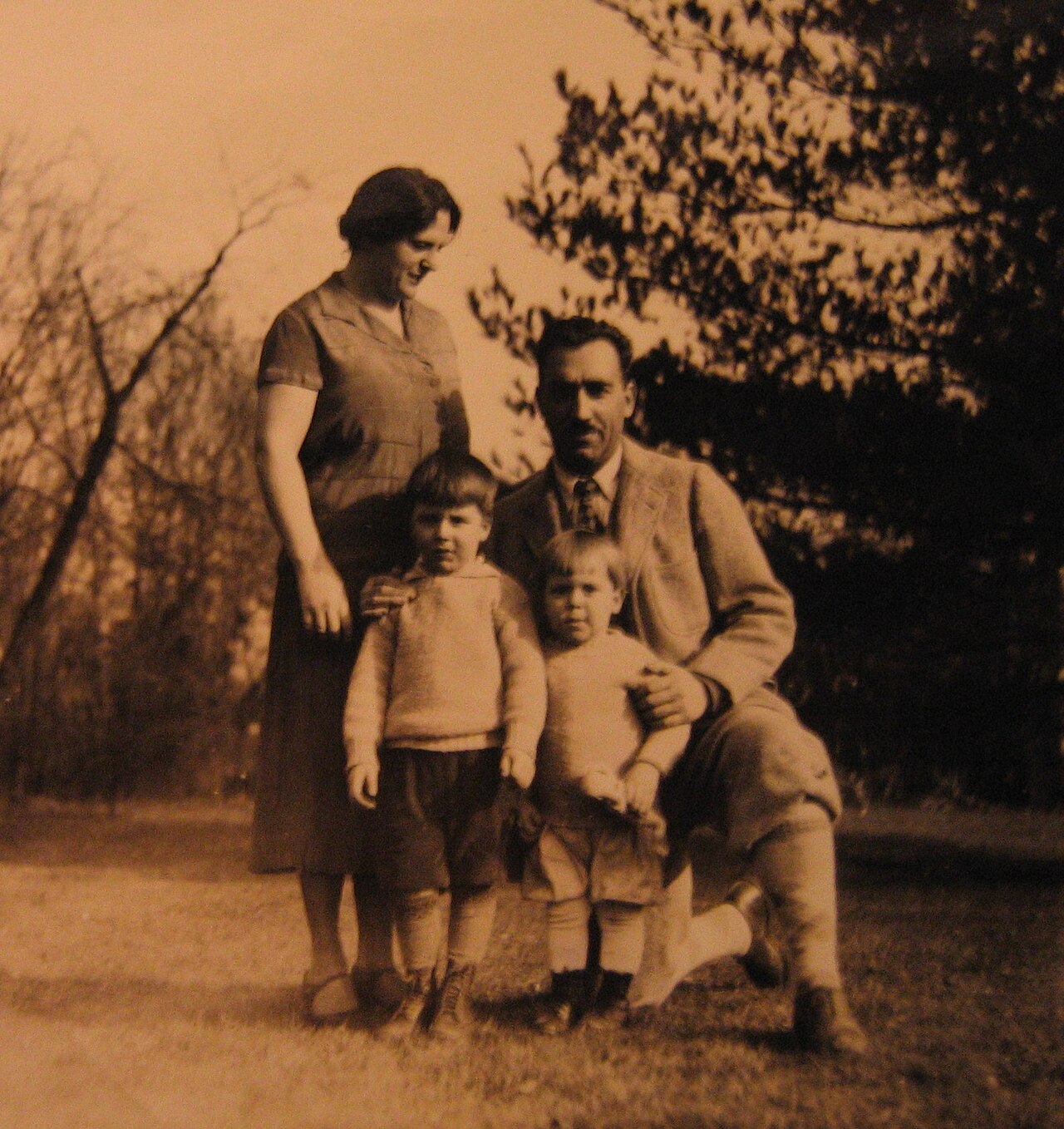
Born in Milan on March 29, 1888, Bossi emigrated to the United States aboard the RMS Oceanic from Cherbourg, France, on July 20, 1914, and settled in Great Neck, New York. He petitioned for naturalization in 1925 and became a U.S. citizen on March 16, 1926, while his two sons—Charles (1922–1989) and Enea Wilbur (1924–1999)—held both Italian and American citizenship. Bossi spoke fluent Italian, French, and English. His personal life was shaped by an unlikely romance: he met Flora Kehrer, a Swiss German woman from Lausanne, through his professional relationship with her uncle, George Boldt. Flora had been sent to the United States by a new stepmother just before World War I and was living with her aunt and uncle in Connecticut. The couple eloped against the wishes of Flora's guardians. They raised their family on Upper Mountain Avenue in Montclair, New Jersey, and maintained a country house in Lansdale, Pennsylvania. Beyond aviation, Bossi co-founded Société Continentale Parker in France in 1927, brokering Parkerizing and Udylite distribution rights that would grow into the European surface-treatment market leader.
Gallery
Frequently Asked Questions
Who is Enea Bossi Sr.?
Enea Bossi Sr. was an Italian-American aerospace engineer and aviation pioneer born in Milan, Italy, on March 29, 1888. He emigrated to the United States in 1914 and became a naturalized citizen in 1926, dedicating his career to pushing the boundaries of aircraft design. He passed away on January 9, 1963.
What aircraft did Enea Bossi Sr. design?
He is best known for two landmark machines: the Budd BB-1 Pioneer, recognized as the first aircraft constructed from stainless steel, and the Pedaliante, a pedal-driven airplane. The Pedaliante is disputably credited as the first fully human-powered flight in aviation history.
What made the Budd BB-1 Pioneer significant?
The Budd BB-1 Pioneer was the first aircraft ever built using stainless steel as its primary structural material, a breakthrough that demonstrated the metal's viability in aerospace applications. Bossi's design showed that corrosion-resistant, high-strength steel could replace conventional aluminum in airframe construction.
What is the Pedaliante airplane?
The Pedaliante was a human-powered aircraft designed by Enea Bossi Sr., in which the pilot generated thrust by pedaling rather than using an engine. It is disputably credited with achieving the first fully human-powered flight, though the claim remains debated among aviation historians.
Why is Enea Bossi Sr. important to aviation history?
Bossi Sr. pushed aerospace engineering in two distinct directions: proving that stainless steel could be a practical airframe material and exploring the limits of human-powered flight. His work expanded the materials palette and the conceptual boundaries of what an aircraft could be.
More in Aviation inventors 1-24
Spotted an error? Know more?
Reader corrections go straight into our review queue. Suggest an edit · How this site is sourced