
Albert Gillis von Baumhauer
Dutch aviation pioneer who designed the first Dutch helicopter.

Netherlands Institute for Military History · No restrictions
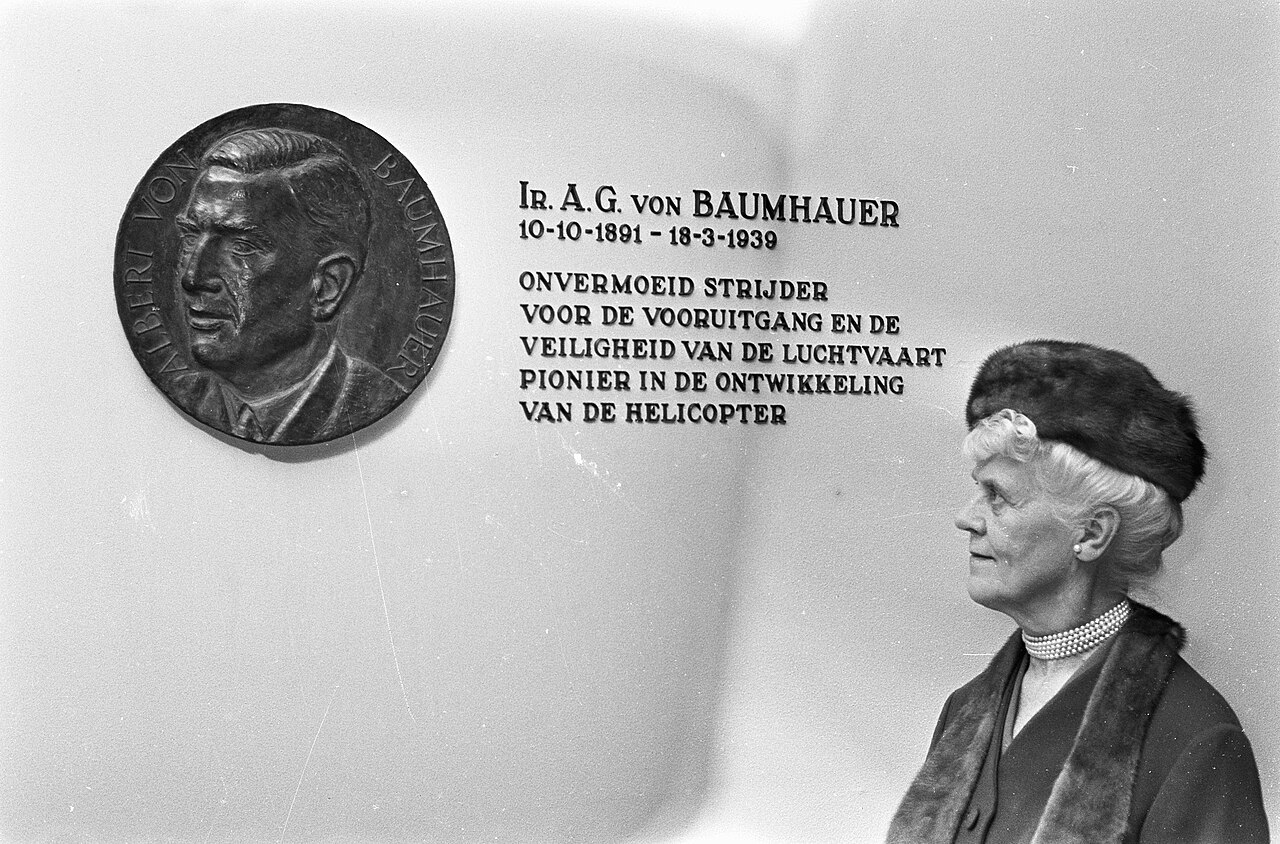
Albert Gillis von Baumhauer (October 1891 – 18 March 1939) was a Dutch aviation pioneer. He is noted for designing the first Dutch helicopter and for key inventions including cyclic and collective control and a single rotor design.
- Born
- October 1891, Heerenveen
- Died
- 18 March 1939, Alder, State of Washington
- Field
- Aviation engineering
- Nationality
- Dutch
- Known for
- First Dutch helicopter, cyclic and collective control, single rotor design
Lore & Background
Von Baumhauer built a biplane glider in 1910 with the Six brothers. In 1913 he built a model helicopter with two counter-rotating rotors that flew but was unstable. After studies in Delft, Göttingen, and Zürich, he met Theodore von Kármán and Ludwig Prandtl. He worked at Spyker in 1910, became chief engineer at Van Berkel in 1919, and developed the Van Berkel W-B seaplane. He married Johanna Hildegonda Oldenhuis Gratama on 12 May 1919 and had three children. After Van Berkel's aircraft division closed in 1921, he joined the National Research Centre for Aviation as deputy director, focusing on aviation safety.
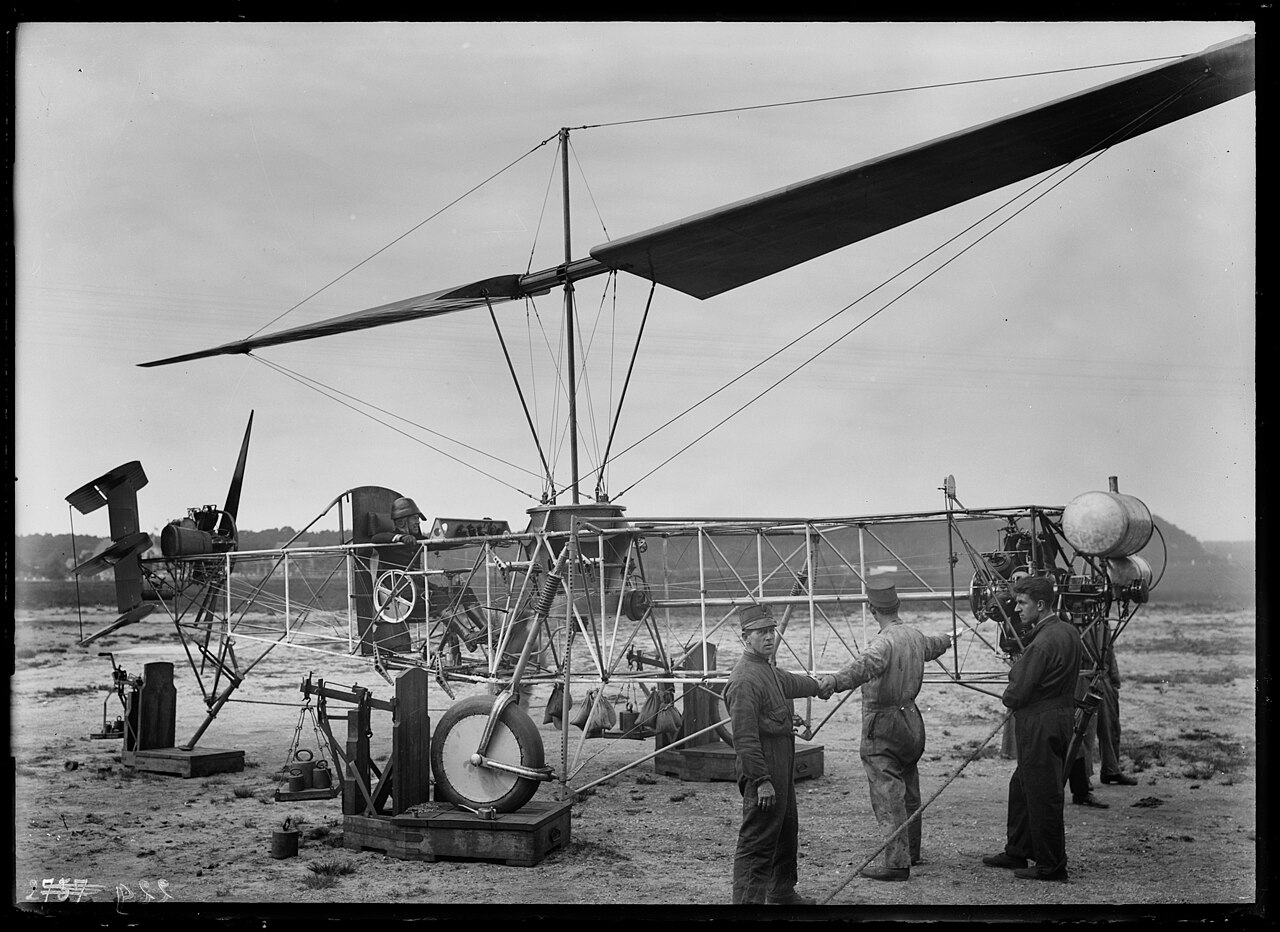
In 1924, von Baumhauer entered a British Ministry of Aviation helicopter contest with severe requirements. He founded the First Dutch Helicopter Aviation with a Six brother in November 1924. The helicopter was ready in April 1925, and first flew in September 1925 piloted by Lt. F.H. van Heyst. On 10 February 1926, van Heyst kept it several metres off the ground for 5 minutes. The contest was later cancelled due to a fatal accident in England, but von Baumhauer continued experiments until 1930. On 28 August 1930 he made a half-hour flight; the next day a hinge bolt failed, destroying the helicopter but leaving him unharmed. The machine was not rebuilt due to lack of funds.
In 1937, von Baumhauer became an engineer at the Civil Aviation Administration. In March 1939 he died in the crash of the prototype Boeing 307 Stratoliner in Alder, Washington. At his death, his nomination as professor at TU Delft was ready. He was a Fellow of the Royal Aeronautical Society, corresponding member of the Deutsche Akademie für Luftfahrtwissenschaften, and Netherlands representative for the Daniel Guggenheim Fund.
Reader's Guide
Von Baumhauer's helicopter design introduced several innovations that shaped modern helicopters. He used a single main rotor with a tail rotor to counteract torque, a departure from the common twin-rotor designs of the era. The tail rotor was powered by its own engine, though its angle of incidence could not be adjusted in flight. More significantly, he applied the swashplate principle for collective and cyclic pitch control: two concentric rings below the rotor, with a non-rotating inner ring that could be tilted and moved along the shaft, and an outer ring that rotated and adjusted blade angles via rods. This allowed blade pitch to vary with the blade's angle, a mechanism still used today. His work influenced later helicopter development, despite the cancellation of the British contest and the destruction of his prototype. His contributions to aviation safety through wind tunnel tests and scientific studies also marked his career. His death in the Stratoliner crash cut short a career that had earned international recognition and a pending professorship.
Did You Know?
- He made a half-hour helicopter flight on 28 August 1930.
- His helicopter used a tail rotor powered by the main engine via a shaft.
From Gliders to Helicopters: A Dutch Aviation Career
Albert Gillis von Baumhauer's path into aviation began in the Netherlands, where he was born in Heerenveen in October 1891. By 1910, he was already collaborating with the Six brothers to construct a biplane glider, and just three years later he had built a small helicopter model featuring two counter-rotating rotors. The craft achieved flight, though it lacked the stability needed for practical use. His formal education took him to Delft, then to Göttingen for aerodynamics, and finally to the Technical University of Zürich, where he encountered the renowned aerodynamicist Theodore von Kármán and the mathematician Ludwig Prandtl. Professionally, von Baumhauer worked at the Spyker car factory starting in 1910 and later became chief engineer at Van Berkel in 1919, where he oversaw development of the W-B seaplane for the Dutch Naval Air Service. When Van Berkel's aircraft division closed in 1921, he moved to the National Research Centre for Aviation, serving as deputy director and focusing on flight safety through wind tunnel testing and scientific research.
Revolutionary Helicopter Engineering
Von Baumhauer's helicopter design broke with the dominant thinking of his era in several critical ways. Where most contemporary machines relied on two counter-rotating rotors, his aircraft employed a single main rotor, a configuration that simplified the airframe considerably. To manage the torque generated by that single rotor, he incorporated a tail rotor driven by its own dedicated engine, a choice that made control easier, though its angle of incidence was fixed and could not be altered in flight. Perhaps his most enduring contribution was the implementation of collective and cyclic pitch control through a swashplate mechanism. Beneath the rotor hub, two concentric rings were mounted and joined by bearings. The inner ring, which did not rotate, could be tilted and slid along the rotor shaft, while the outer ring turned with the blades and transmitted pitch adjustments through connecting rods. This arrangement allowed each blade's angle to be modified according to its position in the rotation cycle. The principle remains fundamental to helicopter control systems used today.
The British Contest and a Decade of Flight
In 1924 the British Ministry of Aviation launched a helicopter competition with a £50,000 prize, demanding a closed circuit at 100 km/h, vertical take-off, a climb to 600 metres, and a safe glide landing after engine shutdown. Von Baumhauer registered that same year and, with one of the Six brothers, founded the First Dutch Helicopter Aviation company to build and fly the machine. The aircraft was ready by April 1925, and its maiden flight occurred in September at Soesterberg, piloted by Lieutenant F.H. van Heyst. By February 1926, van Heyst had held the craft several metres above the ground for five minutes. Operations shifted to Schiphol, where B. Grass and Peter J. Six served as test pilots. Though the British contest was cancelled after a fatal accident in England, von Baumhauer pressed on until 1930. On 28 August 1930 he flew the helicopter for half an hour. The next day a fatigue crack in a rotor-blade hinge bolt caused the machine to fall and be completely destroyed; he was unharmed. With funds nearly gone, the helicopter was never rebuilt, yet his dedication to rotary-wing flight endured to the end of his life.
Recognition, Final Role, and Tragic End
By the late 1930s, von Baumhauer's reputation extended well beyond the Netherlands. He had been elected a Fellow of the Royal Aeronautical Society, named a corresponding member of the Deutsche Akademie für Luftfahrtwissenschaften, and appointed the Netherlands' representative to the Daniel Guggenheim Fund in the United States, where he oversaw aviation safety matters. In 1937 he took a position as engineer at the Civil Aviation Administration under the Ministry of Public Works, tasked with testing and inspecting new aircraft types. His career was on the verge of another milestone: at the time of his death, a nomination for a professorship at TU Delft was already prepared. In March 1939, von Baumhauer travelled to the United States on a study trip. He was aboard the prototype of the four-engine Boeing 307 Stratoliner when it crashed in Alder, Washington state, killing him. He was 47. His personal life had been anchored by his 1919 marriage to Johanna Hildegonda Oldenhuis Gratama, with whom he raised three children. Though his helicopter was never rebuilt after the 1930 accident, the control principles he pioneered continue to underpin every modern helicopter in operation.
Gallery
Frequently Asked Questions
Who is Albert Gillis von Baumhauer?
Albert Gillis von Baumhauer was a Dutch aviation engineer who worked in the early 1900s. He is best known for building the first helicopter designed and constructed in the Netherlands.
What are Albert Gillis von Baumhauer's key inventions?
He is credited with developing both cyclic and collective pitch control mechanisms, as well as a single-rotor helicopter layout. These contributions helped shape the fundamental flight-control architecture still used in modern helicopters.
Where and when was Albert Gillis von Baumhauer born?
He came into the world in October 1891 in Heerenveen, a town in the Netherlands.
How did Albert Gillis von Baumhauer's life end?
He passed away on 18 March 1939 in Alder, Washington, in the United States, at the age of roughly forty-seven.
Why is Albert Gillis von Baumhauer important to aviation history?
By delivering the first Dutch helicopter, he anchored the Netherlands in the very early era of rotary-wing flight. His pioneering work on cyclic and collective control plus a single-rotor configuration added crucial building blocks to the broader evolution of practical helicopter technology.
More in Aviation inventors 1-24
Spotted an error? Know more?
Reader corrections go straight into our review queue. Suggest an edit · How this site is sourced