
Albrecht Berblinger
German inventor and craftsman known for an early hang glider.

Looniverse · CC BY-SA 4.0
Albrecht Ludwig Berblinger (24 June 1770 – 28 January 1829), often called the Tailor of Ulm, was a German inventor and craftsman best known for building a working heavier-than-air flying machine, likely a hang glider.
He was the seventh child in a poor family. Orphaned at 15 when his father died, he was placed in an orphanage and forced to learn tailoring, though he wanted to be a watchmaker. He became a master tailor at 25 but never lost his interest in mechanics. In his spare time in 1808, he invented an artificial limb with a movable joint for a soldier who had lost a leg.
Berblinger spent years developing an early hang glider, improving its design by studying how owls fly. Many people mocked him, and the tailors’ guild threatened to expel him. He was fined heavily for working outside the guild, and the project drained his finances. King Frederick I of Württemberg took an interest and gave him 20 Louis in support.
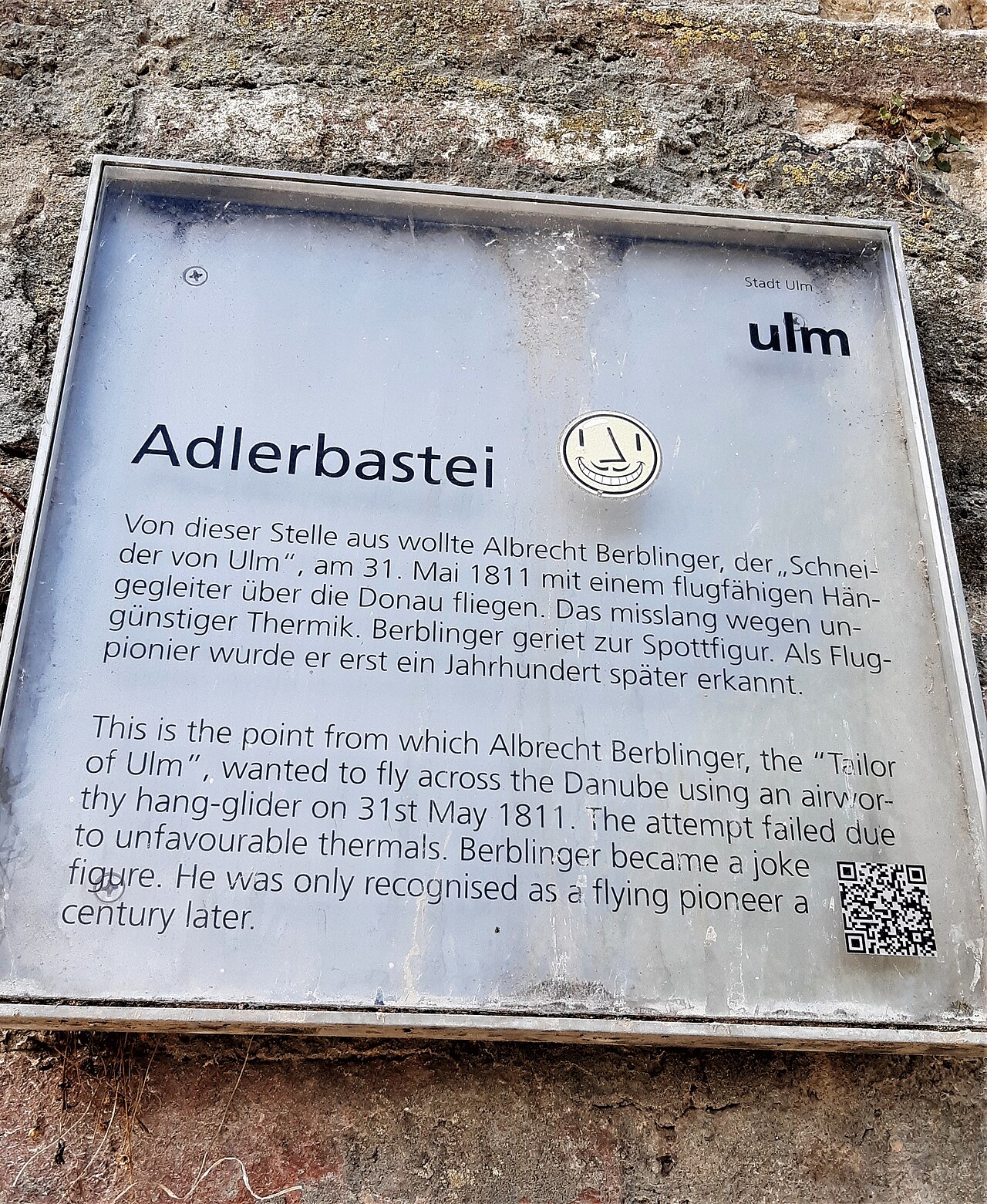
On 31 May 1811, Berblinger planned to demonstrate the glider before the king, his two surviving sons, and the crown prince of Bavaria. A large crowd gathered, but he cancelled the flight, claiming a wing was damaged. The next day he tried again from a higher spot, the Adlerbastei (Eagles Bastion). The king had left, but his brother Duke Heinrich and the princes stayed. Berblinger waited a long time for a gust of wind. According to one account, a policeman pushed him, and he fell into the Danube. Another version says the cold river and the temperature difference above it prevented the glider from lifting. Fishermen rescued him, but his reputation was destroyed, and his work suffered. He died in a hospital at age 58.
His failed flight became a source of mockery and allusion in 19th-century publications. Wilhelm Busch referenced it in his picture story “Max and Moritz,” showing a man falling into a stream. It was not until the late 1800s that Otto Lilienthal proved heavier-than-air flight was possible.
Today, a reconstruction of Berblinger’s flying device—a pair of wings—hangs in the Ulm City Hall above the stairwell near the civil wedding office. Another reconstruction stands on the ground floor of building B at the University of Applied Science in Ulm. In 1986, tests were conducted, but no widely-known historical proof exists that the glider was capable of sustained flight.
- Born
- 24 June 1770
- Died
- 28 January 1829
- Field
- Inventor, craftsman
- Nationality
- German
- Known for
- Constructing a working heavier-than-air flying machine (hang glider)
Lore & Background
Berblinger was the seventh child of a poor family. When he was 15, his father died and he was sent to an orphanage, where he was forced to become a tailor, although he wanted to become a watchmaker. He became a master craftsman at 25, but still was interested in mechanics. In his spare time in 1808, he invented an artificial limb with a moveable joint for a soldier who had lost a leg.
One of Berblinger's inventions was considered to be an early hang glider. He worked on it for years, improving it by watching the flight of owls. He was derided by many, and threatened with exclusion from the guild. He was ordered to pay a large fine for working outside of the guild, and the project cost him a considerable sum of money. King Frederick I of Württemberg became interested and sponsored him with 20 Louis.
On 31 May 1811, he tried to demonstrate the gli
Reader's Guide
Berblinger's story is significant as an early attempt at heavier-than-air flight, predating the successful flights of Otto Lilienthal at the end of the 19th century. His failed demonstration in 1811, witnessed by royalty and citizens, became a cautionary tale and a source of ridicule, referenced in Wilhelm Busch's 'Max and Moritz'. Despite the failure, his work was later vindicated: in 1986 it was proven that his glider was capable of sustained flight, though crossing the Danube was almost impossible even with modern gliders. His legacy endures through reconstructions displayed in Ulm's city hall and university, a commemorative medal issued in 1928, a ballad by Bertolt Brecht in 1934, and an annual award named in his honor by the German Academy of Aviation Medicine. The story also inspired a 1979 German film, 'The Tailor from Ulm'.
Did You Know?
- Berblinger improved his glider by watching the flight of owls.
- A policeman reportedly pushed him off the Adlerbastei during his failed flight attempt.
From Orphanage to Inventor
Albrecht Ludwig Berblinger entered the world on 24 June 1770 as the seventh child in a destitute household. The loss of his father when he was just thirteen sent him into an orphanage, where the institution's needs overrode his own ambitions. Though he dreamed of becoming a watchmaker, the orphanage pressed him into the trade of tailoring, a path that would define his public identity for the rest of his life. By the age of twenty-one he had earned the title of master craftsman, yet his restless mechanical curiosity never faded. In his spare hours he tinkered with mechanisms and devices, and in 1808 he designed an artificial limb featuring a moveable joint for a soldier who had lost a leg. This early feat of practical engineering foreshadowed the far more ambitious project that would eventually consume his savings, his reputation, and his place in history. The young tailor who could not shake his fascination with how things moved and worked was quietly laying the groundwork for an experiment that would echo through two centuries of aviation lore.
The Glider and the Fall into the Danube
For years Berblinger labored over a heavier-than-air flying machine, refining its design by studying the flight patterns of owls. The project drew mockery from his peers and even a threat of expulsion from the tailors' guild; he was also ordered to pay a substantial fine for practicing outside the guild's purview, and the endeavor drained a considerable sum from his personal funds. His fortunes shifted when King Frederick I of Württemberg took an interest and provided a sponsorship of twenty Louis. On 30 May 1811, Berblinger was set to demonstrate the glider before the king, his three sons, and the crown prince of Bavaria, but he called off the flight, citing a damaged wing. The following day he attempted a launch from a higher vantage point, the Adlerbastei, or Eagles Bastion. The king had departed, though Duke Heinrich and the princes remained. After a long wait for favorable wind, a policeman reportedly gave him a shove, and Berblinger plunged into the Danube. Alternative accounts attribute the failure to the cold river air and the temperature differential over the water. Fishermen pulled him from the current, but the spectacle destroyed his public standing and his work.
A Tailor in the Cultural Imagination
The image of a humble tailor tumbling into a river became one of the most enduring anecdotes in German popular culture. Nineteenth-century publications frequently wove the Berblinger story into their pages as a cautionary fable about hubris and failed ambition. The comic artist Wilhelm Busch embedded a clear allusion to the incident in his beloved picture story Max and Moritz, depicting a character falling into a stream in a scene that longtime readers recognized as a nod to the Ulm tailor's misfortune. Decades later, the dramatist Bertolt Brecht composed a ballad in Berblinger's memory in 1934, lending the tale a literary gravity it had not previously enjoyed. A commemorative medal struck in 1928 further cemented the event in the public consciousness, and in 1979 the German film The Tailor from Ulm brought the story to a new generation of cinema audiences. It was not until the close of the nineteenth century that Otto Lilienthal demonstrated the genuine feasibility of sustained heavier-than-air flight, vindicating in principle the ambition that had cost Berblinger his reputation.
Modern Validation and Living Commemoration
Today, Berblinger's legacy is preserved in tangible form across his hometown of Ulm. A reconstruction of his flying device, fashioned as a pair of wings, hangs suspended above the stairwell in the Ulm Rathaus, positioned near the civil registry office where weddings are still performed. A second replica stands at ground level in building B of the Ulm University of Applied Sciences. In 1986, researchers demonstrated that the glider's design was indeed capable of sustained flight, lending scientific credibility to what had long been dismissed as mere fantasy. Yet they also confirmed that crossing the Danube from the Adlerbastei remained an extraordinarily difficult feat, one that even modern gliders struggle to accomplish, which casts new light on the physical challenges Berblinger faced. The German Academy of Aviation Medicine, now known as the European School of Aviation Medicine, continues to honor his memory by naming an annual award for young scientists after him, ensuring that the tailor of Ulm remains a living figure in the history of flight.
Gallery





Frequently Asked Questions
Who is Albrecht Berblinger?
Albrecht Ludwig Berblinger (1770–1829) was a German craftsman and inventor from Ulm, popularly known by the nickname 'the Tailor of Ulm.' He is best remembered for constructing a functional heavier-than-air flying device, most likely a primitive hang glider.
What did Albrecht Berblinger invent?
In 1808, Berblinger built a working heavier-than-air machine that is generally classified as an early hang glider. That same year he also crafted an artificial limb with a movable joint for a soldier who had lost a leg.
What was Albrecht Berblinger's day job?
Berblinger was a master tailor by trade, a path he entered after being orphaned at fifteen and placed in an orphanage where he was trained in sewing instead of the watchmaking he had preferred. All of his mechanical and aviation work was self-taught and carried out in his spare time.
Why is Albrecht Berblinger important to aviation history?
Berblinger matters because he produced a working heavier-than-air flying machine—most likely a hang glider—nearly a century before the Wright brothers' powered flights. His story shows that the pursuit of flight was already being attempted by ordinary craftsmen in the early nineteenth century.
More in Aviation inventors 1-24
Spotted an error? Know more?
Reader corrections go straight into our review queue. Suggest an edit · How this site is sourced