Cheese slaw
A cheese-based side dish with disputed Australian origins.

T.Tseng · CC BY 2.0
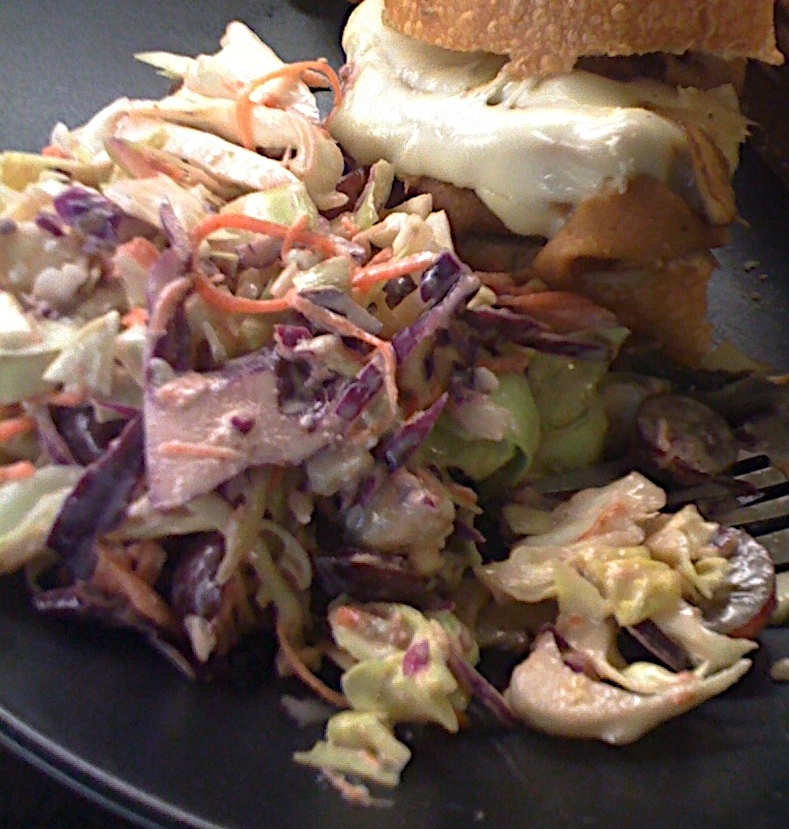
Cheese slaw is a side dish made with grated, crumbled, or cubed cheese, grated carrot, and a mayonnaise dressing. While cheddar is the most common cheese, blue or Swiss varieties are sometimes used. Unlike typical coleslaw, it often omits cabbage, though cabbage can be included. Other optional vegetables include chives, spring onions, shallots, parsley, and broccoli.
The dish has disputed origins, with ties to both Townsville in north Queensland, Australia, and Broken Hill, New South Wales. In Broken Hill, it is a staple in restaurants and homes, often served as a side, and sometimes used as a topping for barbecued chicken, which melts the cheese. In the United States, cheese slaw is also eaten in some areas, where it may be made with blue cheese or blue cheese dressing instead of mayonnaise, and is occasionally used as a hot dog topping.
- Type
- side dish
- Main ingredients
- cheddar cheese, carrot, mayonnaise
- Region
- Australia (Townsville, Queensland; Broken Hill, New South Wales); United States
- Earliest known date
- at least 1939
- Common variations
- blue cheese, Swiss cheese, cabbage, chives, spring onions, shallots, parsley, broccoli
Lore & Background
Cheese slaw is prepared using grated cheese, crumbled or cubed cheese, grated carrot, and a mayonnaise dressing. It is very similar to some coleslaw recipes but is distinguished by the inclusion of cheese. Cheddar cheese is typically used, although other cheeses such as blue and Swiss are sometimes used. It often does not contain cabbage, as per coleslaw, although cabbage is occasionally used. Cheese slaw may contain other vegetables, such as chives, spring onions, shallots, parsley, and broccoli.
The origin of cheese slaw has been somewhat disputed. Cheese slaw dates to at least 1939 in Australia, when a recipe for it was printed in the Townsville Daily Bulletin, a newspaper published in Townsville, Queensland. The recipe was for a 'ham and cheese slaw', and included shredded cabbage, cubed cheese, julienne ham, mayonnaise, lemon juice, and mustard. Cheese slaw recipes were also published in the Australian Women's Weekly in 1946 and 1966.
Some people claim that cheese slaw originated in Broken Hill, New South Wales. Cheese slaw is found extensively in Broken Hill, where it is served in restaurants, prepared in households, and has been stated to be 'ingrained in the local diet'. It has been served in Broken Hill cafes and milk bars since the second half of the 20th century. In Broken Hill, it is typically served as a side dish. Some people in Broken Hill top barbecued chicken with cheese slaw, which causes the cheese to melt.
Reader's Guide
Cheese slaw holds significance as a regional Australian dish with a contested history, reflecting local culinary traditions in both Townsville, Queensland, and Broken Hill, New South Wales. Its earliest documented appearance is a 1939 recipe in the Townsville Daily Bulletin, though claims of origin in Broken Hill persist. The dish is deeply ingrained in Broken Hill's local diet, served in restaurants and households, and has been a staple in cafes and milk bars since the mid-20th century. Its legacy extends to the United States, where versions sometimes include blue cheese or blue cheese dressing and are used as a hot dog topping. The dish's adaptability—using various cheeses, vegetables, and dressings—has allowed it to persist as a simple, savory side. Unlike coleslaw, cheese slaw often omits cabbage, centering on cheese and carrot bound by mayonnaise. Its continued popularity in Broken Hill and sporadic presence in the U.S. demonstrates how a humble side dish can become a marker of regional identity, even when its exact origins remain unresolved.
Did You Know?
- Cheese slaw dates to at least 1939, when a recipe for 'ham and cheese slaw' was printed in the Townsville Daily Bulletin.
- In Broken Hill, some people top barbecued chicken with cheese slaw, causing the cheese to melt.
- In the United States, cheese slaw is sometimes prepared using blue cheese and used as a hot dog dressing.
- Cheese slaw often does not contain cabbage, unlike coleslaw, though cabbage is occasionally used.
Composition & Preparation
Cheese slaw is a side dish that draws on the familiar structure of coleslaw while introducing a distinctly dairy-forward twist. The foundation of the dish typically involves grated, crumbled, or cubed cheese—most commonly cheddar—combined with grated carrot and bound together with a mayonnaise-based dressing. What sets it apart from traditional coleslaw is precisely that cheese component, though the two share enough structural DNA that they are often compared. Unlike its cabbage-heavy cousin, cheese slaw frequently omits cabbage altogether, though it is occasionally incorporated. Beyond the core ingredients, cooks sometimes enrich the mixture with a variety of additional vegetables, including chives, spring onions, shallots, parsley, and even broccoli. While cheddar reigns as the standard choice, adventurous preparations have called for blue cheese or Swiss, adding sharpness or nuttiness to the creamy base. The result is a dish that sits comfortably between a salad and a cheese course, versatile enough to appear on a table as a supporting act to the main event.
Tracing the Origins
The exact birthplace of cheese slaw has never been settled to everyone's satisfaction, making it a dish with a somewhat contested genealogy. The earliest documented recipe surfaced in 1939, printed in the Townsville Daily Bulletin, a newspaper serving the north Queensland city of Townsville. That particular entry described a "ham and cheese slaw," calling for shredded cabbage, cubed cheese, julienne-cut ham, mayonnaise, lemon juice, and mustard—a slightly more elaborate construction than the simpler versions that would follow. The dish continued to gain visibility in Australian food culture when the Australian Women's Weekly, a widely read monthly magazine, published cheese slaw recipes in both 1946 and 1966, suggesting it had become a recognized household preparation across the country. Despite these early Queensland and national magazine appearances, a persistent claim ties the dish's true origin to Broken Hill in New South Wales, a rivalry that has kept the question of where it really started alive for decades.
The Broken Hill Institution
Nowhere is cheese slaw more deeply embedded in daily life than in Broken Hill, New South Wales, where it has become almost a civic identity. The dish is not merely available there; it is described as "ingrained in the local diet," a phrase that captures how thoroughly it has permeated the community's food culture. Since the second half of the twentieth century, Broken Hill cafes and milk bars have served it as a standard offering, and it is prepared regularly in private homes across the town. In most settings it functions as a side dish, accompanying the main course in the way a potato salad might in another region. One particularly local tradition takes the concept a step further: some residents pile cheese slaw over barbecued chicken, allowing the heat of the meat to melt the cheese into a gooey, savory coating. This practice, unique to the Broken Hill table, transforms the cold, creamy salad into something closer to a warm cheese sauce, illustrating how a single community can take a simple recipe and make it unmistakably its own.
Crossing the Pacific
Cheese slaw has crossed the Pacific to find a modest but distinct following in parts of the United States, where it has been adapted to local tastes and serving conventions. American versions of the dish sometimes swap the traditional cheddar for blue cheese, lending a sharper, more pungent profile to the creamy base. In some U.S. kitchens, the mayonnaise dressing is replaced entirely with blue cheese salad dressing, creating a tangier, more liquid consistency. Cabbage, which is often absent from the Australian preparation, finds a more regular place in the American interpretation, bringing the dish closer in structure to a conventional coleslaw. Perhaps the most surprising American adaptation is the use of cheese slaw as a hot dog topping, a role that repurposes the side dish as a condiment and speaks to the American appetite for layering bold flavors onto simple street food. These variations demonstrate how a recipe can travel and mutate, retaining its core identity while acquiring entirely new functions in a different culinary landscape.
Gallery
Frequently Asked Questions
What is cheese slaw?
Cheese slaw is a creamy Australian side dish built around grated or crumbled cheese, shredded carrot, and a mayonnaise-based dressing. It is typically served alongside a main course rather than as a standalone meal.
What ingredients go into cheese slaw?
The core trio is cheddar cheese, grated carrot, and mayonnaise, though some cooks swap in blue or Swiss cheese for a sharper flavour. Optional additions like chives, spring onions, shallots, parsley, or broccoli are common, and cabbage can be folded in even though it is often left out entirely.
Where did cheese slaw originate?
The dish's true birthplace remains contested, with strong claims from both Townsville in north Queensland and Broken Hill in New South Wales. In Broken Hill especially, it has become a well-established staple on restaurant menus and in home kitchens.
How is cheese slaw different from regular coleslaw?
The biggest distinction is that cheese slaw frequently drops cabbage, replacing the vegetable-forward base with a cheese-and-carrot mix bound in mayo. It also tends to include aromatics like spring onions or chives, giving it a more savoury, less sweet profile than classic coleslaw.
How old is cheese slaw?
The earliest documented reference to the dish dates back to at least 1939, making it a mid-twentieth-century Australian creation. Despite that relatively recent start, it has since become a recognised part of the country's regional food identity.
More in Australian cuisine 1-24
Spotted an error? Know more?
Reader corrections go straight into our review queue. Suggest an edit · How this site is sourced