
Ruger Mini-14
A lightweight semi-automatic rifle resembling a scaled-down M14.
The Ruger Mini-14 is a lightweight, semi-automatic rifle first produced by Sturm, Ruger & Co. in 1973. Its look is similar to a smaller M14, and it fires the 5.56×45mm NATO cartridge, but it uses a unique gas system of its own design. The rifle is in service with military, law enforcement, corrections, and civilian users in the United States and internationally.
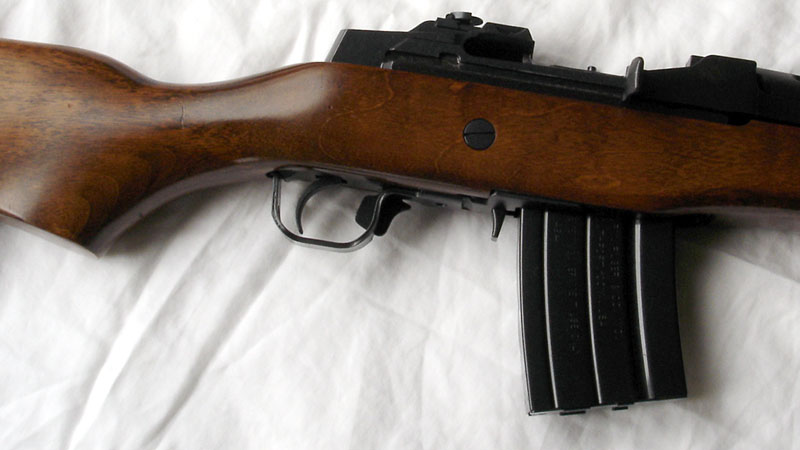
The design was the work of L. James Sullivan and William B. Ruger. It uses an investment-cast, heat-treated receiver and is mechanically related to the M1 rifle in that area, but has a self-cleaning, fixed-piston gas system. Early models had an exposed bolt hold-open without a manual button, angular wood stocks, and wooden heat shields. These were later redesigned with a new stock and bolt hold-open mechanism. The original rear sight was an aperture with large protective wings and no scope bases. In 1982, the Ranch Rifle variant added integral scope bases on the receiver, a folding-aperture rear sight, and factory scope rings.
The Mini Thirty, chambered for the 7.62×39mm cartridge, appeared in 1987. This round was chosen because large amounts of surplus military ammunition were cheaply available in the U.S. at the time, and its ballistics are similar to the .30-30 Winchester, making it a viable deer rifle. In 2003, the entire line was overhauled to improve accuracy, update styling, and cut production costs. The standard Mini-14 was discontinued, and the name became the family designation. By 2005, all Mini-14-type rifles were based on the Ranch Rifle design, with integral scope bases, a nonfolding ghost ring rear sight, and a winged front sight like that on the Ruger police carbine. These 580-series rifles have a modified gas system to reduce barrel vibration and can achieve two-inch groups at 100 yards (2 MOA). Around 2007 or 2008, a heavier, larger-diameter barrel tapered from the gas block to the muzzle was added, along with tighter tolerances for better accuracy. All models come in stainless steel or blued finish with hardwood, synthetic, or laminated stocks, and barrel lengths of 16.12 or 18.5 inches.
The Ranch Rifle is the basic model, with a wood or synthetic stock, blued or stainless receiver, and an 18.5-inch tapered barrel (1:9" RH twist). It has an adjustable ghost ring rear sight, a winged front sight, and includes a detachable Picatinny scope rail mount.
Quick Facts
- Origin
- United States
- Is Ranged
- yes
- Service
- 1974–present
- Wars
- Rhodesian Bush War / The Troubles / Basque conflict / Militias-Comando Vermelho conflict
- Designer
- L. James Sullivan, William B. Ruger
- Design Date
- 1967–1973
- Manufacturer
- Sturm, Ruger & Co.
- Production Date
- 1973–present
- Weight
- 2.9 kg
- Length
- Model 5816: 965 mm
- Part Length
- 330 -
- Cartridge
- .222 Remington / .223 Remington / .300 AAC Blackout / 5.56×45 mm NATO / 7.62×39 mm / 6.8 SPC
Facts from the source article.
Lore & Background
The Mini-14 was designed by L. James Sullivan and William B. Ruger, incorporating an investment-cast, heat-treated receiver and a self-cleaning, fixed-piston gas system. Early production rifles had an exposed-bolt hold-open device without a manual engagement button, angular stocks, and wooden heat shields. These were later redesigned with a new stock and bolt hold-open mechanism. In 1982, Ruger introduced the Ranch Rifle with integral scope bases and a folding-aperture rear sight. The Mini Thirty, chambered for 7.62×39mm, debuted in 1987, capitalizing on surplus military ammunition imports and offering ballistics similar to the .30-30 Winchester. In 2003, the design was overhauled to improve accuracy, update styling, and reduce production costs; by 2005, all Mini-14-type rifles were based on the Ranch Rifle design with a nonfolding ghost ring aperture rear sight and a modified gas system. Around 2007 or 2008, a heavier, larger-diameter barrel was added, contributing to greater potential accuracy.
Reader's Guide
The Mini-14 has maintained a notable presence in both civilian and professional markets since its introduction. Its design, outwardly similar to the M14 but chambered in a smaller caliber, offered a lightweight alternative for various users. The rifle's adaptability is evident in its numerous variants, including the Ranch Rifle for civilian use, the Target Rifle with a heavy barrel and harmonic tuner, the Tactical Rifle with a shorter barrel and flash suppressor, and the Mini Thirty for the 7.62×39mm cartridge. Government and law enforcement models, such as the Mini-14 GB and the selective-fire AC-556, expanded its role. The AC-556, introduced in 1979, offered semi-automatic, three-round burst, and full automatic fire modes, and was used by French agencies under the designation Mousqueton A.M.D. The rifle's production history includes a straight-pull action variant for the United Kingdom following legislation banning semi-automatic centerfire rifles. The Mini-14's continued evolution through design overhauls and caliber options has kept it relevant across decades.
Did You Know?
- The Mini Thirty, chambered in 7.62×39mm, was introduced in 1987.
- The AC-556 is a selective-fire version with semi-automatic, three-round burst, and full automatic modes.
- A straight-pull action version was manufactured for sale in the United Kingdom.
Design Philosophy & Engineering Heritage
The Mini-14 was born from a straightforward idea: take the proven architecture of the M14 and shrink it into a more manageable package chambered in 5.56×45mm NATO. L. James Sullivan and William B. Ruger brought that vision to life in 1973, producing a rifle whose silhouette immediately recalls the full-size M14 yet carries its own identity under the hood. The receiver is investment-cast and heat-treated, and in the receiver area the mechanism echoes the M1 rifle's approach. The gas system, however, is a self-cleaning, fixed-piston design unique to the Mini-14, clearly distinguishing its operating principle from the M14's. Sullivan and Ruger also wove in numerous cost-saving engineering changes to keep the platform accessible to a broader market. The visual resemblance to the M14 is deliberate and instant, but the internal engineering tells a different story—one of purposeful simplification, modernization, and a compact form factor that made a military-caliber rifle practical for everyday civilian and tactical use.
A Decade of Refinement
The Mini-14's earliest production years carried visible rough edges. First-run rifles, identifiable by serial prefixes before 181, featured a complex exposed-bolt hold-open device lacking any manual engagement button, somewhat angular stocks, and wooden heat shields. Ruger quickly retooled the line, introducing a redesigned stock, a new bolt hold-open mechanism, and other small corrections. In 1982 the Ranch Rifle arrived, adding integral scope bases to the receiver, a folding-aperture rear sight, and factory scope rings—filling a gap left by the original's large-winged aperture sight with no scope mounting provision. The most sweeping change came in 2003, when the entire design was overhauled for better accuracy, updated styling, and lower production costs. The standard Mini-14 name became a family designation, and every new rifle adopted the Ranch Rifle layout with a nonfolding ghost ring rear sight and a winged front sight. Serial numbers beginning at 580 marked this generation, which also featured a modified gas system aimed at damping barrel vibration and achieving two-minute-of-angle groups at 100 yards. By 2007 or 2008, a heavier, visibly tapered barrel and tighter tolerances pushed the accuracy ceiling even higher.
The Variant Ecosystem
Ruger has steadily expanded the Mini-14 family into a versatile platform spanning multiple calibers and roles. The Ranch Rifle serves as the baseline, offered in wood or synthetic stocks with blued or stainless receivers and an 18.5-inch tapered barrel at a 1:9 twist rate, chambered in both .223 Remington and 5.56 NATO. The Target Rifle, introduced in 2007, steps up to a 22-inch cold hammer-forged heavy barrel with an adjustable harmonic tuner, designed exclusively for .223. The Tactical Rifle, arriving in 2009, shortens the barrel to 16.12 inches, adds a flash suppressor, and offers a collapsible ATI stock with Picatinny rails; by 2015 it also accepted .300 AAC Blackout. The Mini Thirty, launched in 1987, brings 7.62×39mm capability to the platform with a 1:10 twist rate, and a dedicated Tactical variant followed in 2010. Government models, catalogued as GB for government barrel, add bayonet lugs, threaded barrels, and flash suppressors. The family also stretches into 6.8mm Remington SPC, and every variant is available in stainless or blued finishes with hardwood, synthetic, or laminated stocks.
From Gun Shop to the Field
The Mini-14 occupies a unique niche spanning civilian, law enforcement, corrections, and military use across the United States and internationally. For deer hunters, the Mini Thirty proved particularly effective, especially in states that prohibit calibers smaller than 6 mm for big-game pursuit. Its 7.62×39mm ballistics closely mirror the well-known .30-30 Winchester, and at the time of its 1987 introduction, surplus military ammunition in that caliber was flooding the U.S. market at rock-bottom prices, making it an economical and capable choice. Target shooters gravitate toward the Target Rifle's 22-inch heavy barrel and harmonic tuner, which deliver sub-two-MOA groups without iron sights. Tactical users find the 16.12-inch barrel, flash suppressor, and Picatinny-equipped collapsible stock well suited to patrol or close-quarters roles. Ruger also addresses legal constraints by offering 5-round magazines alongside the standard 20-round boxes, ensuring compliance with state and international magazine-capacity restrictions. The result is a single platform family that genuinely serves a wide spectrum of end users.
Gallery



Frequently Asked Questions
What is the Ruger Mini-14?
It is a compact semi-automatic rifle produced by Sturm, Ruger & Co. beginning in 1973. Its silhouette resembles a scaled-down M14, but it runs on a proprietary fixed-piston gas system of its own design rather than the M14's mechanism.
Who designed the Ruger Mini-14?
The rifle was engineered by L. James Sullivan in collaboration with William B. Ruger. Sullivan handled much of the mechanical development while Ruger's company provided the manufacturing and commercial backing.
What calibers can the Mini-14 chamber?
The most common loadings are 5.56×45mm NATO and .223 Remington, but the platform has also been offered in 7.62×39mm, 6.8mm Remington SPC, .300 AAC Blackout, and .222 Remington.
How does the Mini-14's gas system differ from the M14?
Although the investment-cast receiver shares mechanical lineage with the M1/M14 family, the Mini-14 employs a self-cleaning fixed-piston gas system unique to its design. This arrangement is simpler to maintain and more tolerant of fouling than the M14's long-stroke piston.
What variants of the Mini-14 exist?
Ruger has produced the Ranch Rifle, Target Rifle, Tactical Rifle, Mini Thirty (7.62×39mm), and the straight-pull AC-556 among others. Military and law-enforcement users in the United States and abroad have adopted versions such as the Mousqueton A.M.D. and the Mini-14 GB.
More in Assault Rifles, Part 3 1-24
Spotted an error? Know more?
Reader corrections go straight into our review queue. Suggest an edit · How this site is sourced