
AKM
Lighter, stamped-receiver successor to the AK-47.
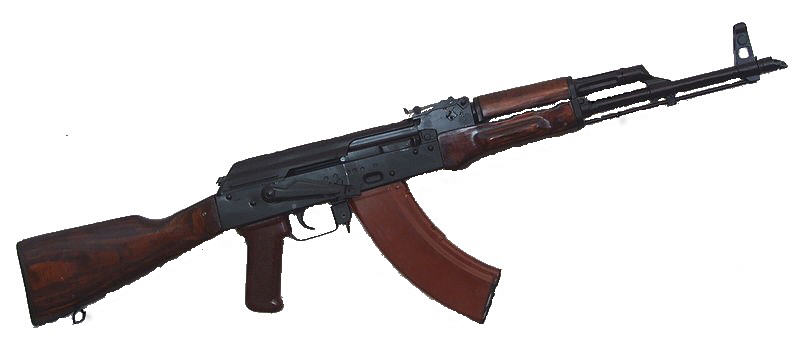
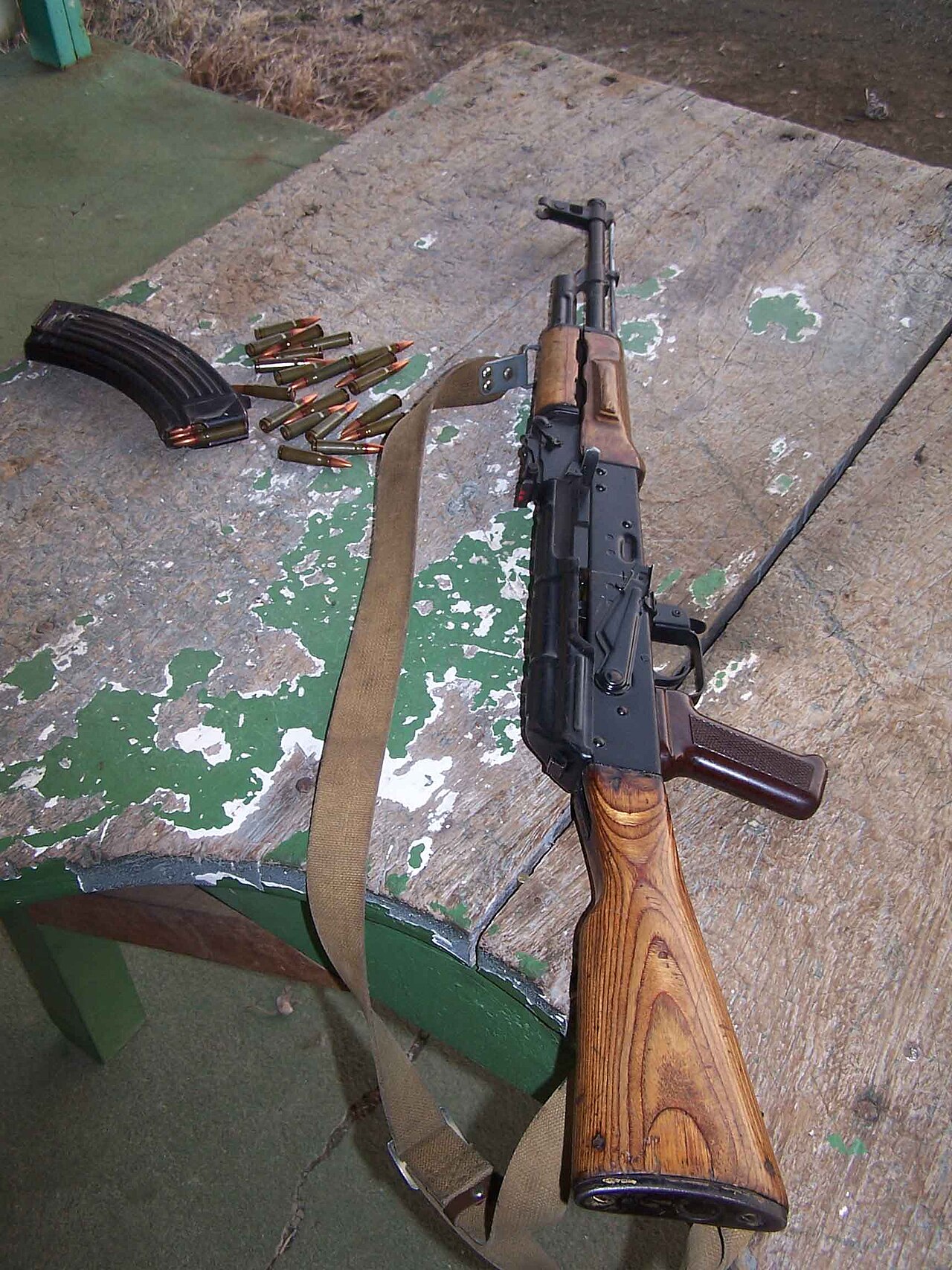
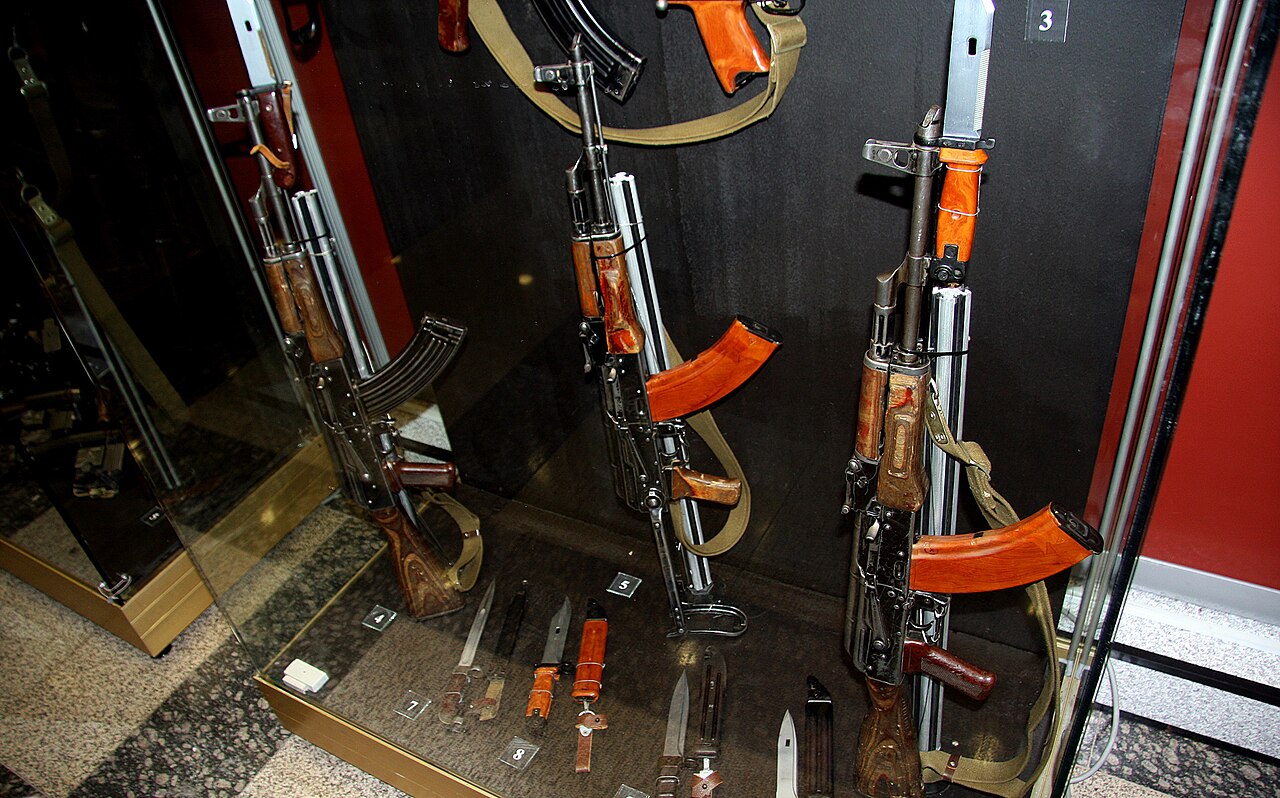
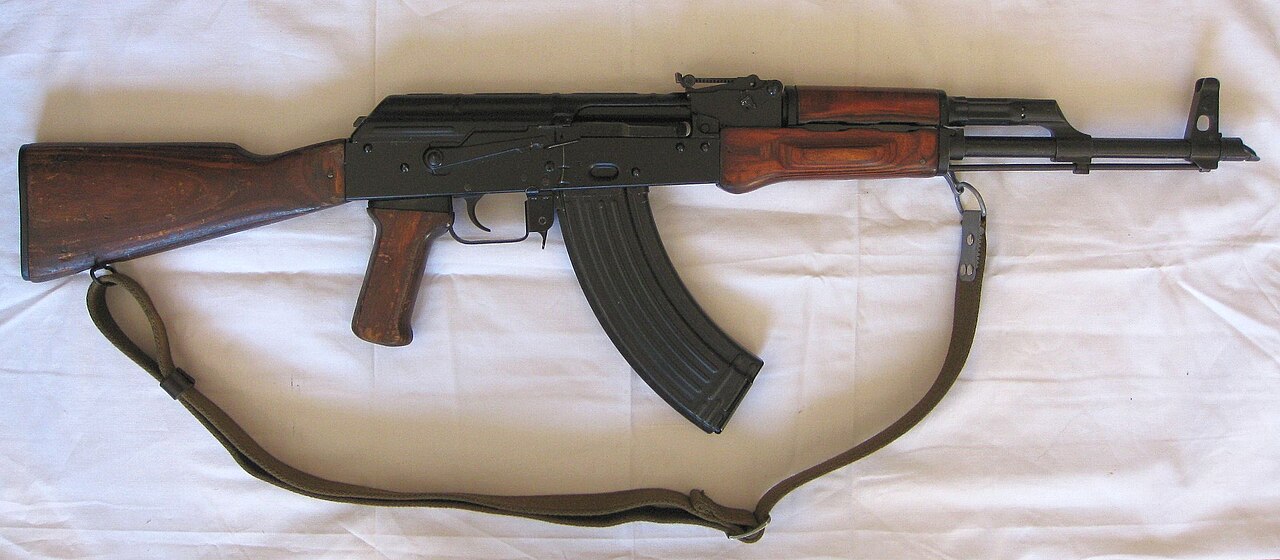
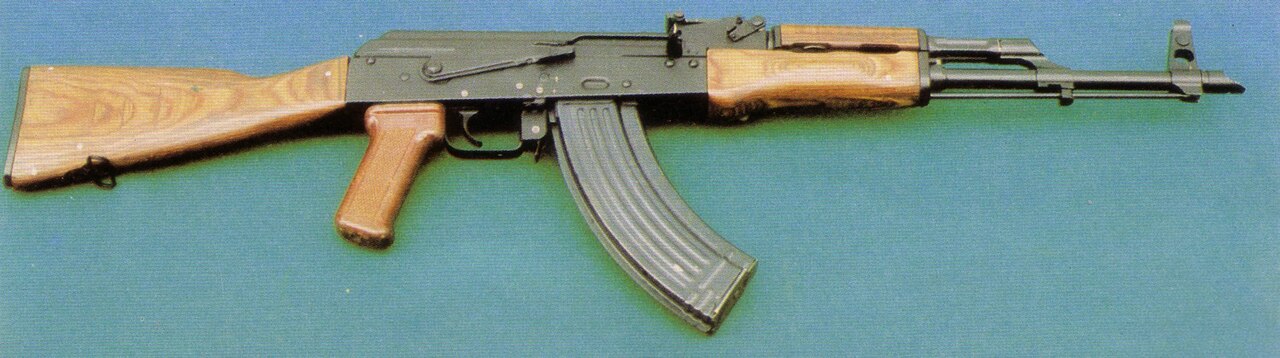
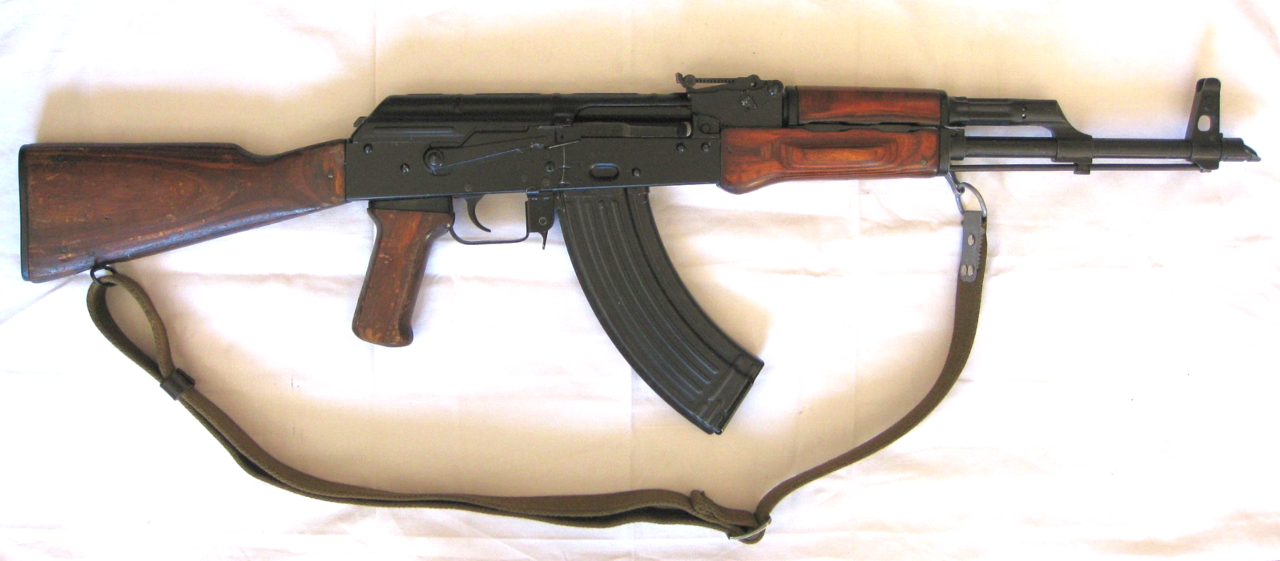
The AKM is a Soviet assault rifle chambered in 7.62×39 mm, first produced in 1959. It was designed by Mikhail Kalashnikov as a lighter and more advanced version of the AK-47. This model became the most numerous variant of the Kalashnikov family and served as the standard-issue rifle for the Soviet Army and Warsaw Pact nations.
The AKM is a selective-fire weapon, capable of semi-automatic or fully automatic operation. It uses a gas-operated, rotating bolt system with a cyclic rate of about 600 rounds per minute. A large bolt carrier, permanently attached to a long-stroke gas piston, rides on two rails inside the receiver. The gas chamber sits above the barrel, and there is noticeable clearance between the moving and stationary parts.
Compared to the AK-47, the AKM introduced several changes to simplify mass production. The earlier milled steel receiver was replaced with a U-shaped stamped steel sheet, 1.0 mm thick. This change reduced the rifle’s weight by roughly 1 kg and improved accuracy during automatic fire while addressing some reliability issues. The chrome-lined barrel, which resists wear and corrosion from corrosive ammunition, was retained. The stamped receiver uses rivets to attach a rear stock trunnion and a forward barrel trunnion, and it includes a rigid tubular cross-section for strength. Guide rails for the bolt carrier, which also incorporate the ejector, are spot-welded inside. The receiver cover is made from thinner stamped metal, reinforced with longitudinal and lateral ribs to maintain durability.
The barrel has a chrome-lined bore with four right-hand grooves and a 240 mm rifling twist rate. It is pinned into the forward trunnion, unlike the AK-47’s screw-in barrel. Horizontal slots on the barrel align and secure the handguards. To reduce muzzle rise during automatic fire, the AKM was fitted with a slant-cut compensator threaded onto the barrel with a left-hand thread. This compensator redirects propellant gases upward and to the right. Some early AKMs used the older muzzle nut from the AK-47 instead, and the slant compensator can also be fitted to an AK-47.
The gas block lacks a cleaning rod capture or sling loop but includes an integrated bayonet support collar with a cleaning rod guide hole. The forward sling loop was moved to the front handguard retainer cap, which also has notches to position the handguards.
Quick Facts
- Origin
- Soviet Union
- Is Ranged
- yes
- Service
- 1959–present
- Designer
- Mikhail Kalashnikov
- Design Date
- 1950s
- Manufacturer
- Izhmash / Tula Arms Plant
- Production Date
- 1959–1977 (Soviet Union) · 1959–present (licensed manufacturers)
- Weight
- AKM: 3.3 kg / AKMS: 3.5 kg / 30-round magazine: 0.33 kg / 6H4 bayonet: 0.32 kg
- Length
- AKM, AKML: 880 mm / AKMS, AKMSN: 920 mm stock extended / 655 mm stock folded
- Part Length
- 415 mm
Facts from the source article.
Lore & Background
The AKM features a gas-operated rotating bolt, a slanted muzzle compensator, and simplified manufacturing for cost-effective mass production. Its receiver is stamped from a 1.0 mm sheet of steel, replacing the milled receiver of the AK-47, which reduced weight by approximately 1 kg and improved automatic accuracy. The barrel is chrome-lined with four right-hand grooves and a 240 mm rifling twist rate. The slant compensator redirects propellant gases upward and to the right to mitigate muzzle rise during automatic fire. The gas block lacks a cleaning rod capture or sling loop but has an integrated bayonet support collar. The bolt carrier has a lightening cut and a fluted bolt stem, and the firing pin is flat rather than round. The buttstock, handguards, and upper handguard are made from birch plywood laminates, with the stock hollowed to reduce weight and longer and straighter than that of the AK-47. The stock houses a cleaning kit secured by a spring-loaded trapdoor. The recoil spring uses a dual U-shaped wire guide. The trigger assembly includes a hammer-release delaying device that ensures the weapon fires only when the bolt is fully locked and reduces trigger slap and rate of fire. The rear tangent sight is calibrated from 100 to 1,000 m, with the battle zero set at 300 m.
Reader's Guide
The AKM became the most widely produced variant of the Kalashnikov series, serving as the standard service rifle of the Soviet Army and Warsaw Pact states. Though replaced in Soviet frontline units by the AK-74 in the 1970s, variants of the AKM continue to be manufactured and remain in use today. Its design emphasized simplified manufacturing for cost-effective mass production, with the stamped receiver and other improvements reducing weight and enhancing automatic accuracy and reliability. The AKM's influence extends through its widespread adoption and continued production, making it a significant firearm in military history.
Did You Know?
- The AKM's receiver is stamped from a 1.0 mm sheet of steel, unlike the milled receiver of the AK-47.
- The slant compensator on the AKM redirects propellant gases upward and to the right to reduce muzzle rise.
- The AKM's wooden buttstock is hollowed to reduce weight and is longer and straighter than that of the AK-47.
Origins & Strategic Role
The AKM entered service in 1959 as the Soviet military's answer to the need for a lighter, more refined evolution of the legendary AK-47. Conceived by Mikhail Kalashnikov himself, the weapon was chambered in the 7.62×39 mm intermediate cartridge and quickly assumed the role of standard-issue rifle across the Soviet Army and every member state of the Warsaw Pact. Its name—Avtomat Kalashnikova modernizirovannyy—translates simply as 'Modernized Kalashnikov automatic rifle,' a label that captures its purpose: not a radical departure, but a deliberate, systematic upgrade of a design already proven in combat. The AKM went on to become the most widely produced member of the entire Kalashnikov family, a testament to how well its refinements served the logistical and tactical demands of an entire military alliance. By streamlining construction while preserving the core operating principles that made the original so dependable, Kalashnikov ensured the platform could be fielded in enormous numbers without sacrificing the reliability that soldiers had come to expect.
Manufacturing Revolution
The single most consequential change Kalashnikov made for the AKM was replacing the AK-47's milled steel receiver with a U-shaped stamping formed from a smooth 1.0 mm sheet of steel. Where the earlier rifle required a solid block of metal to be machined away, the new receiver could be pressed, riveted, and spot-welded into shape with far less material and labor. Trunnions were fastened with rivets rather than being integral to the receiver, and the bolt-carrier guide rails were installed through spot welding. The receiver cover was thinned to a lighter gauge but reinforced with both longitudinal and latitudinal ribs to preserve structural integrity. Furniture—buttstock, upper and lower handguards—was produced from birch plywood laminates that resisted warping, required no lengthy seasoning, and cost less than solid wood. The cumulative effect was a weapon roughly one kilogram lighter, cheaper to build, and far better suited to the mass-production demands of an entire bloc's armed forces.
Mechanical & Ballistic Architecture
At its core the AKM operates on the same gas-driven, rotating-bolt principle as its predecessor, cycling at roughly 600 rounds per minute in either semi-automatic or fully automatic mode. The bolt carrier is a large, robust component with a permanently attached long-stroke gas piston, riding on two rails cut into the receiver walls with generous clearance between moving and stationary parts. The barrel retains the chrome-lined bore that has become a hallmark of Soviet small arms, offering resistance to wear and corrosion—especially important given the corrosively primed ammunition common across the Eastern Bloc. Four right-hand grooves at a 240 mm twist rate stabilize the 7.62×39 mm projectile. A defining visual and functional feature is the slant-cut muzzle compensator, threaded on with a left-hand thread, which redirects expanding gases upward and to the right to suppress muzzle climb during automatic bursts. The bolt carrier itself received a lightening cut on its right side, a slimmed handle, and a fluted stem, while the round fluted firing pin of the AK-47 was swapped for a flat one. Gas relief ports, previously arranged horizontally on the cylinder, were relocated to the gas block in a radial pattern.
Enduring Legacy
By the 1970s the Soviet military had begun replacing the AKM in frontline units with the AK-74, marking a generational shift in the service rifle. Yet the AKM's story did not end with that transition. As the most widely produced variant in the entire Kalashnikov lineage, it continued to be manufactured in various forms well beyond its original service window, and rifles bearing its core architecture remain in active use today. The design's practical virtues—chrome-lined barrels that resisted wear and corrosion, a stamped receiver that could be built with simplified manufacturing methods, and a slant compensator that could even be retrofitted onto an older AK-47—ensured it never became truly obsolete. Its cost-effective production philosophy meant the weapon could be replicated and maintained in settings where precision machining was scarce. In this way the AKM transcended its Soviet origins to become a persistently relevant platform, a rifle whose 1959 engineering choices still echo in arsenals decades later.
Gallery
Frequently Asked Questions
What is the AKM and who designed it?
The AKM is a Soviet assault rifle introduced in 1959, created by Mikhail Kalashnikov as a lighter, stamped-receiver evolution of the original AK-47. It chambered the 7.62×39 mm cartridge and became the backbone of Soviet and Warsaw Pact small-arms arsenals.
How does the AKM's firing system work?
It employs a gas-operated, rotating-bolt mechanism in which a large bolt carrier is permanently mated to a long-stroke gas piston. This setup drives a cyclic rate of roughly 600 rounds per minute in fully automatic mode, while also allowing semi-automatic fire.
What is the main difference between the AKM and the AK-47?
The AKM replaced the AK-47's milled receiver with a stamped one and shed approximately one kilogram (about 2.2 lb) of weight. Beyond that mass reduction, the internal layout and operating principle remained essentially the same.
Why is the AKM considered the most significant Kalashnikov variant?
It became the most numerous production model in the entire Kalashnikov family and served as the standard-issue rifle across the Soviet Army and allied Warsaw Pact nations. Its lighter weight and lower manufacturing cost made it far easier to produce and field at scale than earlier milled-receiver versions.
What are the AKM's key specifications?
The rifle fires 7.62×39 mm ammunition, uses a gas-operated rotating-bolt action, and cycles at approximately 600 rounds per minute. It offers both semi-automatic and fully automatic (selective-fire) modes of operation.
More in Assault Rifles, Part 3 1-24
Spotted an error? Know more?
Reader corrections go straight into our review queue. Suggest an edit · How this site is sourced