
Multi Caliber Individual Weapon System
Indian multi-caliber assault rifle with modular, rivet-less design.
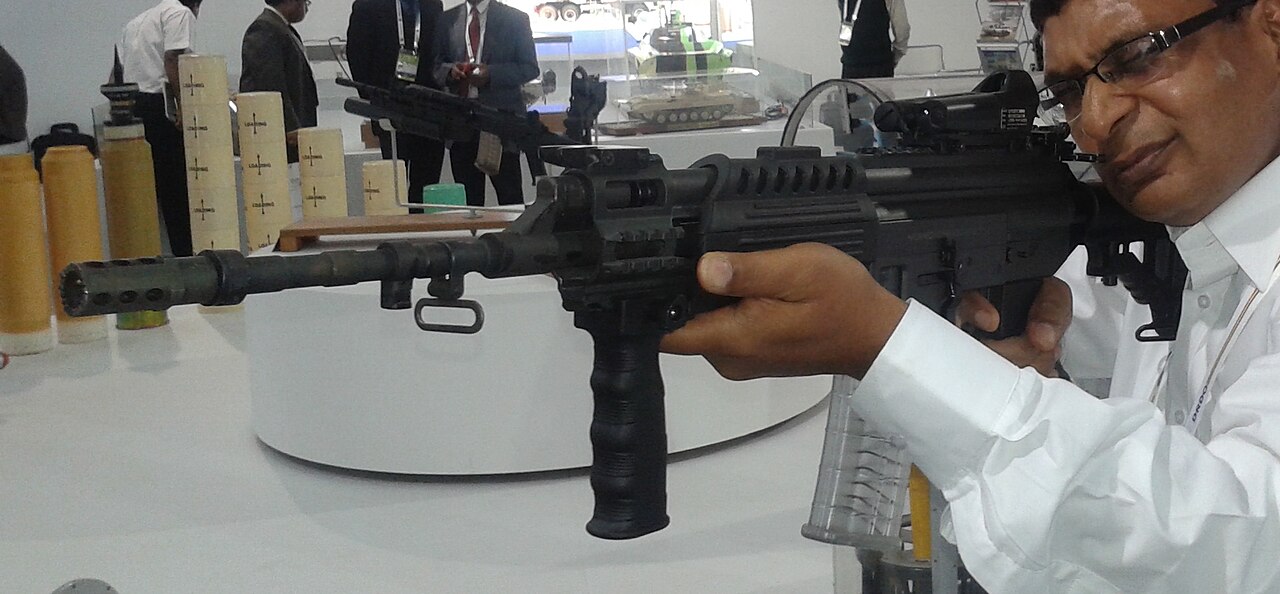
The Multi Caliber Individual Weapon System (MCIWS) is an Indian assault rifle developed by the Armament Research and Development Establishment, a laboratory under the Defence Research and Development Organisation. It debuted at the DEFEXPO 2014 exhibition. By 2015, it was also referred to as the Advanced Automatic Rifle (AAR) and the F-INSAS rifle.
The Indian Army selected an indigenous assault rifle to replace the INSAS rifle, a decision made by former Chief of Army Staff General Dalbir Singh Suhag. This move aimed to save foreign exchange and boost local manufacturing. Three prototype rifles were produced for testing as a potential successor to the INSAS. Interest also came from Indian paramilitary forces, including the Border Security Force, Central Reserve Police Force, Indo-Tibetan Border Police, and Sashastra Seema Bal. A DRDO newsletter from September 18, 2018, stated the MCIWS was ready for serial production. However, in October 2017, the procurement process was superseded by an Army effort to acquire around 700,000 rifles in 7.62mm caliber.
The MCIWS is designed to fire 5.56×45mm NATO, 7.62×39mm, and 6.8mm Remington SPC ammunition. Its design draws influence from both the AR-15 and the FN FNC, while the barrel assembly appears based on the AK-47. Soldiers can reconfigure the rifle for different missions by changing barrels. It uses a gas-operated short stroke piston system and 30-round plastic-type magazines. Ambidextrous features include the charging lever and magazine release. The rifle includes an indigenous under-barrel grenade launcher for airburst-type grenades effective up to 500 meters. Various sights can be mounted on a Picatinny rail on the upper receiver. The rifle is made of aluminium alloy and has a modular, rivet-less design.
Quick Facts
- Origin
- India
- Is Ranged
- Yes
- Design Date
- 2015–present
- Manufacturer
- Armament Research and Development Establishment / Ordnance Factory Tiruchirappalli
- Number
- 6 Preproduction prototypes
- Weight
- 3.5 kg (empty) / 4 kg (loaded with magazine)
- Length
- 910 mm (including butt)
- Cartridge
- 5.56×45mm NATO / 7.62×39mm / 6.8mm Remington SPC
- Action
- Gas-operated, rotating bolt
- Rate
- 600-650 rpm
- Velocity
- 715 -
- Range
- 700 meters
Facts from the source article.
Lore & Background
The Indian Army chose an indigenous assault rifle to replace the INSAS rifle currently in service. The decision, which could save money in foreign exchange and boost local manufacture, was made by the former Chief of Army Staff, General Dalbir Singh Suhag. Several rifles are currently undergoing small arms trials with three prototype rifles made for testing as a future replacement to the INSAS rifle. The MCIWS has also found interest with Indian paramilitary forces including the Border Security Force, Central Reserve Police Force, Indo-Tibetan Border Police and the Sashastra Seema Bal.
The MCIWS is configured to fire in 5.56×45mm NATO, 7.62×39mm and in 6.8mm Remington SPC. Its design is influenced by both the AR-15 and the FN FNC. The barrel assembly appears to be based on the AK-47. The design would allow soldiers to configure it according to the needs of the missions by changing rifle barrels. The MCIWS uses a gas-operated short stroke piston design, and uses 30-round plastic-type magazines. The rifle also has ambidextrous features, such as the charging lever and magazine release. The MCIWS includes an indigenous under barrel grenade launcher to fire airburst-type grenades which can take out targets up to 500 meters. Various sights can be mounted on the Picatinny rail on the upper receiver. The rifle is of aluminium alloy and features a modular, rivet-less design.
According to a DRDO September 18, 2018 newsletter, the MCIWS is now ready for serial production. In October 2017, the MCIWS procurement was superseded by an Army process to acquire around 7 lakh 7.62mm calibre rifles.
Reader's Guide
The Multi Caliber Individual Weapon System represents India's effort to develop an indigenous replacement for the INSAS rifle, driven by the goal of saving foreign exchange and boosting local manufacture. Its notable feature is the ability to fire three different calibers—5.56×45mm NATO, 7.62×39mm, and 6.8mm Remington SPC—by changing the barrel, allowing soldiers to adapt the rifle to mission requirements. The design draws from the AR-15 and FN FNC, with a barrel assembly resembling the AK-47. The rifle incorporates ambidextrous controls and a Picatinny rail for mounting sights, along with an indigenous under barrel grenade launcher capable of engaging targets up to 500 meters. Despite interest from paramilitary forces and a 2018 announcement that the rifle was ready for serial production, its procurement was superseded in October 2017 by an Army process to acquire around 700,000 7.62mm calibre rifles, leaving the MCIWS's role in Indian service uncertain.
Did You Know?
- The MCIWS was first seen at the DEFEXPO 2014 exhibition.
- It is also known as the Advanced Automatic Rifle (AAR) and the F-INSAS rifle as of 2015.
- Its under barrel grenade launcher fires airburst-type grenades effective up to 500 meters.
Program Origins and the Airburst Revolution
The OICW program emerged in the 1980s as a direct successor to the Advanced Combat Rifle initiative, inheriting both its ambition and its pattern of costly, goal-missing development. Its defining ambition was to solve a persistent infantry problem: engaging enemies who had taken position behind cover where conventional rifle fire simply could not reach. The proposed solution was a programmable airburst round—smaller than a standard grenade yet large enough to deliver meaningful fragmentation—fired from a low-velocity cannon integrated with a short assault rifle. The concept leveraged advances in computer technology to allow each round to be preset to detonate above or beside a concealed target, creating a lethal fragment pattern where a bullet could not. The program was structured as a competition, and in the 1990s ATK partnered with Heckler & Koch to emerge as the leading contender. They produced numerous prototypes in the late 1990s, exploring configurations that paired the 20 mm airburst launcher with either a 5.56 mm rifle based on the HK G36 or the MP7 personal defense weapon. Despite ultimately failing to replace the M16 or achieve its original goals, the OICW initiative consumed millions of dollars while generating genuinely innovative weapon concepts that would influence subsequent small-arms development.
The XM29 Prototype and Its Cascading Failures
By the early 2000s, the OICW had crystallized into a specific design designated the XM29, built around the HK CAWS platform using a non-conventional 18.5×76 mm (12-gauge) cartridge. However, the weapon accumulated a cascade of problems that rendered it unsuitable for fielding. It exceeded both weight and cost targets, and the 20 mm High Explosive Air Bursting round failed to demonstrate sufficient lethality during testing. Compounding these issues, the kinetic-energy component was constrained to be short and light, forcing the 5.56×45 mm NATO barrel to a mere 250 mm—far too short to generate the muzzle velocity needed for effective standard infantry use. The resulting package was simultaneously too heavy and too bulky for a soldier to operate effectively in the field. The Army responded by initiating development of alternative weapons and formally shelved the XM29 in 2004. The kinetic-energy portion was redirected into the separate XM8 rifle program, while the airburst capability evolved independently into the XM25, effectively splitting the original combined concept into two distinct weapons.
Three Increments, One Cancellation
The OICW program was eventually restructured into three distinct increments, each addressing a different capability gap. Increment 1 envisioned a complete weapon-system family capable of replacing the M4 carbine, M16 rifle, M249 light machine gun, and even some M9 pistols, with a modular shotgun (the XM26 Lightweight Shotgun System) as an accessory. Other manufacturers argued the goals had shifted enough to justify a fresh competition, with potential challengers including updated M16-based systems, the Steyr AUG, and the FN SCAR. However, in July 2005 the increment was placed on an eight-week hold to gather input from other military services, and by October 31, 2005, it was cancelled outright. The stated rationale was a need to reevaluate small-caliber weapon priorities in light of emerging requirements identified during Operation Enduring Freedom and Operation Iraqi Freedom. Increment 2 focused on the standalone XM25 airburst launcher using larger 25 mm munitions, repositioned as a special-applications support weapon rather than an individual combat rifle. Increment 3 retained the XM29 concept, with the M203 grenade launcher slated for replacement by a combination of Increments 2 and 3.
A Legacy Scattered Across a Dozen Programs
Although the OICW never achieved its primary mission of replacing the M16, its most enduring contribution was the constellation of weapons and technologies it spawned. The kinetic-energy lineage produced the XM8 rifle and, from that program, the M320 40 mm grenade launcher. The airburst lineage gave rise to the XM25 semi-automatic standalone launcher, the XM109 high-velocity anti-materiel rifle, the XM307 Automatic Close Support Weapon, and the XM312 .50 BMG variant. The Mk 47 Mod 0 automatic grenade launcher, capable of firing smart 40 mm airburst rounds, also traces its technology to OICW research. The program's modular philosophy influenced the Land Warrior system and the XM26 Lightweight Shotgun System. Even the 25×40 mm HEAB ammunition tested under the XM1018 designation represented a genuine leap in small-arms munition design. In this sense, the OICW's failure as a single unified weapon was paradoxically its greatest success: it distributed its innovations across multiple programs, ensuring that the airburst concept and programmable-munition technology continued to evolve in forms that better matched actual infantry needs.
Gallery
Frequently Asked Questions
What is the Multi Caliber Individual Weapon System (MCIWS)?
The MCIWS is an Indian assault rifle engineered by the Armament Research and Development Establishment, a lab operating under DRDO. It is built around a modular, rivet-less chassis and was first publicly displayed at the DEFEXPO 2014 trade show.
Which calibers can the MCIWS chamber?
The rifle is designed to accept three different cartridges: 5.56×45mm NATO, 7.62×39mm, and 6.8mm Remington SPC. This multi-caliber flexibility is the core idea behind its name.
How does the MCIWS function and what are its standout features?
It cycles via a gas-operated short-stroke piston and feeds from 30-round polymer magazines. Ergonomic and accessory options include an ambidextrous charging lever and magazine release, a full-length Picatinny rail, and an under-barrel grenade launcher.
Why did the Indian Army develop the MCIWS in the first place?
Under then Chief of Army Staff General Dalbir Singh Suhag, the Army decided to replace the aging INSAS rifle with a home-grown alternative. The stated goals were to cut foreign-exchange outlays and push domestic small-arms manufacturing forward.
What other names has the MCIWS gone by?
By 2015 the same platform was also being called the Advanced Automatic Rifle (AAR) and the F-INSAS rifle. All three designations point to the single DRDO-developed weapon first shown at DEFEXPO 2014.
More in Assault Rifles, Part 3 1-24
Spotted an error? Know more?
Reader corrections go straight into our review queue. Suggest an edit · How this site is sourced