
AK-63
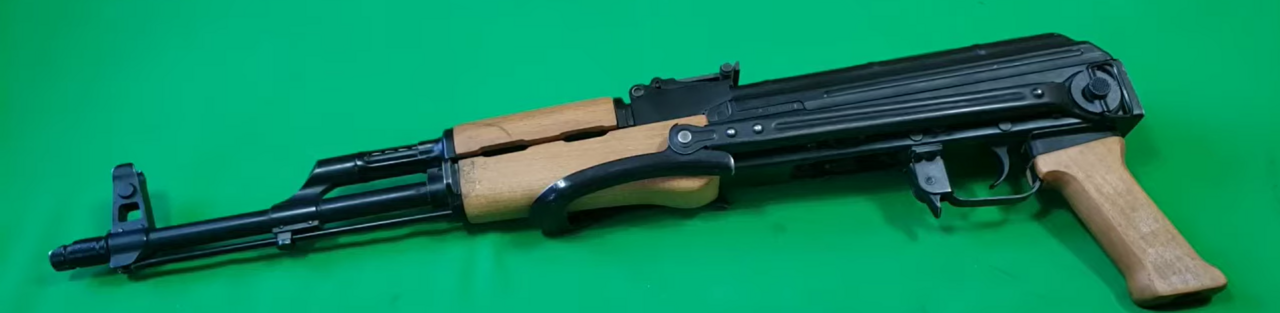
Hungarian AKM variant with distinctive straight pistol grip.
The AK-63 is a Hungarian-made version of the AKM assault rifle, produced by the state-owned Fegyver- és Gépgyár (FÉG). It was widely sold to countries in Eastern Europe, the Middle East, Africa, and South America during and after the Cold War.
The Hungarian military adopted the AK-63 in late 1977 as a cheaper alternative to the AMD-65, which was costly to produce and had fragile forward grips. A folding-stock variant, the AK-63D, was added to the catalog in 1978, at which point the fixed-stock model became known as the AK-63F. All AK-63s in Hungarian service are scheduled to be replaced by 2030.
Externally, the AK-63F and AK-63D closely resemble the Soviet AKM and AKMS. The main difference is the AK-63’s straight pistol grip, inherited from the earlier AKM-63. The handguard lacks the palm swells found on Soviet AKMs, and the bolt carrier does not have the stepped lightening cut, though the gas tube retains its relief ports. The wood furniture has a bright, laminated blond finish.
Variants include the AK-63F (fixed stock, designated AMM in Hungarian service), the AK-63D (under-folding steel stock, designated AMMS), the modernized AK-63MA (unveiled in 2013), and two semi-automatic models for the US civilian market: the SA-85M (imported by Kassnar, with about 7,000 pre-ban units now considered collectible) and the SA-85S (thumbhole stock, around 24,500 imported from 1990 to 1994). The SA-2000S was a Federal Assault Weapons Ban-era version with a single-stack magazine, sold only in the US.
The AK-63 is the main service rifle of the Hungarian Defence Forces, set to be replaced by the CZ BREN 2. Other users include Iran (likely captured Iraqi rifles), India (being phased out for the AK-203), Iraq, Nicaragua, Somalia, and Zambia. Former users include Croatia, which used it during the Croatian War of Independence. Non-state users have included the Farabundo Martí National Liberation Front, the Islamic State, the Kurdistan Workers’ Party, the Sandinista National Liberation Front, and the Women’s Protection Units.
Quick Facts
- Origin
- Hungarian People's Republic
- Is Ranged
- yes
- Service
- 1977–present
- Wars
- Iran–Iraq War / Lebanese Civil War / Sri Lankan Civil War / Somalian Civil War / Gulf War / Yugoslav Wars / Iraq War / Syrian Civil War / War in Iraq (2013–2017)
- Design Date
- 1977
- Manufacturer
- Fegyver- és Gépgyár
- Production Date
- 1977–2001
- Weight
- 7.9 lbs (3.6 kg)
- Length
- 34.6 in (88 cm)
- Part Length
- 16.3 in (41.5 cm)
- Cartridge
- 7.62×39mm
- Caliber
- 7.62mm
Facts from the source article.
Lore & Background
Although the AMD-65 had been the Hungarian service rifle since 1965, it was more expensive to build, and the forward grips had a reputation for being easily damaged in the field. In the late-1970s, the Hungarian Defense Ministry requested that FÉG manufacture a cheaper rifle based on the more traditional Soviet AKM design. By the end of 1977, the AK-63 was adopted by the Hungarian People's Army (beginning with the Ground Forces). In 1978, FÉG added a folding stock AKMS version of the AK-63 to their catalogue; thereafter, the fixed-stock AK-63 became known as the AK-63F (Wooden Stock) and the folding-stock version was designated AK-63D (Descent). All AK-63s in Hungarian military service are expected to be replaced by 2030.
The AK-63 F and D (AMM and AMMS) are both nearly identical externally to the USSR-manufactured AKM and AKMS. The main difference is that the AK-63 series retains the distinctive-looking straight pistol grip of the AKM-63. The forward hand grip of the AK-63 also lacks the palm swells which characterize the Soviet AKM (and most AKM copies made in many other countries). The stepped lightening cut on the bolt carrier is absent and retains the relief ports on the gas tube. The wood on the AK-63, like that of the AKM-63, has a bright, laminated blond finish.
Reader's Guide
The AK-63 represents Hungary's pragmatic shift from the more expensive AMD-65 to a cost-effective, traditional AKM pattern. Its adoption in 1977 standardized a cheaper service rifle for the Hungarian People's Army while retaining the distinctive straight pistol grip of earlier Hungarian Kalashnikov variants. The series saw wide export during and after the Cold War to nations in Eastern Europe, the Middle East, Africa, and South America, including Iraq, Iran, India, Nicaragua, Somalia, and Zambia. Non-state users such as the Farabundo Marti National Liberation Front, Islamic State, Kurdistan Workers' Party, Sandinista National Liberation Front, and Women's Protection Units have also employed the AK-63. The semi-automatic SA-85M, imported to the United States by Kassnar of Harrisburg, PA, became a collector's item with around 7,000 pre-ban examples imported before 1989. The AK-63 remains the main service rifle of the Hungarian Defence Forces, though it is slated for replacement by the CZ BREN 2 by 2030. Its legacy is that of a widely distributed, no-frills AKM derivative that served multiple state and non-state actors across several continents.
Did You Know?
- The AK-63F is designated AMM (Automata Kalasnyikov Modernizált Magyarosított) in Hungarian service.
- Around 7,000 pre-ban SA-85M semi-automatic versions were imported to the US before 1989.
- The AK-63 series is expected to be replaced in Hungarian service by 2030.
From AMD-65 to AK-63: A Cost-Driven Rebirth
For over a decade, Hungary's armed forces relied on the AMD-65, a domestically designed assault rifle adopted in 1965. However, two persistent problems plagued the platform: its production costs were notably higher than alternatives, and its forward grips earned a poor reputation for being fragile under field conditions. By the late 1970s, the Hungarian Defense Ministry grew impatient with these drawbacks and turned to the state-owned Fegyver- és Gépgyár (FÉG) plant with a straightforward directive—produce a more economical rifle built around the battle-proven Soviet AKM architecture. FÉG delivered quickly. By the close of 1977, the Hungarian People's Army had formally adopted the new weapon, rolling it out first to its Ground Forces. The following year, FÉG expanded the line with a folding-stock iteration, prompting a nomenclature split: the fixed-stock model became the AK-63F (the F standing for the wooden stock), while the collapsible-steel-stock variant took the designation AK-63D (from Descent). Today, every AK-63 still in Hungarian military inventory is slated for retirement by 2030, when the CZ BREN 2 is expected to take its place.
A Familiar Face with Hungarian Fingers
To the untrained eye, an AK-63 sits on the shelf almost indistinguishable from a Soviet AKM or AKMS. Yet several subtle mechanical and cosmetic choices set the Hungarian-made rifle apart. The most immediately visible trait is the pistol grip: rather than the slightly curved profile found on most AKM copies, the AK-63 preserves the straighter, more angular grip inherited from Hungary's earlier AKM-63. The forward handguard also omits the rounded palm swells that characterize the Soviet original and many international clones. Inside the receiver, the bolt carrier lacks the stepped lightening cut present on standard AKMs, and the gas tube retains its relief ports—a detail shared with the AKM-63. Perhaps the most distinctive visual signature is the furniture: the wooden components carry a bright, laminated blond finish that gives the rifle a noticeably lighter, warmer appearance compared to the darker walnut tones typical of Soviet production. Together, these small deviations make the AK-63 a recognizable member of the Kalashnikov family while quietly asserting its own Hungarian identity.
From Military Stock to Collector's Shelf
The AK-63 family spans a wide spectrum of configurations. In Hungarian service, the fixed-stock AK-63F carries the designation AMM (Automata Kalasnyikov Modernizált Magyarosított), while the folding-stock AK-63D is known as the AMMS. FÉG unveiled a modernized iteration, the AK-63MA, in 2013, signaling continued investment in the platform. The rifle's civilian legacy in the United States is particularly rich. The SA-85M, a semi-automatic variant imported by Kassnar of Harrisburg, Pennsylvania, saw roughly 7,000 pre-ban units enter the country before 1989; today it is regarded as a sought-after collector's piece commanding premium prices. The SA-85S, featuring a thumbhole stock, was produced between 1990 and 1994, with approximately 24,500 units imported to the US market. Finally, the SA-2000S was designed specifically to comply with the Federal Assault Weapons ban, incorporating a single-stack magazine, and was sold exclusively in the United States. Each variant reflects a different regulatory and commercial era.
A Rifle That Crossed Borders
Beyond Hungary's own borders, the AK-63 found a remarkably wide audience during and after the Cold War, with exports reaching across Eastern Europe, the Middle East, Africa, and South America. In Hungary itself it served as the primary assault rifle of the Defence Forces until its planned replacement by the CZ BREN 2. In Iran, rifles most likely captured from Iraqi stockpiles ended up in the hands of the Revolutionary Guards. India once fielded the weapon before phasing it out in favor of the AK-203. Other documented users include Iraq, Nicaragua, Somalia, and Zambia. The AK-63 also saw combat in Croatia's War of Independence. Its reach extended well beyond state militaries: the Farabundo Martí National Liberation Front in El Salvador, the Sandinista National Liberation Front in Nicaragua, the Kurdistan Workers' Party, the Islamic State, and the Women's Protection Units all reportedly employed the rifle. This global footprint—spanning conventional armies, insurgent groups, and revolutionary movements—underscores how a cost-driven Hungarian design decision in the late 1970s produced a weapon with an outsized international presence.
Gallery
Frequently Asked Questions
What is the AK-63?
The AK-63 is a Hungarian assault rifle produced by the state-owned FÉG arms plant as a domestic reinterpretation of the AKM platform. It entered Hungarian military service in 1977 and was subsequently exported to countries across Eastern Europe, the Middle East, Africa, and South America.
How does the AK-63 differ from a standard AKM?
Its most immediately recognizable trait is a straight pistol grip, unlike the curved grip typical of Soviet-produced AKMs. It was also conceived as a lower-cost alternative to Hungary's own AMD-65, which suffered from expensive manufacturing and a fragile forward grip.
What variants of the AK-63 exist?
The fixed-stock model is designated AK-63F, while the folding-stock version, the AK-63D, joined the lineup in 1978. A modernized AK-63MA appeared in 2013, and the platform also gave rise to the SA-85M, SA-85S, and SA-2000S export configurations.
Which countries operated the AK-63?
In addition to Hungary, the rifle was fielded by Iran, India, Iraq, Nicaragua, Somalia, and Zambia. It proved popular among Cold War–era buyers seeking a reliable, affordable small arm outside the Soviet supply chain.
How many AK-63-pattern rifles were imported into the United States?
Approximately 7,000 SA-85M rifles entered the U.S. market before the 1989 import ban, followed by roughly 24,500 SA-85S units between 1990 and 1994. Those two import windows made the AK-63 family one of the more prevalent non-Soviet AK-pattern rifles in American civilian hands.
More in Assault Rifles, Part 3 1-24
Spotted an error? Know more?
Reader corrections go straight into our review queue. Suggest an edit · How this site is sourced