
AK-47
The originating firearm of the Kalashnikov family of rifles.
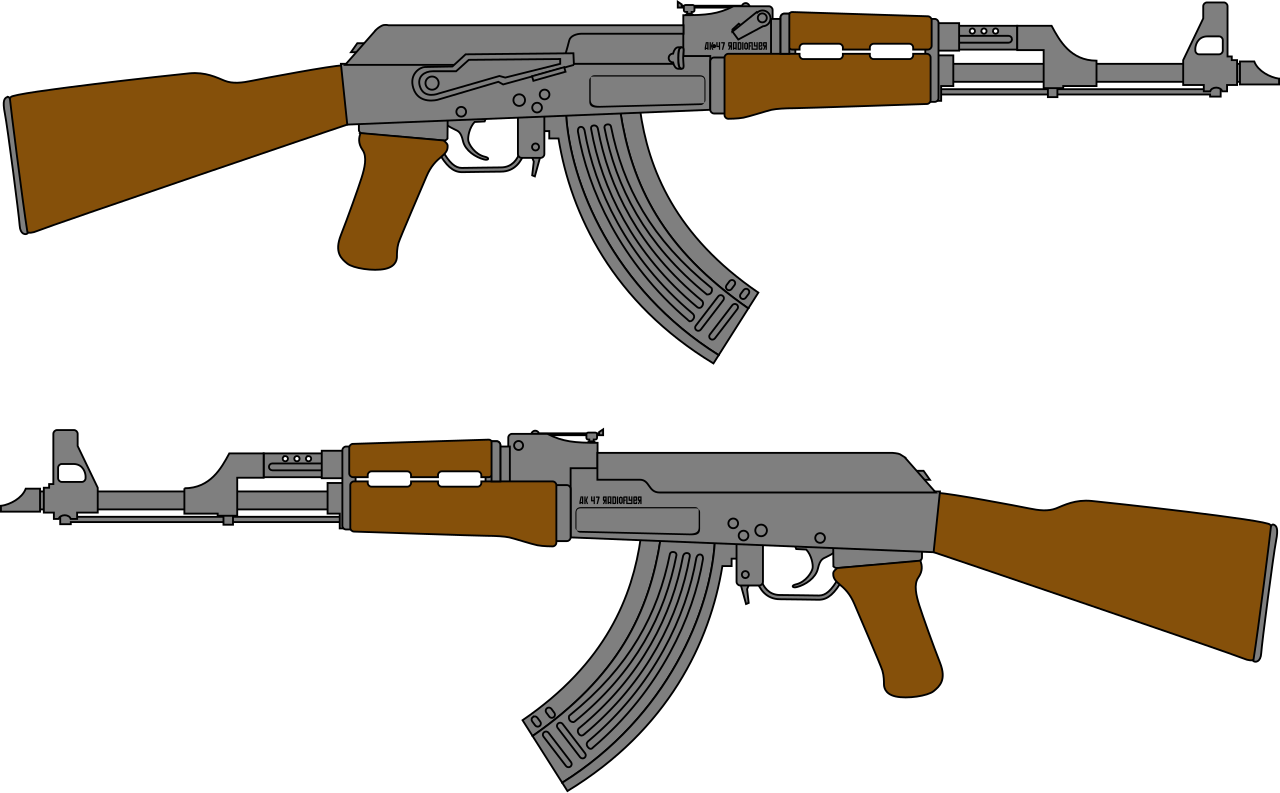
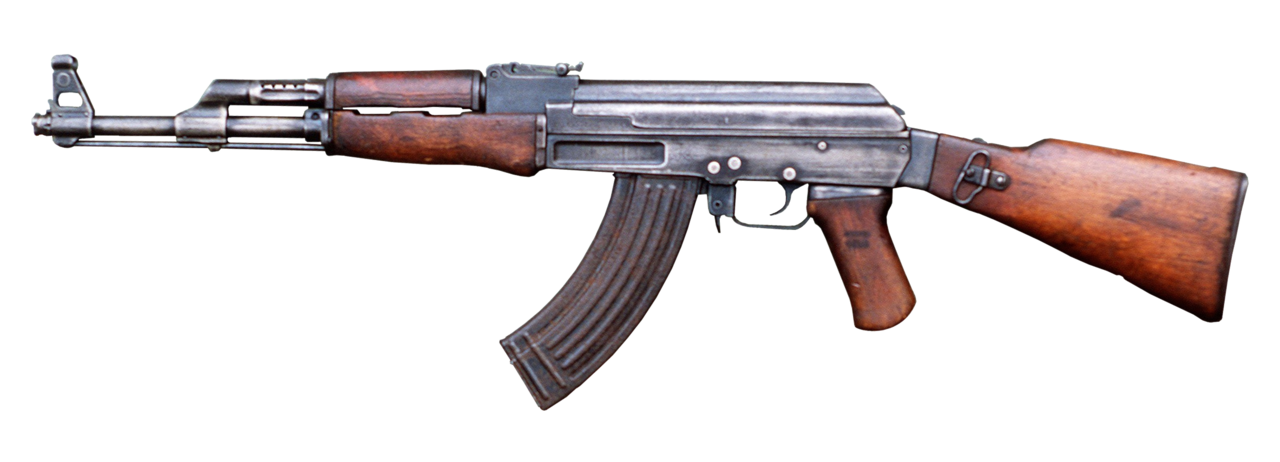
The AK-47, officially known as the Avtomat Kalashnikova (Russian: Автомат Калашникова, lit. 'Kalashnikov's automatic'), is a Soviet assault rifle chambered for the 7.62×39mm cartridge. Developed by Mikhail Kalashnikov, it is the originating firearm of the Kalashnikov family of rifles and, after more than seven decades, remains one of the most popular and widely used firearms in the world.
Quick Facts
- Origin
- Soviet Union
- Is Ranged
- Yes
- Service
- 1949–1974 (Soviet Union) / 1949–present (other countries)
- Designer
- Mikhail Kalashnikov
- Manufacturer
- Fabryka Broni Radom, Kalashnikov Concern, Norinco, and Zastava Arms
- Production Date
- 1948–present
- Number
- ~75 million / ~100 million Kalashnikov–style rifles
- Spec Label
- AK-47 with Type 3 receiver
- Part Length
- Overall length: / 415 mm / Rifled bore length: / 369 mm
- Cartridge
- 7.62×39mm
Facts from the source article.
Lore & Background
Design work on the AK-47 began in 1945. It was presented for official military trials in 1947, and in 1948 the fixed-stock version was introduced into active service for selected units of the Soviet Army. In early 1949, the AK was officially accepted by the Soviet Armed Forces and used by the majority of the member states of the Warsaw Pact. The model and its variants owe their global popularity to their reliability under harsh conditions, low production cost, availability in virtually every geographic region, and ease of use.
Mikhail Kalashnikov began his career as a weapon designer in 1941 while recuperating from a shoulder wound received during the Battle of Bryansk. He stated that he designed the weapon after a fellow soldier asked why Soviet soldiers had only one rifle for two or three men while the Germans had automatics. The AK-47 is best described as a hybrid of previous rifle technology innovations, combining features of the American M1 Garand and the German StG 44. Some claimed that Kalashnikov copied designs like Bulkin's TKB-415 or Simonov's AVS-31.
Early prototypes (also known as the AK-46) had a rotating bolt, a two-part receiver, dual controls, and a non-reciprocating charging handle on the left side. In late 1946, assistant Aleksandr Zaitsev suggested a major redesign to improve reliability. The November 1947 prototypes used a long-stroke gas piston, combined the upper and lower receivers into a single receiver, and combined the selector and safety into a single control lever on the right side. The first production models had stamped sheet metal receivers, but difficulties led to a heavy machined receiver being substituted; these milled rifles started production in 1951 and are known as 'Type 2 AK-47'.
Reader's Guide
The AK-47 and its variants have been manufactured in many countries and have seen service with armed forces as well as irregular forces and insurgencies throughout the world. As of 2004, of the estimated 500 million firearms worldwide, approximately 100 million belong to the Kalashnikov family, three-quarters of which are AK-47s. The model is the basis for the development of many other types of individual, crew-served, and specialized firearms.
Introduced in 1959, the AKM is a lighter stamped steel version and the most ubiquitous variant of the entire AK series. Most licensed and unlicensed productions of the Kalashnikov assault rifle abroad were of the AKM variant, partially due to the much easier production of the stamped receiver. This model is the most commonly encountered, having been produced in much greater quantities. In the 1960s, the Soviets introduced the RPK light machine gun, an AK-type weapon with a stronger receiver, a longer heavy barrel, and a bipod, that eventually replaced the RPD light machine gun.
The AK-47's design simplified production and proved reliable under a wide range of conditions with convenient handling characteristics. The weapon's global spread and enduring use stem from its combination of reliability, low cost, and ease of use, making it a foundational design in small arms.
Did You Know?
- The AK-47 was developed by Mikhail Kalashnikov after he was wounded at the Battle of Bryansk in 1941.
- As of 2004, approximately 100 million firearms of the Kalashnikov family existed, three-quarters of which were AK-47s.
A Strategic Partnership Forged in 2019
The AK-203 emerged from a broader geopolitical and industrial partnership between India and Russia. In 2019, the two nations formalized their cooperation through an Inter-Governmental Agreement, with Indian Prime Minister Narendra Modi personally inaugurating the Indo-Russia Rifles facility in Korwa, Uttar Pradesh. The joint venture brought together India's Ordnance Factory Board alongside Russia's Rosoboronexport and Kalashnikov Concern, all operating under the umbrella of Rostec. At the time of signing, production of 750,000 rifles had already received approval. The structure of the venture—50.5% Indian ownership and 49.5% Russian—reflected a deliberate balance of sovereignty and expertise. The facility at Korwa Ordnance Factory spans 8.5 acres, housing the manufacturing operations of Indo-Russia Rifles Private Limited. This arrangement was not merely a procurement deal; it was a technology-transfer framework designed to eventually make India fully self-sufficient in producing its next-generation assault rifle, marking a significant shift in the country's defense manufacturing philosophy.
Engineering Under the Hood
The AK-203 is a gas-operated rifle chambered for the 7.62×39mm cartridge, utilizing standard AK-type magazines. Its physical profile is compact yet functional: 3.8 kg in weight, with a folded-stock length of 690 mm and an extended length of 930 mm. The weapon fires at a cyclic rate of 700 rounds per minute. Structurally, each rifle comprises 50 primary components and 180 sub-components, and is rated to endure at least 15,000 rounds over its service life. A birdcage-style muzzle brake handles both recoil management and flash suppression. However, the polymer front housing with its free-floating case design drew criticism in combat footage from the Russo-Ukraine conflict, where operators reportedly found it awkward to grip under fire. This design choice, while modern in material, raised practical handling questions that contrast with the simpler steel furniture of earlier Kalashnikov variants. The rifle represents a bridge between the proven AK architecture and contemporary manufacturing expectations.
The Long Road to Indigenisation
The path from agreement to full domestic production was neither smooth nor quick. Originally slated to begin in May 2020, manufacturing was pushed back due to pricing disputes—domestically produced rifles would initially cost 20–25% more than imported units. The COVID-19 pandemic then froze negotiations entirely, as travel restrictions prevented the submission of a competitive commercial bid. In December 2021, India signed a contract worth approximately ₹5,124 crore for 601,427 rifles, with the first 70,000 batch carrying 70% indigenous content and the remainder targeting 100%. The technology transfer was massive: Russia delivered 90,000 pages of technical documentation in three phases by mid 2024. Indian engineers then had to convert Russian military standards to Indian equivalents, absorb 120 distinct manufacturing processes, and indigenise 1,600 precision gauges of Russian origin. By July 2024, 60 critical components were already sourced from vendors across India before final assembly and testing.
Sher and the Future of Indian Infantry
The AK-203 holds a unique place in Indian military history as the fourth-generation standard-issue rifle for the Army's infantry, following the Lee-Enfield .303, the L1A1, and the INSAS. During the transitional period in the 1980s, when the L1A1 was aging and the INSAS was still in development, India had relied on captured Soviet AK-47s, Czech Vz. 58s, and Bulgarian AR-M1s. Now, with the INSAS being phased out, the AK-203—soon to be rebranded as Sher—will anchor the infantry's small-arms inventory. Once fully indigenised, production is expected to reach 12,000 units per month, roughly one rifle every 100 seconds, or about 150,000 annually. Deliveries are projected to complete by December 2030, ahead of the October 2032 contract deadline. The Korwa facility, which employed 260 staff in early operations, is set to expand to 537 personnel, 90% of them Indian, with full testing authority transferred domestically.
Gallery

Frequently Asked Questions
Who is AK-47?
The AK-47, formally designated the Avtomat Kalashnikova 1947, is a Soviet assault rifle designed by Mikhail Kalashnikov. It is the founding member of the entire Kalashnikov rifle family.
What are AK-47's powers/role?
Chambered for the 7.62×39mm cartridge, the AK-47 is a selective-fire infantry rifle prized for its ruggedness and ease of maintenance. Its role has been as a standard-issue combat weapon adopted by dozens of militaries and insurgent groups worldwide.
Why is AK-47 important?
It is consistently cited as one of the most popular and widely produced firearms in history. As the originating design of the Kalashnikov lineage, it established the template that every subsequent variant builds upon.
When did AK-47 enter service?
Kalashnikov began developing the design in 1945, the rifle passed official Soviet military trials in 1947, and it was formally introduced into active service in 1948.
More in Assault Rifles, Part 3 1-24
Spotted an error? Know more?
Reader corrections go straight into our review queue. Suggest an edit · How this site is sourced