
AK-104
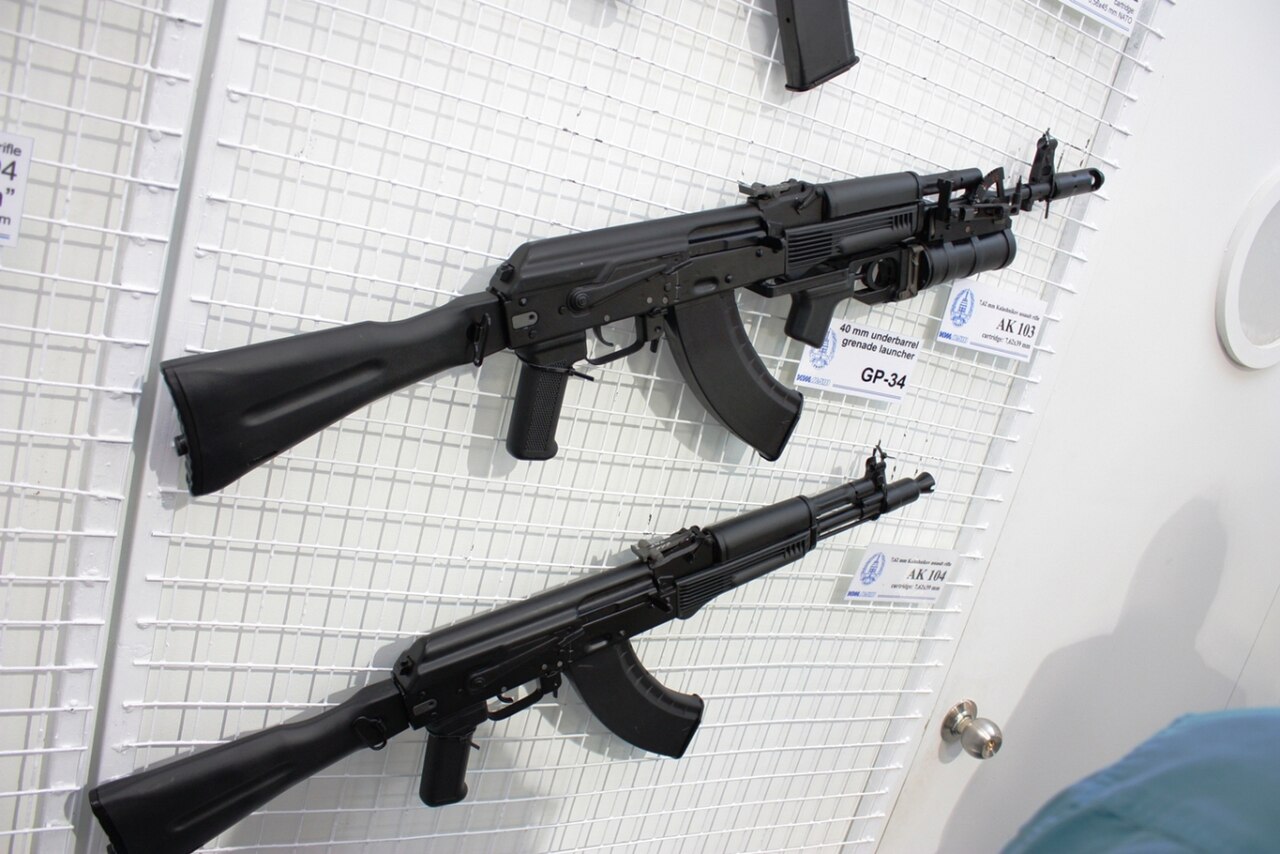
Compact carbine variant of the AK-103 with side-folding polymer stock.
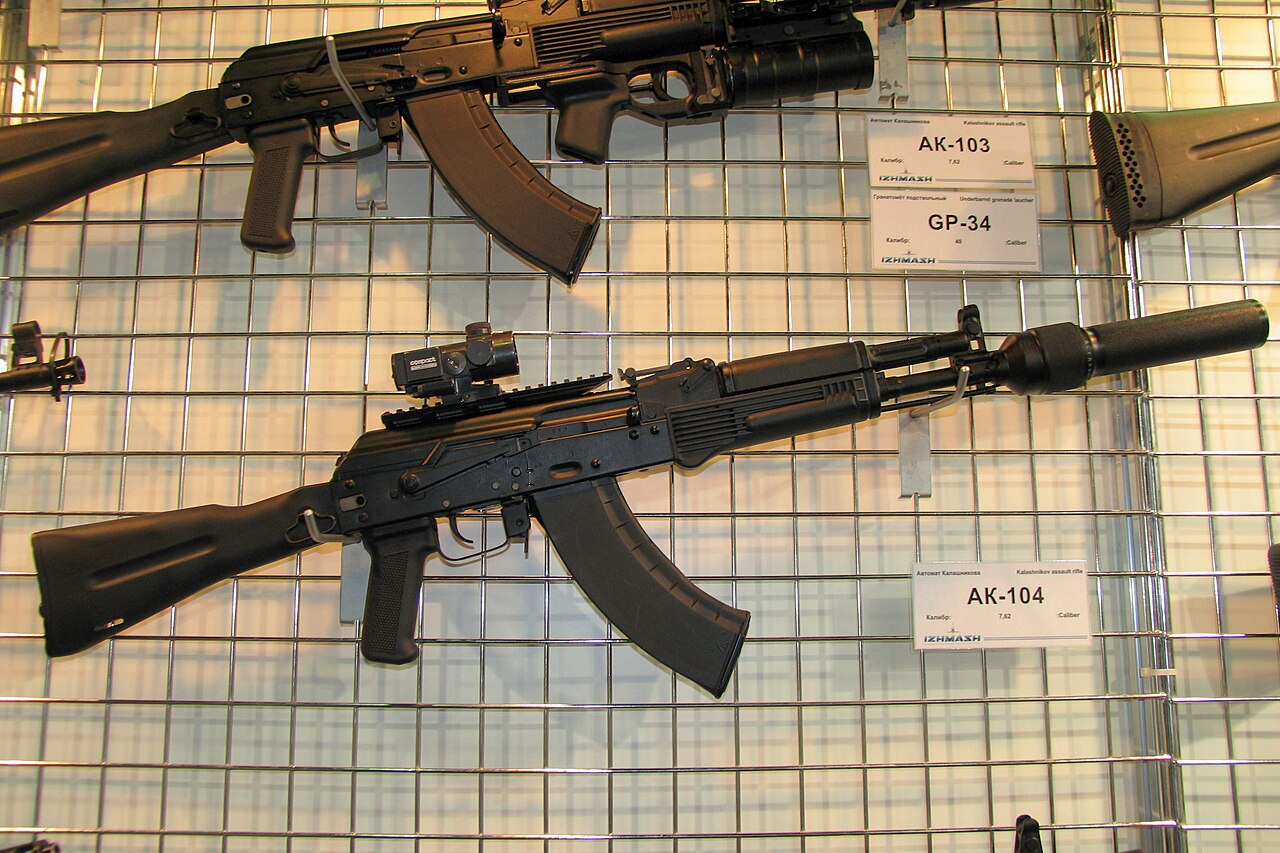
The AK-104 is a carbine variant of the AK-103 chambered in 7.62×39mm. It feeds from any standard 7.62×39 AK pattern magazine and is part of the AK-100 series of rifles. The AK-104 is notable for its compact dimensions and solid, side-folding polymer stock, which distinguishes it from the shorter, skeleton-stocked AKS-74U.
Quick Facts
- Origin
- Russia
- Is Ranged
- Yes
- Service
- 2001–present
- Wars
- Syrian Civil War
- Designer
- Mikhail Kalashnikov
- Design Date
- 1994
- Manufacturer
- Kalashnikov Concern
- Weight
- 3.0 kg empty / 3.2 kg with empty magazine / 3.7 kg with loaded magazine
- Length
- 824 mm with stock extended / 586 mm with stock folded
- Part Length
- 314 mm
- Cartridge
- 7.62×39mm
- Action
- Gas-actuated, rotating bolt
Facts from the source article.
Lore & Background
The AK-104 is a carbine in the AK-100 series, sharing the same dimensions as other carbines in that series. It features a solid, side-folding polymer stock, unlike the shorter, skeleton-stocked AKS-74U. The rifle uses an adjustable notched rear tangent iron sight calibrated in 100 m increments from 100 to 500 m, with a front post adjustable for elevation in the field; horizontal adjustment is done by the armory before issue. The AK-104 has a muzzle booster derived from the AKS-74U. Protective coatings ensure corrosion resistance of metal parts, while the forearm, magazine, butt stock, and pistol grip are made of high-strength plastic.
Variants include the AK-105, a shortened carbine version of the AK-74M with identical barrel lengths; the SLR-107CR, a civilian semi-automatic rifle with a 16-inch extended barrel to comply with U.S. regulations; the PSAK-104, a civilian semi-automatic series duplicating the AK-104 aesthetic; and the KR-104, a short-barreled rifle version by Kalashnikov-USA. Small production examples have been built from demilled parts kits and U.S.-made 922R compliant parts, and a very small number of Saiga rifles built on the AK-104 assembly line in Izhevsk, Russia have been imported and converted to AK-104 configuration.
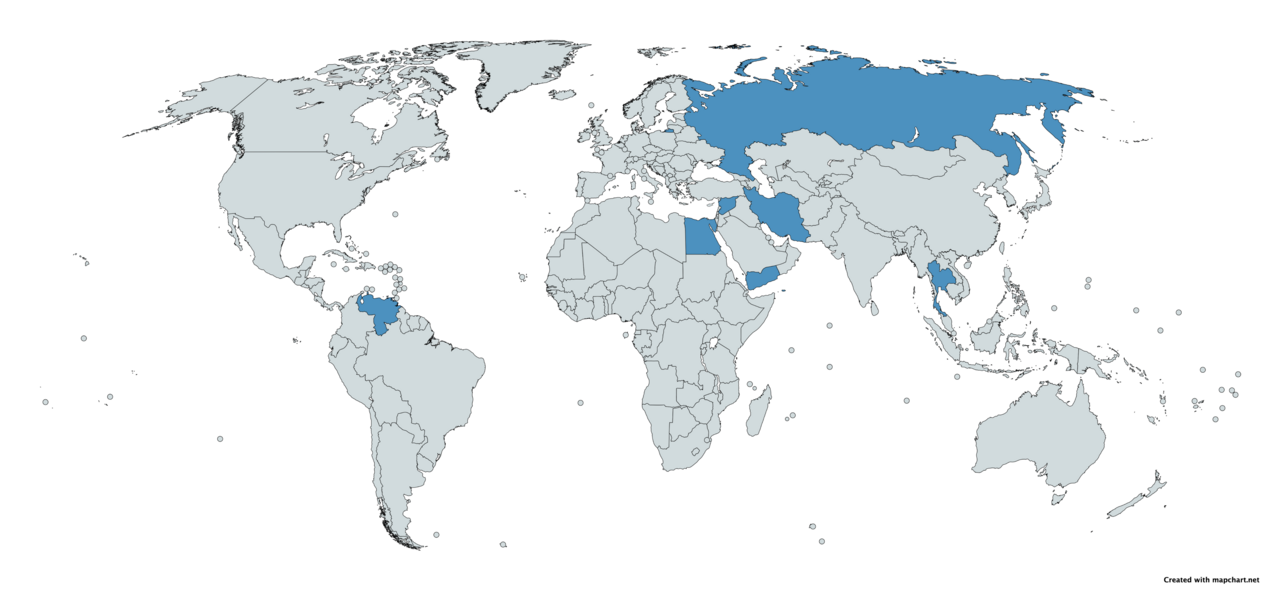
The AK-104 is used by the Russian Federal Protective Service. A batch has reportedly been delivered to Syria's Interior Ministry Anti-Terrorism Syrian Special Mission Forces. Thailand's Directorate of Logistics procured the rifle from the Russian Federation. Venezuela produces it under license by CAVIM alongside the AK-103. It is also in service with some units of the Yemeni Army.
Reader's Guide
The AK-104 represents a compact, modernized carbine within the AK-100 series, offering the 7.62×39mm cartridge in a shorter package with a solid side-folding polymer stock. Its design incorporates a muzzle booster derived from the AKS-74U and protective coatings for corrosion resistance. The rifle's adjustable iron sights and polymer furniture reflect a practical approach to a service carbine. Its adoption by the Russian Federal Protective Service and other military and police units in Syria, Thailand, Venezuela, and Yemen indicates its role as a specialized close-quarters weapon. The existence of civilian variants such as the SLR-107CR, PSAK-104, and KR-104, along with small-production clones built from parts kits, demonstrates the AK-104's influence on the civilian market, particularly in the United States, where import restrictions have led to various semi-automatic adaptations. The AK-104's legacy is tied to its position as a compact, reliable derivative of the AK-103, serving both military and civilian users.
Did You Know?
- The AK-104 uses a muzzle booster derived from the AKS-74U.
- Venezuela produces the AK-104 under license by CAVIM alongside the AK-103.
Design & Engineering Philosophy
The AK-105 occupies a deliberate middle ground within the AK-100 family, sitting between full-length assault rifles such as the AK-74M, AK-101, and AK-103 and the ultra-compact AKS-74U. Its defining trait is a 310-millimeter barrel—roughly twelve and a half inches—paired with a solid, side-folding polymer stock that lets the weapon collapse for transport or airborne insertion while still offering a stable firing platform when extended. Notably, the carbine can still be fired with the stock folded. All exterior furniture, including the pistol grip, magazines, and forward handguard, is molded from high-strength polymer, giving the rifle a cohesive, modern silhouette. The rear sight is an adjustable U-notch tangent calibrated in one-hundred-meter increments out to five hundred meters, while the front post permits field elevation adjustments; windage is set by the armory before the weapon reaches its user. A muzzle booster inherited from the AKS-74U channels escaping propellant gases to tame recoil and steady full-auto bursts. Corrosion-resistant coatings shield the metal surfaces, and the overall construction prioritizes durability in demanding field environments.
Operational Role & Mission Profile
The AK-105 was conceived to fill a specific tactical niche: a carbine long enough to deliver reliable accuracy yet compact enough for soldiers who must move quickly through confined spaces, urban terrain, or airborne drops. It was developed as the successor to the AKS-74U, a much shorter rifle with an 8.1-inch barrel and a skeleton stock, though both weapons remain in service side by side. The Russian Army is the primary domestic user, and the carbine's folding stock makes it particularly well suited to paratrooper operations, where space inside a transport aircraft is at a premium. Even with the stock collapsed, the rifle retains a workable firing position, giving operators flexibility in close-quarters scenarios. The 5.45×39mm cartridge provides a balance of manageable recoil and effective terminal performance at the ranges the carbine is expected to engage. In Brazil, the military and law enforcement have specifically chosen the AK-105 for urban policing and counter-narcotics missions, underscoring how its compact profile and controllable automatic fire make it a practical tool for operators who cannot carry a full-length rifle.
Global Footprint & Unlicensed Copies
Although the AK-105 is primarily a Russian domestic weapon, its service list stretches across several continents and political systems. In the post-Soviet space, Armenia and Kazakhstan have adopted it as a standard-issue carbine, while Azerbaijan's State Border Service fields the rifle for perimeter-security duties. Namibia's Marine Corps has also incorporated the AK-105 into its arsenal. Perhaps the most striking example of the design's influence is North Korea, where an unlicensed local copy designated the Type 88 carbine has been produced for Special Operations Forces and armored-vehicle crews—a testament to the platform's mechanical simplicity and the difficulty of keeping its design secrets contained. In the Middle East, elements of Syrian special forces have made use of the carbine. Within Russia itself, beyond the Army, the Ministry of Internal Affairs and the FSB's elite Alpha Group have drawn on the AK-105 for close-protection and counter-terrorism duties. The breadth of this user base, from border guards to special-operations operators, speaks to the rifle's versatility and the wide appeal of a compact, polymer-bodied AK-platform weapon.
Manufacturing & the AK-100 Family
The AK-105 is manufactured at the Izhmash factories in Izhevsk, Russia, the historic heart of the Kalashnikov design lineage. It occupies a defined slot within the broader AK-100 family, which also includes full-length variants such as the AK-74M, AK-101, and AK-103, all sharing a common design philosophy but differing in barrel length, stock configuration, and intended role. The carbine's production emphasizes low-maintenance reliability: metal surfaces are treated with protective coatings designed to deliver outstanding corrosion resistance, while the forearm, magazine, butt stock, and pistol grip are all fabricated from high-strength plastic, reducing the number of separate metal parts that could corrode or require frequent lubrication. This material choice also keeps the weapon relatively light, an important consideration for a carbine meant to be carried by infantry in extended field operations or by special-operations teams on multi-day missions. The 5.45×39mm chambering ties the AK-105 to the same ammunition ecosystem as its longer siblings, simplifying logistics for units that mix carbine and rifle teams.
Gallery
Frequently Asked Questions
What is the AK-104?
The AK-104 is a compact carbine built as a shorter variant of the AK-103, sitting within the broader AK-100 family of rifles. It is chambered in 7.62×39mm and accepts any standard AK-pattern magazine of that caliber.
What stock does the AK-104 use and why does it matter?
It features a solid, side-folding polymer stock rather than a wire or skeleton frame. This gives the rifle a sturdier feel when shouldered and sets it apart from the much lighter, skeleton-stocked AKS-74U.
How long is the AK-104 barrel?
The barrel measures 314 mm, or roughly 12.4 inches, making it a true carbine-length platform. Its iron-sight radius is adjustable in 100-meter increments up to 500 meters.
What muzzle device does the AK-104 carry?
It uses a muzzle booster that was carried over from the AKS-74U design. This keeps the gas system and overall profile consistent with the shorter AK carbine lineage.
How does the AK-104 differ from the AKS-74U?
While both are compact carbines, the AK-104 pairs its 7.62×39mm chambering with a solid polymer side-folding stock, whereas the AKS-74U relies on a slimmer skeleton stock. The AK-104 also belongs to the newer AK-100 series rather than the older 74-family.
More in Assault Rifles, Part 3 1-24
Spotted an error? Know more?
Reader corrections go straight into our review queue. Suggest an edit · How this site is sourced