
AK-103
Export derivative of the AK-74M chambered in 7.62×39mm.
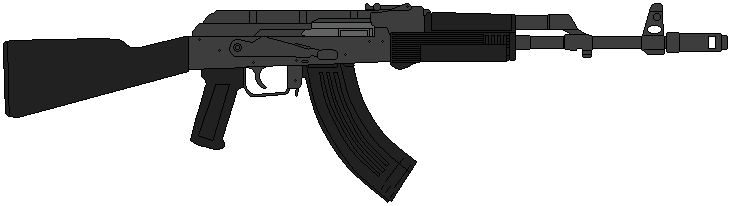
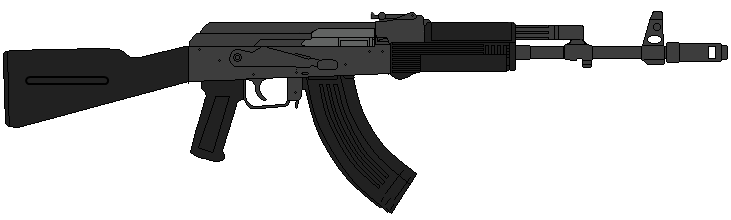
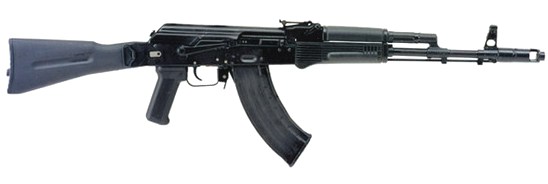
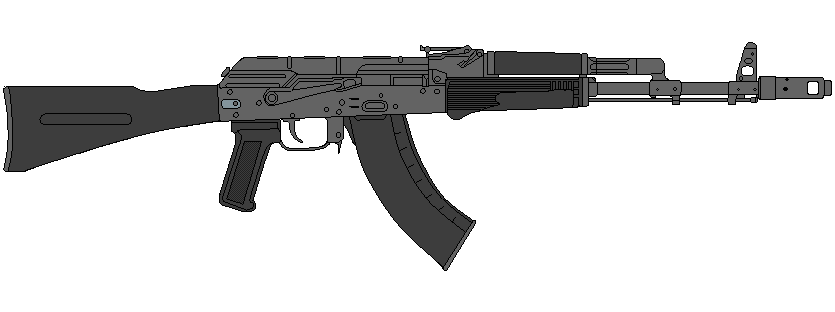
The AK-103 is a Russian assault rifle chambered in 7.62×39mm, designed by Mikhail Kalashnikov as part of the export-oriented AK-100 family. It is a derivative of the AK-74M, adapted to fire the 7.62×39mm M43 cartridge, similar to the earlier AKM.
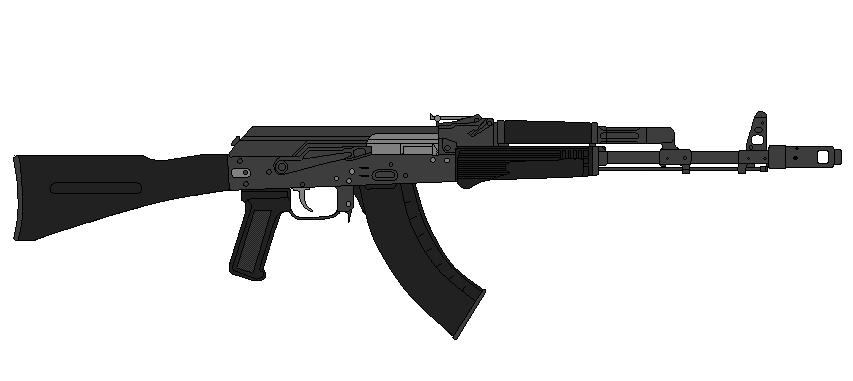
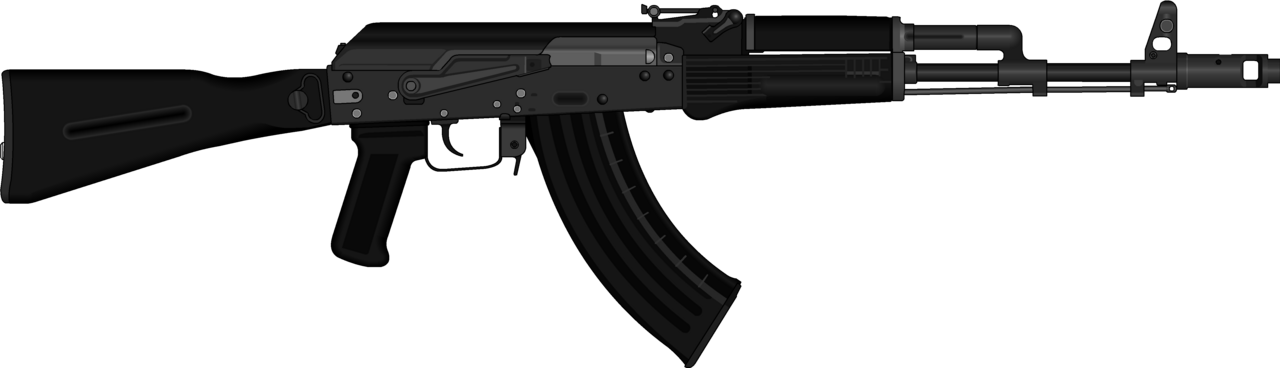
Officially offered for export on March 13, 1993, the AK-103 accepts various sights, including night vision and telescopic optics, and can mount a knife-bayonet or a GP-34 grenade launcher. Newer versions feature Picatinny rails for additional accessories. The rifle uses high-strength shatterproof plastic for the pistol grip, handguards, folding stock, and sometimes the magazine, replacing wood or metal. Metal parts receive protective coatings against corrosion. The AK-104 is a compact variant with a shorter barrel and a muzzle brake derived from the AKS-74U.
Magazines for the AK-103 include current-issue 30-round steel-reinforced ABS plastic magazines with a matte black finish, weighing 0.25 kg (0.55 lb) empty. Early steel AK-47 magazines are 9.75 inches (248 mm) long, while later ribbed steel AKM and newer plastic 7.62×39mm magazines are about 1 inch (25 mm) shorter. The shift from steel to plastic magazines significantly reduces weight, allowing a soldier to carry more ammunition for the same load. All 7.62×39mm AK magazines are backward compatible with older AK variants.
Variants include the semi-automatic only AK-103-1 and the three-round-burst AK-103-2. The STL-1A (or STL-A1) is another variant. The CS/LR11 is a Chinese clone made by China Jing An Import & Export Corporation (CJAIE), while the SDM AK-103 is a Chinese clone marketed by Sino Defense Manufacturing. The KR-103 is a semi-automatic clone by Kalashnikov USA. The PSA AK-103, a semi-automatic partial clone by Palmetto State Armory, shares many features but uses an AKM-style bolt and carrier.
Quick Facts
- Service
- 2001–present
- Designer
- Mikhail Kalashnikov
- Number
- 250,000+
- Length
- 943 mm stock extended / 705 mm stock folded
- Action
- Gas operated, rotating bolt
- Origin
- Russia
- Is Ranged
- Yes
- Design Date
- 1993
- Manufacturer
- Kalashnikov Concern
- Unit Cost
- Gov. price US$150–160 per unit in 2014
- Production Date
- 1994–present
- Variants
- AK-104
Facts from the source article.
Lore & Background
The AK-103 was officially offered for export on March 13, 1993. It is an AK-100 derivative of the AK-74M that is chambered for the 7.62×39mm M43 cartridge, similar to the AKM. The rifle uses plastic components where possible instead of wood or metal, with such components being the pistol grip, handguards, folding stock and depending on the type, the magazine. Protective coatings provide corrosion resistance for metal parts. The forearm, magazine, butt stock and pistol grip are made of high strength shatterproof plastic.
The AK-103 can be fitted with a variety of sights, including night vision and telescopic sights, plus a knife-bayonet or a grenade launcher like the GP-34. Newer versions can fit Picatinny rails, allowing more accessories to be mounted. The AK-104 is a compact version of the AK-103 chambered for 7.62×39mm ammunition, with a muzzle brake derived from the older AKS-74U combined with a shorter barrel.
The current issue steel-reinforced matte true black nonreflective surface finished 7.62×39mm 30-round magazines, fabricated from ABS plastic weigh 0.25 kg (0.55 lb) empty. Early steel AK-47 magazines are 9.75 in (248 mm) long, and the later ribbed steel AKM and newer plastic 7.62×39mm magazines are about 1 in (25 mm) shorter. The transition from steel to mainly plastic magazines yielded a significant weight reduction and allow a soldier to carry more rounds for the same weight. All 7.62×39mm AK magazines are backwards compatible with older AK variants.
Reader's Guide
The AK-103 represents a modernized export variant of the Kalashnikov platform, combining the proven 7.62×39mm cartridge with the updated manufacturing techniques and materials of the AK-100 series. Its widespread adoption by military and special forces units across multiple countries—including Russia, India, Venezuela, and Algeria—demonstrates its acceptance as a reliable service rifle. The rifle's use of high-strength plastic components reduced weight compared to earlier wooden and metal furniture, while maintaining compatibility with existing AK magazines and accessories. Licensed production in countries such as Armenia, Ethiopia, Saudi Arabia, and Venezuela indicates the AK-103's role in international defense cooperation and local manufacturing initiatives. The existence of clones from China and the United States further underscores its influence on the global small arms market. The AK-103-2 variant, capable of three-round burst fire, saw use in the Libyan conflict by both anti-Gaddafi forces and loyalists. The rifle's ability to mount night vision, telescopic sights, grenade launchers, and Picatinny rails reflects the evolution of the AK platform to meet modern combat requirements.
The India-Russia Joint Venture
In 2019, India and Russia formalized an Inter-Governmental Agreement that laid the groundwork for a landmark defense manufacturing partnership. On March 3 of that year, Prime Minister Narendra Modi officially inaugurated the Indo-Russia Rifles facility in Korwa, Uttar Pradesh. The joint venture united India's Ordnance Factory Board with Russia's Rosoboronexport and Kalashnikov Concern, all operating under the Rostec umbrella. The enterprise was charged with producing the AK-200 rifle family, with initial approval covering 750,000 units. The road to production, however, proved turbulent. Pricing disagreements pushed the start date from May 2020 to year's end, and the ambition of achieving full domestic manufacturing meant early Indian-made rifles would carry a 20-to-25-percent price premium over Russian imports. The joint venture had to submit a competitive commercial bid before any production could begin. Global travel restrictions imposed during the pandemic further stalled negotiations, ultimately preventing any manufacturing from commencing in 2020.
Design and Engineering Profile
The AK-203 is a gas-operated assault rifle chambered for the 7.62×39mm cartridge, utilizing standard AK-type magazines. It weighs 3.8 kilograms and measures 690 millimeters with the stock folded, extending to 930 millimeters in full configuration. The weapon cycles at 700 rounds per minute and is engineered to endure at least 15,000 rounds over its operational lifespan. Each rifle comprises 50 primary components and 180 sub-components. For recoil management and muzzle flash suppression, the AK-203 features a birdcage-type muzzle brake device. The rifle's polymer front housing employs a free-floating case design, though combat footage from the Russo-Ukraine conflict has raised concerns about the handling characteristics of this particular housing. As one of the latest iterations in the AK lineage originally conceived by Mikhail Kalashnikov, the AK-203 represents a modern refinement of a small-arms philosophy that has shaped infantry weapons for decades.
Adoption and Service Integration in India
The AK-203, affectionately nicknamed "Sher," marks the fourth generation of standard-issue infantry rifle for the Indian Army. It follows the Lee-Enfield .303 bolt-action rifle that served from 1947 through the mid-1960s, the L1A1 semi-automatic in service from 1961 to 1998, and the INSAS 5.56mm assault rifle that has been the standard issue since 1994. The transition was not without precedent; during the gap between the L1A1's obsolescence and the INSAS's development, India had already incorporated roughly 12,000 captured Soviet AK-47s alongside Czech Vz. 58s and Bulgarian AR-M1s. In August 2021, the Indian Air Force and its Garud Commando Force made an emergency procurement of 70,000 rifles worth approximately 300 crore rupees, with the first batch arriving on January 25, 2022. By mid-2024, IRRPL had delivered 35,000 rifles to the Army in two separate batches, and the INSAS was beginning its phase-out.
The Road to Full Indigenisation
The journey toward complete domestic manufacturing has been a multi-year process of knowledge transfer and industrial maturation. The first 70,000 rifles produced in India carried only 5 percent indigenous content, with targets of 70 percent for that initial batch and 100 percent for subsequent runs. By July 2024, indigenous content had reached 25 percent; by mid-2025 it had climbed to 50 percent, with 70 and 100 percent milestones set for October and December. The first 15,000 fully indigenised rifles were slated for December delivery. Russia transferred 90,000 pages of technical documentation in three phases, while Indian manufacturers absorbed 120 distinct manufacturing processes and indigenised 1,600 Russian-origin precision gauges. The 8.5-acre Korwa facility employed 260 personnel including permanent Russian experts, with plans to expand to 537 staff, 90 percent Indian. Once fully indigenised, the rifle would be rebranded as Sher, with production scaling to 12,000 units monthly—roughly one rifle every 100 seconds—projecting annual output near 150,000 units.
Gallery
Frequently Asked Questions
What is the AK-103?
The AK-103 is a Russian assault rifle from the AK-100 export family, designed by Mikhail Kalashnikov as a 7.62×39mm adaptation of the AK-74M. It was built specifically for foreign markets that preferred the older M43 cartridge over the 5.45mm round.
How does the AK-103 differ from the AK-74M?
The core difference is the cartridge: the AK-103 fires the 7.62×39mm M43 round, the same ammunition the classic AKM used, whereas the AK-74M is chambered in 5.45×39mm. Mechanically it shares the AK-74M's receiver and control layout but swaps the barrel and gas system to handle the larger, slower bullet.
What variants of the AK-103 exist?
Three main variants are listed: the AK-103-1 (semi-automatic), the AK-103-2 (three-round burst), and the AK-104, which is a shortened compact version. All three share the same 7.62×39mm chambering and AK-100-family construction.
When was the AK-103 officially offered for export?
The rifle was formally placed on the international export market on March 13, 1993, as part of Kalashnikov's broader AK-100 family push to compete in foreign procurement contracts.
What accessories can the AK-103 accept?
It supports night-vision sights, telescopic optics, a knife-bayonet, and a GP-34 underbarrel grenade launcher. Newer production versions add Picatinny rails on the handguard and receiver for mounting a wider range of third-party accessories.
More in Assault Rifles, Part 3 1-24
Spotted an error? Know more?
Reader corrections go straight into our review queue. Suggest an edit · How this site is sourced