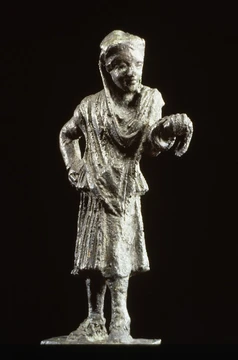
Use of costume in Athenian tragedy
Costume in Athenian tragedy disguised actors and conveyed character instantly.

In Athenian tragedy, costume was a fundamental element of performance, serving both religious and dramatic functions. Actors wore heavily disguising costumes, including masks, to renounce their individuality and allow the god Dionysus to speak through them. The costumes were likely elaborately decorated versions of everyday 5th-century BCE clothing, including garments such as the chiton, chlamys, and kothurnus, and were designed to convey character type, gender, age, social status, and class to the audience.
- Field
- Ancient Greek theatre
- Known for
- Use of masks, symbolic costumes, and standardized garments in tragic performance
- Period
- 5th century BCE and later
- Culture
- Athenian
- Key sources
- Vase paintings, archaeological remains, later authors like Pollux
Lore & Background
The costumes worn in Athenian tragedy were probably an elaborately decorated version of everyday clothing from the 5th century BCE. Garments included the chiton (robe or tunic), chlaina (overgarment), chlamys (short cloak), kothurnus (high, thick-soled boots), himation (overgarment), and peplos (cloak). The chiton differed from everyday wear by incorporating sleeves, which were coloured and patterned; long white sleeves were worn by male actors for female roles. There is no clear evidence that Aeschylus' actors wore flat boots specifically as a theatrical feature; the kothurnus was already a high boot. By the later Hellenistic and Roman periods, platform soles and a head-dress called an onkos were introduced, raising actors to heroic status and enhancing visibility.
Reader's Guide
The use of costume in Athenian tragedy was central to the genre's religious and dramatic identity. Masks, the most striking feature, allowed three speaking actors to portray up to eight or nine characters through multiple role-playing, and transitions within a character could be shown by different masks. The masks were made of stiffened linen, thin clay, cork, or wood, covered the whole head, and had hair. They served to blot out facial expression, so visual meaning was expressed by the entire body, with actors seen as silhouettes. Modern practice research suggests masks lead to a more demonstrative, declamatory style and can impede sound projection, though the Greeks may have overcome this with mouth apertures that later became wide-open or shaped like a mouth-trumpet for amplification. The costumes also had iconographic functions, as in performances of Alcestis, where Apollo wore white for the sun, Death wore a black peplos and black wings, and Herakles wore a bearskin and carried a club. The wide variety of masks is attested by Pollux, who lists 30 male and 17 female masks, including types like the tyrant, the boastful soldier, and the courtesan.
Did You Know?
- The tragic actors' costume was probably an elaborately decorated version of everyday clothing worn in the 5th century BCE.
- Masks were made of stiffened linen, thin clay, cork, or wood, and covered the whole head with hair.
- The kothurnus was a high, thick-soled boot, not a short lace-up boot; there is no clear evidence that Aeschylus' actors wore flat boots as a theatrical feature.
- Pollux, a 2nd-century CE rhetorician, lists 30 different male masks and 17 female masks in his Onomastikon.
More in Ancient Greek theatre 1-24
Spotted an error? Know more?
Reader corrections go straight into our review queue. Suggest an edit · How this site is sourced