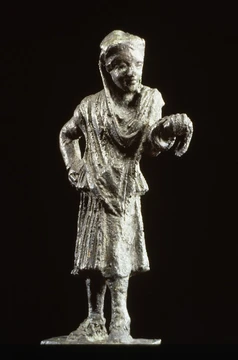
Artists of Dionysus
Associations of performers who organized Greek theatre and negotiated privileges.

The Artists of Dionysus, also known as the Dionysiac Artists, were associations of actors and other performers who organized Greek theatrical and musical performances during the Hellenistic Period and under the Roman Empire. First attested in the 270s BC, they acted as independent political entities, negotiating privileges with cities, kings, and the Roman Republic, and sometimes quarreling among themselves and with communities. By the late first century BC, regional associations mostly faded, replaced under the Julio-Claudian emperors by a single 'ecumenical' association that flourished in the second and third centuries AD; the latest securely dated evidence for this ecumenical synod comes from the late 4th or early 5th century AD, and a law of 415 AD in the Theodosian Code still mentions them.
- Active period
- First attested 270s BC; latest securely dated evidence from late 4th or early 5th century AD, with a legal mention in 415 AD
Lore & Background
The Artists of Dionysus emerged in the 270s BC, with regional associations in Athens, Egypt, Isthmia and Nemea, and Ionia and the Hellespont. These groups varied in structure: the Athenian association was tied to Athens, the Egyptian to the Ptolemaic court, while the Isthmian and Nemean group was a loose confederation. The Ionian and Hellespontine association, based in Teos, became powerful enough to clash with civic authorities. Most theatrical performers were not members; the artists were an elite minority enjoying special prestige. A long-running conflict between the Athenian and Isthmian-Nemean artists was eventually arbitrated by the Roman Republic.
Reader's Guide
The Artists of Dionysus were significant as early professional associations that functioned as independent political actors, engaging in diplomacy with cities, kings, and the Roman Republic to secure privileges like inviolability, tax exemptions, and safe travel. They organized performances at major Panhellenic festivals and local events, providing actors, technical crew, and props. Their internal structure mirrored Hellenistic city-states, with laws, decrees, and officials. They emphasized their religious devotion to Dionysus. Their legacy includes being among the first documented performing arts unions, influencing the organization of festivals across the Mediterranean. The ecumenical synod under the Roman Empire centralized these groups, but they vanished by the early 5th century AD, possibly due to changing political and religious landscapes.
Did You Know?
- The Artists of Dionysus are first attested in the 270s BC, with references in an inscribed decree of the Amphictyony of Delphi and in Callixenus of Rhodes' description of Ptolemy II's Grand Procession.
- They acted as independent political entities, sending envoys and receiving embassies, and even minted their own coinage in the second century BC (Ionian-Hellespontine association).
- Under the Julio-Claudian emperors, a single 'ecumenical' association was established, calling itself the sacred thymelic synod of ecumenical artists of Dionysus.
Divine Portfolio & the Symbolism of the Thyrsus
Dionysus presided over an extraordinarily wide range of domains—wine-making, orchards, fruit, vegetation, fertility, festivity, insanity, ritual madness, religious ecstasy, and theatre. His wine, music, and ecstatic dance were seen as liberating forces that freed followers from self-conscious fear and care, subverting the oppressive restraints of the powerful. His signature attribute, the thyrsus—a fennel-stem sceptre sometimes wound with ivy and dripping with honey—functioned dually as both a beneficent wand and a weapon against those who opposed his cult and the freedoms he championed. Devotees who participated in his mysteries were thought to be seized and empowered by the god's own presence. He was also known as Bacchus, a name tied to the frenzy (baccheia) he was said to induce in his followers. This duality of nourishment and destruction, of ecstatic liberation and violent retribution, made his worship a force that simultaneously sustained and challenged the social order.
Origins, Etymology & the Question of Foreignness
The origins of Dionysus remain genuinely uncertain. Traditional accounts place his cult's introduction in Greece via Thrace from Asia Minor, and most narratives describe him as a foreigner who arrived from abroad. Yet Linear B tablets from Pylos, dating to the twelfth or thirteenth century BC, bear the Mycenaean form di-wo-nu-so, suggesting he was among the earliest gods attested in mainland Greek culture. The 1989–90 Greek-Swedish Excavations at Kastelli Hill in Chania further confirmed early worship through Linear B inscriptions found on unearthed artefacts. The dio- prefix has been linked since antiquity to Zeus (genitive Dios), while the second element -nūsos remains of unknown origin—perhaps connected to Mount Nysa, where nymphs nursed the infant god, or to an archaic word for 'tree,' or to a Thracian term meaning 'son.' Jane Ellen Harrison read the name as 'young Zeus,' while Robert S. P. Beekes has argued for a Pre-Greek origin, noting that all attempts at an Indo-European etymology remain doubtful. Nonnus offered yet another reading: 'Zeus-limp,' derived from a supposed Syracusan word for limping, an etymology later scholars have dismissed.
Theatre, Ritual & the Realm of Souls
Wine served as the earthly incarnation of Dionysus and the central religious focus of his cult, capable of easing suffering, bringing joy, and inspiring divine madness. His festivals included the performance of sacred dramas enacting his myths, which scholars identify as the foundational impetus for the emergence of theatre in Western civilisation. Beyond the celebratory, the cult of Dionysus is also described as a 'cult of the souls': his maenads sustain the dead through blood-offerings, while he himself mediates between the living and the departed. He is sometimes categorised as a dying-and-rising god, a typology that has led scholars to note parallels between Dionysus and Jesus, though key differences and differing contexts complicate any direct comparison. In Orphism, his identity shifts considerably—son of Zeus and Persephone, a chthonic aspect of Zeus, or the twice-born son of Zeus and the mortal Semele—while the Eleusinian Mysteries identify him with Iacchus, son or husband of Demeter. This multiplicity of identity underscores the fluid, syncretic nature of his worship across different Greek traditions.
Roman Reception & the Politics of Suppression
The Romans identified Bacchus with their own Liber Pater, 'the free Father' of the Liberalia festival, who patronised viniculture, wine, male fertility, and the traditions attached to coming of age and citizenship. Over time, festivals of Bacchus were merged with those of Liber and Dionysus. However, the Roman state regarded independent, popular festivals of Bacchus—the Bacchanalia—as genuinely subversive. The free mixing of social classes and genders within these gatherings transgressed traditional social and moral constraints, and the state responded with severe repression: celebration of the Bacchanalia was made a capital offence. Only toned-down forms, with greatly diminished congregations approved and supervised by the State, were permitted to continue. This stands in sharp contrast to the Greek understanding of Dionysian worship as a liberating force that subverted the oppressive restraints of the powerful, revealing how the same ecstatic freedom could be perceived as either sacred empowerment or political threat depending on the cultural and political context in which it was practised.
Frequently Asked Questions
What were the Artists of Dionysus?
They were collective guilds of actors, musicians, and other stage performers who coordinated theatrical and musical productions across the Greek-speaking world. Think of them as the professional unions of the ancient stage, operating from the Hellenistic era through the Roman period.
When did the Artists of Dionysus first appear and when did they disappear?
The earliest secure references date to the 270s BC, and the group persisted until at least the early fifth century AD, with a final legal reference in 415 AD. That gives them a remarkable span of roughly seven centuries of continuous activity.
What made the Artists of Dionysus politically significant?
Rather than being mere entertainment groups, they functioned as quasi-independent political bodies that bargained directly with city-states, Hellenistic kings, and later the Roman Republic for performance rights and financial privileges. They could also get into disputes with local authorities or with rival performer groups.
How did the structure of the Artists of Dionysus change over time?
Initially there were multiple regional associations operating independently, but by the late first century BC those local groups largely dissolved. Under the Julio-Claudian emperors, they were consolidated into one unified ecumenical association that continued to thrive.
Why do scholars consider the Artists of Dionysus important for understanding ancient theatre?
They reveal that Greek performance was not just a civic or religious event but a professionalized, organized industry with its own legal standing and negotiation power. Their surviving records give us a rare window into how actors, musicians, and producers maintained their livelihoods across centuries.
More in Ancient Greek theatre 1-24
Spotted an error? Know more?
Reader corrections go straight into our review queue. Suggest an edit · How this site is sourced