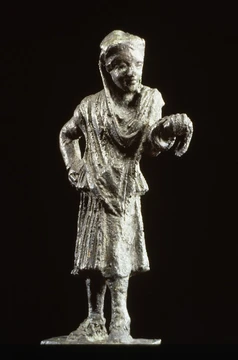
Theatre of ancient Greece
Ancient Greek theatre originated tragedy, comedy, and satyr play.

Theatre of ancient Greece flourished from the 6th century BC, centered in the city-state of Athens, which became a significant cultural, political, and religious place. Theatre was institutionalized as part of the festival called the Dionysia, honoring the god Dionysus. Three dramatic genres emerged: tragedy (late 500 BC), comedy (486 BC), and the satyr play. Modern Western theatre borrows technical terminology, classification into genres, and many themes, stock characters, and plot elements from ancient Greek theatre.
- Field
- Theatre
- Nationality
- Greek
- Known for
- Originating tragedy, comedy, and satyr play; influencing Western theatre
- Earliest recorded actor
- Thespis (c. 532 BC)
- Key festival
- Dionysia (City Dionysia from c. 508 BC)
Lore & Background
The word τραγῳδία (tragodia), from which 'tragedy' derives, is a compound of τράγος (tragos, 'goat') and ᾠδή (ode, 'song'), indicating a link with ancient Dionysian cults, though how fertility rituals became the basis for tragedy and comedy is impossible to know with certainty. Greek tragedy was created in Athens around 532 BC, when Thespis was the earliest recorded actor and winner of the first theatrical contest. Thespis is often called the 'Inventor of Tragedy,' but his importance is disputed; the statesman Solon is credited with creating poems in which characters speak with their own voice, and spoken performances of Homer's epics by rhapsodes were popular before 534 BC. The dramatic performances were important to the Athenians, as shown by the creation of a tragedy competition and festival in the City Dionysia, organized around 508 BC, possibly to foster loyalty among the tribes of Attica. Phrynichus, a competitor, won his first competition between 511 BC and 508 BC, used historical subjects, and is thought to be the first to use female characters (though not female performers).
Reader's Guide
After the Achaemenid destruction of Athens in 480 BC, theatre became formalized and a greater part of Athenian culture, with the 5th century BC regarded as the Golden Age of Greek drama. The centrepiece of the annual Dionysia was a competition between three tragic playwrights at the Theatre of Dionysus, each submitting three tragedies plus a satyr play. Aristotle claimed Aeschylus added the second actor and Sophocles introduced the third; Greek playwrights never used more than three actors. Tragedy and comedy were viewed as completely separate genres. The power of Athens declined after the Peloponnesian War, and theatre started performing old tragedies again. Greek theatre continued into the Hellenistic period, whose primary form was New Comedy, comic episodes about ordinary citizens; the only extant playwright from the period is Menander. New Comedy influenced Roman comedy, seen in the works of Plautus and Terence. The architecture of Greek theatres included the theatron (seating built into a hill), orchestra (circular performance space), and skené (backdrop wall). The death of a character was always heard behind the skené, as it was considered inappropriate to show a killing in view of the audience.
Did You Know?
- The word 'tragedy' comes from Greek words meaning 'goat song,' linked to ancient Dionysian cults.
- Thespis, the earliest recorded actor, won the first theatrical contest in Athens around 532 BC.
- Phrynichus was the first poet known to use a historical subject, in his play 'The Fall of Miletus' (493–2 BC).
- Greek tragedy typically used no more than three speaking actors, but comedy and later tragedy sometimes broke this rule.
The Olympian Pantheon and Its Geographic Reach
Most ancient Greeks acknowledged a core group of twelve major deities—Zeus, Hera, Poseidon, Demeter, Athena, Ares, Aphrodite, Apollo, Artemis, Hephaestus, Hermes, and either Hestia or Dionysus—though philosophical traditions like Stoicism and certain strands of Platonism hinted at a single transcendent deity beneath the multiplicity. The worship of these figures was not confined to the Greek mainland; it radiated outward to the Ionian islands and coasts of Asia Minor, to the colonies of Magna Graecia in Sicily and southern Italy, and even to scattered settlements in the Western Mediterranean such as Massalia. As the pantheon traveled, local epithets distinguished particular aspects of each god, and older regional deities were gradually absorbed into the broader Hellenic framework. The influence also flowed outward: early Italian faiths, including Etruscan religion, drew upon Greek models and in turn shaped the religious landscape of Rome. Notably, the Greeks themselves never grouped their practices into discrete 'religions.' Herodotus simply observed that the Hellenes shared common shrines, common sacrifices, and common customs, a unity of practice rather than a codified doctrine.
Divine Nature, Limitations, and Local Identity
The Greek gods occupied a structured hierarchy with Zeus at the apex, yet even he was not omnipotent. Each major deity governed a specific domain—Zeus commanded the sky and its storms, Poseidon stirred the seas and triggered earthquakes, Hades presided over the realm of the dead, Helios drove the sun across the heavens, and Aphrodite held sway over love. Crucially, these immortal beings were bound by the Moirai, the personifications of fate, which overrode any divine will. In the myth of Odysseus, the gods could only prolong and complicate his journey home to Ithaca after the Trojan War; they could not prevent it. Far from being morally superior, the deities displayed human vices, quarreled among themselves, and even took human lovers, producing demigod offspring. In the Iliad, a theomachy pits Aphrodite, Ares, and Apollo on the Trojan side against Hera, Athena, and Poseidon for the Greeks. Identity was deeply local: Athena belonged to Athens, Apollo to Delphi and Delos, Zeus to Olympia. The Artemis of Sparta, a virgin huntress, was understood as a fundamentally different figure from the many-breasted fertility goddess worshipped at Ephesus, despite sharing the same name.
A Decentralized Spiritual Landscape
Unlike the organized faiths of later centuries, ancient Greek religious life had no central authority, no single church, and no unified creed. Change in belief and practice was regulated only at the civic level, meaning each polis shaped its own rituals and festivals. Scholars have therefore suggested that what the Greeks practiced was less a single 'religion' than a family of closely related 'religious dialects'—variations that resembled one another far more than they resembled the beliefs of non-Greek peoples. The Greeks themselves had no word corresponding to the modern English term 'religion,' and no surviving Greek writer is known to have sorted the gods or cult practices into separate religious categories. The modern habit of labeling these practices as a 'religion' has been questioned as anachronistic. What the sources do reveal is a culture in which action mattered far more than belief. Ancient texts describe cult in rich detail—sacrifices, processions, festivals—yet say very little about formal doctrine or creed, reflecting a worldview in which doing was considered far more significant than believing.
The Underworld and the Question of Death
Death in the Greek imagination was not a single, uniform experience. The underworld, ruled by Hades—brother of Zeus—was itself sometimes called Hades, and within it existed two distinct regions: Tartarus, a place of torment reserved for the damned, and Elysium, a realm of pleasures for the virtuous. In the earliest Mycenaean period, all the dead simply went to Hades. It was the rise of mystery cults during the Archaic age that introduced the differentiated afterlife of punishment and reward. A select group of heroes—Achilles, Menelaus, Peleus, and many of the warriors who fell at Troy or Thebes—were believed to have been physically immortalized and transported to Elysium, the Islands of the Blessed, the ocean, or beneath the earth. These beliefs appear in the oldest sources, Homer and Hesiod, and persisted well into the Christian era. For ordinary people, however, death meant merely continued existence as a disembodied soul, with no prospect of reward. Philosophical alternatives existed but remained minority views: Pythagoras and Plato embraced reincarnation, while Epicurus taught that the soul was composed of atoms that simply dissolved at death, ending existence entirely.
Frequently Asked Questions
When and where did ancient Greek theatre originate?
Ancient Greek theatre took shape in the 6th century BC within the city-state of Athens, which served as the cultural and religious heart of the practice. It became a formalized art form tied to civic festivals celebrating the god Dionysus.
Who is considered the first actor in Greek theatre?
Thespis, active around 532 BC, is traditionally credited as the earliest recorded actor in Greek drama. He is often described as the figure who stepped out from the chorus to perform a distinct individual role, a move that launched the tradition of solo acting.
What are the three dramatic genres of ancient Greek theatre?
The three genres that developed were tragedy (appearing in the late 5th century BC), comedy (from 486 BC), and the satyr play. All three were performed as part of the official festival program in Athens.
Which festival was central to Greek theatrical performance?
The City Dionysia, running from roughly 508 BC, was the principal festival where tragedies, comedies, and satyr plays were staged. It combined religious worship of Dionysus with Athens's most important public cultural event.
How has ancient Greek theatre shaped modern Western drama?
Contemporary Western theatre still relies on genre categories, stage terminology, recurring plot structures, and stock characters that trace directly back to Greek practice. The foundational conventions established in Athens continue to underpin how plays are written, classified, and performed today.
More in Ancient Greek theatre 1-24
Spotted an error? Know more?
Reader corrections go straight into our review queue. Suggest an edit · How this site is sourced