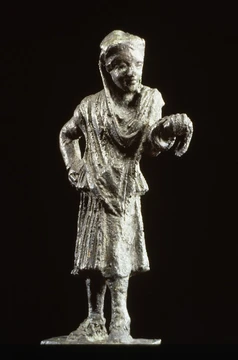
Catastrophe (drama)
Final resolution in drama, unravelling the plot.

In drama, especially in ancient tragedies, the catastrophe is the final resolution of the plot. It untangles the central conflict and ends the story. Structurally, it comes after the protasis, epitasis, and catastasis. In comedies, the catastrophe often involves a marriage; in tragedies, it typically involves the death of one or more main characters.
A catastrophe can be either simple or complex, and the plot and fable are described accordingly. In a simple catastrophe, the main characters do not change their situation, and there is no discovery or unravelling; the plot simply moves from agitation to calm. This type is better suited to epic poetry than to tragedy. In a complex catastrophe, the main character experiences a change of fortune, sometimes through a discovery and sometimes without one. For this change to be effective, it must be both probable and necessary—meaning it must arise naturally from the preceding actions and events, not be forced in just to serve the plot.
The discovery within a complex catastrophe must also be probable and necessary. To be probable, it must emerge from the story itself, not rely on devices like tokens, rings, bracelets, or simple recollection. To be necessary, it must alter the characters’ feelings, producing love or hatred rather than leaving them unchanged. The change can happen through the discovery itself, follow it later, or result directly from it—as in *Oedipus Rex*.
Critics have long debated whether the catastrophe should always end happily, rewarding virtue and punishing vice. Aristotle preferred a shocking catastrophe over a happy one, since moving the audience to terror and pity—the goal of tragedy—is better achieved by the former.
The 17th-century French critic René Le Bossu, writing mainly about epics, divided the catastrophe into two parts: the unravelling (or denouement) and the finishing (or achievement). The finishing is the result of the unravelling, marking the hero’s passage from trouble to rest. This finishing is a single point, without duration, while the unravelling includes everything after the plot is set. Le Bossu noted that a piece may have several interconnected unravellings, with the finishing being the end of the last one.
In the twentieth century, J. R. R. Tolkien distinguished between the catastrophe and the eucatastrophe.
- Field
- Dramatic structure
- Known for
- Final resolution in a dramatic plot; distinction between simple and complex catastrophe; eucatastrophe
Lore & Background
The catastrophe is the concluding part of a dramatic work, following the protasis, epitasis, and catastasis. In comedies, it may be a marriage; in tragedies, the death of one or more main characters. It is either simple or complex: a simple catastrophe involves no change in the state of the main characters, only a passage from agitation to quiet, and is more suited to epic poetry than tragedy. A complex catastrophe involves a change of fortune for the main character, sometimes through a discovery, and must be probable and necessary—springing from the subject itself, not introduced merely to serve a turn.
Reader's Guide
The catastrophe has been a central concept in dramatic theory, with critics debating whether it should always end happily and favor virtue. Aristotle preferred a shocking catastrophe, as it better moves terror and pity, the aim of tragedy. René Le Bossu divided the catastrophe in epics into the unravelling (denouement) and the finishing (achievement), the latter being the hero's passage to rest. In the twentieth century, J. R. R. Tolkien distinguished the catastrophe from the eucatastrophe, a classical catastrophe with an unexpected positive outcome, coining the term to distance it from the vernacular sense of disaster. The concept remains key to understanding plot resolution in classical and later drama.
Did You Know?
- In comedies, the catastrophe may be a marriage between main characters; in tragedies, it may be the death of one or more main characters.
- J. R. R. Tolkien coined the term 'eucatastrophe' to describe a classical catastrophe with an unexpected positive outcome.
Structural Position and Narrative Function
The catastrophe occupies the final segment of a dramatic work, arriving after the protasis, epitasis, and catastasis have set the stage. Its job is to untangle the web of intrigue and deliver the piece to its close. In a comedy, this resolution might take the form of a union between the principal characters; in a tragedy, it often means the death of one or more central figures. The term belongs specifically to the architecture of classical antiquity's dramatic poetry, where the narrative arc is divided into these sequential movements. The catastrophe is what gives the audience the sense of arrival, the point at which all suspended threads are gathered and the emotional tension is released. It is the definitive closing gesture of the work, the moment the story declares itself finished.
Simple and Complex Variations
Critics distinguish two species of catastrophe. In the simple variety, the principal characters experience no shift in their condition; there is no revelation, no untangling of hidden threads. The plot merely transitions from a state of agitation to one of calm and repose. This form suits the epic poem more naturally than tragedy. The complex catastrophe, by contrast, demands that the main character suffer a change of fortune, which may or may not be accompanied by a discovery. Both the change and any discovery must satisfy two tests: probability and necessity. Probability means the turn must grow organically from the subject matter and preceding incidents rather than being inserted for convenience. Necessity requires that the shift not leave the characters feeling exactly as they did before, but instead generate new emotions such as love or hatred. In Oedipus Rex, the change follows immediately from the discovery.
The Moral Outcome Debate
A long-running critical question concerns whether the catastrophe must always reward virtue and punish vice. Aristotle argued in favor of a shocking, unfavorable resolution, reasoning that the emotional aim of tragedy—provoking terror and pity—is better served by a devastating ending than by a comforting one. This position set him against those who insisted that dramatic closure should affirm moral order, ensuring that good characters prevail and wicked ones are brought to justice. The debate touches on a deeper question about what audiences should feel when the curtain falls: should they leave with a sense of cosmic fairness, or should they be shaken by the indifference of fate? The catastrophe, in this framing, becomes not merely a structural necessity but a moral statement, and the choice between a happy and a terrible ending reveals a critic's or playwright's philosophy about the relationship between human action and consequence.
Later Critical Reinterpretations
The concept of catastrophe continued to evolve well beyond classical antiquity. In the seventeenth century, the French critic René Le Bossu proposed a two-part division for epics: the unravelling, or denouement, and the finishing, or achievement. The unravelling encompasses everything that occurs once the plot has been set in motion, and a single work may contain several interconnected unravellings. The finishing, by contrast, is a single point without duration—the hero's passage from turmoil into rest—and it marks the end of the final unravelling. In the twentieth century, J. R. R. Tolkien introduced the term eucatastrophe to describe a classical catastrophe that carries an unexpected positive outcome for the protagonist. He coined the word deliberately to separate the dramatic concept from the everyday English sense of catastrophe as mere disaster, reclaiming the structural term from its negative colloquial baggage.
Frequently Asked Questions
What is Catastrophe in ancient Greek drama?
Catastrophe is the final structural segment of a Greek play, serving as the closing resolution where the central conflict is untangled and the story reaches its end. It belongs to the field of dramatic structure and is the last beat the audience experiences.
Where does Catastrophe sit in the overall plot structure of a Greek play?
It is the fourth and final stage, following the protasis (introduction), epitasis (rising action), and catastasis (climax). Everything before it builds toward this concluding movement.
What is the difference between a simple and a complex Catastrophe?
In a simple catastrophe the characters' circumstances remain unchanged and there is no moment of discovery or reversal; the plot simply closes. A complex catastrophe, by contrast, involves a revelation or an unravelling that shifts the characters' situation before the story ends.
How does the Catastrophe typically play out in tragedy versus comedy?
In tragedies the final resolution usually centers on the death of one or more principal characters, sealing the irreversibility of the conflict. In comedies the closing beat most often takes the form of a marriage or union that restores social harmony.
Why do scholars and fans still talk about Catastrophe when discussing Greek theatre?
It is the element that gives a play its sense of closure and thematic payoff, distinguishing a structured drama from a mere sequence of scenes. The simple-versus-complex distinction also shaped later Western storytelling concepts, including the modern idea of a eucatastrophe or fortunate turning.
More in Ancient Greek theatre 1-24
Spotted an error? Know more?
Reader corrections go straight into our review queue. Suggest an edit · How this site is sourced