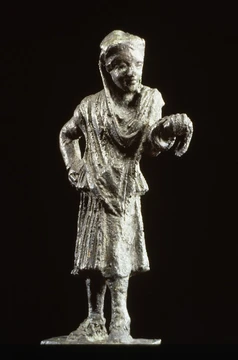
Choregos
Wealthy Athenian citizen who funded dramatic choruses and productions.

In the theatre of ancient Greece, the choregos (pl. choregoi) was a wealthy Athenian citizen who assumed the public duty of financing the preparation for the chorus and other aspects of dramatic production not paid for by the government. This role was part of the liturgical system designed to improve the city-state's economic stability through private wealth funding public good. Choregoi were appointed by the archon and the tribes, and their service, though an honor, was a duty for wealthy citizens.
- Era
- late 6th century BC to late 4th century BC (and revived in 17th century AD)
Lore & Background
Choregoi were appointed by the archon for tragedies and by the tribes for comedies and festivals such as the Dionysia and Thargelia. Candidates had to be wealthy Athenian citizens; for boys' choruses, they had to be over forty. Once nominated, a choregos could accept, claim an exemption via skepsis, or identify a more qualified replacement. The choregos paid for costumes, rehearsals, the chorus (including training, salaries, board and lodging), scenery, props, masks, special effects, and most musicians, including the flute player, as well as actors not in the chorus. The playwright typically acted as director, while the choregos might appoint a chorodidaskalos to train the chorus. If victorious, the choregos hosted a feast.
Reader's Guide
The choregos was central to the flourishing of ancient Greek drama, as private wealth underwrote the costly productions that were a cornerstone of Athenian civic and religious life. The position was part of a broader liturgical system that used private funds for public benefit, driven by social pressure, personal vanity, and political ambition. Victories brought prestige and could launch political careers; monuments were erected in honor of successful choregoi. Notable figures such as Themistocles, Pericles, and Plato served in this role. The choregia was reorganized in 406 BC to spread costs via synchoregia. The role was briefly revived in 17th-century Italian opera as the corago, combining impresario and director duties. The title also appeared at the University of Oxford in 1626 as a named assistant professorship of music. The choregoi exemplify the ancient Greek link between wealth, public service, and cultural achievement.
Did You Know?
- The word choregos derives from Greek χορός 'chorus' + ἡγεῖσθαι 'to lead'.
- Choregoi for boys' choruses were required by Athenian law to be over forty years old.
- The prize for tragedy at the Dionysia was awarded to the choregos, though the playwright's victory was recorded separately.
Frequently Asked Questions
Who was the choregos in ancient Greek theatre?
The choregos was a wealthy Athenian citizen tasked with covering the costs of a dramatic chorus and other production expenses the state did not fund. In practice, they acted as a private sponsor for a public theatrical event.
What did the choregos actually fund?
Their financial responsibility included preparing the chorus and handling other staging elements that fell outside the government's budget. The exact scope varied by production, but it covered the parts of the show the city-state left to private patrons.
How was the choregos chosen for a given production?
The archon and the tribal authorities jointly assigned the role to a wealthy citizen. Although it carried social prestige, it functioned as a compulsory civic obligation rather than a voluntary choice.
Why was the choregos role important to Athens?
It was a core mechanism of the liturgical system, which funneled private wealth into public cultural life to bolster the city-state's economic health. By making the rich finance theatre, Athens turned individual spending into a shared civic asset.
When did the choregos role exist?
It was active from the late 6th century BC through the late 4th century BC, spanning roughly two centuries of Athenian dramatic tradition. The practice was later revived in the 17th century AD.
More in Ancient Greek theatre 1-24
Spotted an error? Know more?
Reader corrections go straight into our review queue. Suggest an edit · How this site is sourced