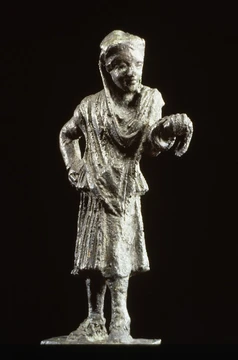
Catharsis
Ancient Greek concept of purification through emotional release.

Catharsis (or katharsis) is a term from Ancient Greek, meaning 'purification' or 'cleansing'. It originally referred to physical purification practices, later extended to emotional and spiritual contexts. In dramaturgy, it describes the process by which an audience experiences negative emotions and then expels them, resulting in a happier state. The concept is central to Aristotle's analysis of tragedy and music, and has been influential in psychology, medicine, and religious thought.
- First mental use
- Earlier Greek writers (e.g., Hippocratic corpus) used it in a mental or emotional sense before Aristotle
Lore & Background
The term kathairein and its relatives appear in Homer, referring to purification rituals. The murder of Thersites by Achilles is not a standard part of the epic cycle as known from surviving summaries. Later Greek practices to cleanse blood-guilt involved rituals such as washing a blood-polluted man with the blood of a sacrificed piglet and running water, as seen in the story of Orestes. The cure of the daughters of Proetus is associated with Melampus, not with Orestes. In Platonism, catharsis is part of the soul's ascent to knowledge, a means to go beyond the senses. Neoplatonists like Plotinus and Porphyry distinguished civic virtues from cathartic virtues, the latter separating the soul from the sensible to contemplate the Mind.
Reader's Guide
Catharsis has been interpreted in multiple ways. Aristotle used it in a medical sense before applying it to music and tragedy. In the Politics, he describes music as serving purgation, bringing relief to those prone to pity, fear, or religious excitement. In the Poetics, tragedy effects relief to these emotions. Scholars debate whether catharsis means purgation or purification. F. L. Lucas argues for 'purgation', while Gerald F. Else contends that the Poetics does not support a therapeutic model. Lessing interprets it as a purification that balances pity and fear. Elizabeth Belfiore proposed an allopathic process. In the twentieth century, an intellectual clarification theory emerged, consistent with Aristotle's argument that the essential pleasure of tragedy comes from learning. The term also appears in Freudian psychoanalysis, where expressing buried trauma brings it into consciousness and releases it, increasing happiness.
Did You Know?
- The word catharsis is derived from the Ancient Greek κάθαρσις, meaning 'purification' or 'cleansing'.
- In medicine, a cathartic is a substance that accelerates defecation.
- Earlier Greek writers (e.g., Hippocratic corpus) used the term in a mental or emotional sense before Aristotle.
- The Greek word κάθαρσις is not a standard term for the Catholic doctrine of purgatory in Greek Christian tradition.
Roots in Ritual and the Body
The word katharsis descends from the Greek verb kathairein, meaning "to purify," a term already present in Homer's verses where it describes ritual cleansing. Scholars have traced its etymology to the Semitic root qatar, meaning "to fumigate," and to the Arabic qaṭar, which carries the sense of distillation, with its noun form referring to a drop or drip. In its earliest Greek usage, the concept was strictly physical: purification practices, medical evacuation of menstrual fluid, and the action of a cathartic substance that accelerates bowel movements. The epic Aithiopis, set within the Trojan War cycle, narrates Achilles undergoing purification after killing Thersites. Later Greek culture developed elaborate blood-guilt rituals, exemplified by Orestes in Aeschylus, where a sacrificed piglet's blood washes over the polluted man before running water completes the cleansing. Burkert notes that an identical ritual appears on a krater from Canicattini, depicting the cure of Proetus's daughters from madness caused by ritual transgression. Burkert famously dismissed the question of whether such rites achieved atonement or mere healing as irrelevant.
Aristotle's Purgation of the Mind
Aristotle stands as the first thinker to transpose katharsis from the body to the mind. In the Politics, he discusses music's capacity to serve education, purgation, and amusement simultaneously. He observes that passionate melodies can throw susceptible listeners into a state comparable to receiving a medicinal purge, and that the compassionate, the timid, and the generally emotional all undergo a similar purgation accompanied by a pleasant sense of relief. In the Poetics, he defines tragedy as a heroic, complete representation of action rendered in ornamented language, one that, through pity and fear, effects relief to those and similar emotions. The underlying logic is medical: just as a cathartic expels harmful matter from the body, a well-crafted performance arouses negative emotion in the spectator and then allows it to be expelled, leaving the audience in a state of renewal and restoration. The term purgation, which Aristotle uses without full explanation in the Politics, promises a fuller treatment in his treatise on poetry.
The Soul's Ascent in Neoplatonism
Within Platonic and Neoplatonic thought, catharsis acquires a spiritual dimension far removed from its medical origins. It becomes a stage in the soul's progressive climb toward knowledge, a means of transcending the senses to embrace the intelligible realm. For Plotinus and Porphyry, catharsis specifically means the elimination of passions, and this distinction reorganizes the hierarchy of virtues. In the second tractate of the first Ennead, Plotinus contrasts civic virtues with cathartic virtues, arguing that the former—concerned with order, beauty, and material existence—are inferior. Though they retain a trace of the Absolute Good, they cannot lead the soul to unity with the divine. Porphyry clarifies that civic virtues serve to moderate individual passions and permit peaceful social coexistence. The purificatory virtues, by contrast, are the precondition for assimilation to divinity: they strip the soul of everything sensible, everything that is not its true self, freeing it to contemplate the Mind, or Nous.
From Stage to Couch: Catharsis in Psychology and Beyond
The dramatic function of catharsis—arousing negative emotion in an audience so that it can be expelled, leaving them happier—remains the term's most widely recognized meaning in the arts. Yet the concept has also permeated religious and psychological vocabulary. In Greek, the word denotes the spiritual purging process central to the Catholic doctrine of purgatory, and Greek Neoplatonists applied it to broader spiritual purification. In modern psychology, catharsis is most closely associated with Freudian psychoanalysis, where it describes the expression of buried trauma identified as the root of a neurosis. The therapeutic act brings that repressed material into consciousness and releases it, producing an increase in the patient's happiness. The thread connecting Aristotle's audience watching Orestes, a Neoplatonist stripping away passion, and a patient on an analyst's couch is the same: a deliberate confrontation with what is painful, followed by its expulsion, and the restoration that follows.
Frequently Asked Questions
What is Catharsis in Ancient Greek theatre?
Catharsis is the idea that watching a tragedy lets the audience feel and then release intense emotions such as pity and fear, leaving them in a calmer, lighter state. The word itself derives from an Ancient Greek root meaning 'purification' or 'cleansing.'
Who first defined Catharsis as a theatrical concept?
Aristotle is the figure most closely tied to formalizing Catharsis in his Poetics, where he links it to the emotional effect tragedy produces in spectators. That said, earlier Greek medical writers in the Hippocratic corpus already employed the term in an emotional or mental sense before Aristotle applied it to drama.
How does Catharsis actually work during a Greek performance?
The plot guides the audience through grief, terror, or sorrow until those built-up negative feelings reach a peak. As the story resolves, the accumulated emotion is discharged, producing a sense of relief or renewal rather than lingering distress.
Was Catharsis only a literary or theatrical idea?
No. The term originally described physical purification rituals and also appeared in medical and religious contexts as a form of spiritual cleansing. Aristotle's theatrical application is the most famous use, but the concept had a broader life in Greek thought.
Why is Catharsis still important to fans of Ancient Greek theatre?
It remains the central lens for understanding why Greek tragedies feel emotionally powerful rather than merely disturbing. Grasping Catharsis helps explain the structural purpose of the tragic ending and the intended bond between playwright and audience.
More in Ancient Greek theatre 1-24
Spotted an error? Know more?
Reader corrections go straight into our review queue. Suggest an edit · How this site is sourced