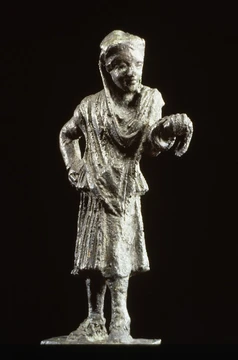
The Birth of Tragedy
Nietzsche's 1872 work on tragedy, Dionysian and Apollonian forces.

The Birth of Tragedy (German: Die Geburt der Tragödie aus dem Geiste der Musik) is an 1872 work of dramatic theory by the German philosopher Friedrich Nietzsche. It was reissued in 1886 as The Birth of Tragedy, Or: Hellenism and Pessimism, with a prefatory essay titled 'An Attempt at Self-Criticism.' The book argues that classical Athenian tragedy transcended pessimism and nihilism by combining two opposing forces: the Dionysian (disordered, undifferentiated reality) and the Apollonian (ordered, differentiated form). Nietzsche claims life always involves a struggle between these elements, each containing the other in an eternal balance.
Quick Facts
- Title Orig
- Die Geburt der Tragödie aus dem Geiste der Musik
- Author
- Friedrich Nietzsche
- Language
- German
- Subjects
- Athenian tragedy · the Apollonian–Dionysian opposition
- Publisher
- E. W. Fritzsch
- Release Date
- 1872
- Media Type
- Pages
- 143
Facts from the source article.
Lore & Background
Nietzsche, originally educated as a philologist, found in classical Athenian tragedy an art form that transcended pessimism. He theorized that before tragedy, there was an era of static Apollonian sculpture and wild Dionysian revelry in festivals and music. The combination of these elements gave birth to tragedy, with the chorus originally composed of satyrs (goat-men), as suggested by the word 'tragedy' from 'goat song.' The audience empathetically participated with the chorus, experiencing an Apollonian dream vision of the god Dionysus on stage, whose ecstatic dismembering and suffering represented the human condition.
After Aeschylus and Sophocles, tragedy died, according to Nietzsche, due to the influence of Euripides and Socrates. Euripides reduced the chorus and made drama more naturalistic, while Socrates emphasized reason, diffusing the value of myth and suffering. Nietzsche believed this drained the individual's ability to participate in art, losing the 'participation mystique' that allowed creative harmony with life's sufferings. He concluded that a rebirth of tragedy might be possible through the operas of Richard Wagner.
The book's history began with two lectures in January and February 1870, on 'The Greek Music Drama' and 'Socrates and Tragedy,' which served as its basis. After receiving copies, Richard and Cosima Wagner suggested Nietzsche write a book. He submitted a manuscript in April 1871, but after the publisher was unresponsive, he privately printed a portion as 'Socrates and Greek Tragedy.' A revised manuscript was accepted by E. W. Fritzsch in November 1871, and the book reached bookstores on 2 January 1872. A second edition appeared in 1874, and a third in 1886 with the new title and prefatory essay.
Reader's Guide
The Birth of Tragedy is significant for its radical departure from the Enlightenment view of Greek culture as noble and simple, instead portraying the Greeks as grappling with pessimism. Nietzsche's central dichotomy—the Dionysian and Apollonian—became a foundational concept in aesthetics and cultural criticism, influencing later thinkers. The work also reflects the influence of Arthur Schopenhauer, particularly the ideas of 'will' and 'representation,' though Nietzsche opposed Schopenhauer's negation of the will, arguing life is worth living despite suffering. The book was angrily criticized by professional scholars, notably philologist Ulrich von Wilamowitz-Moellendorff, who denounced it as slipshod and misleading. Nietzsche's friend Erwin Rohde responded by exposing inaccuracies in Wilamowitz-Moellendorff's citations, and Richard Wagner also issued a response. Despite early controversy, the book has endured as a key text in Nietzsche's oeuvre, shaping discussions of tragedy, art, and the human condition.
Did You Know?
- The word 'tragedy' is contracted from 'trag(o)-aoidiā' meaning 'goat song,' from 'tragos' (goat) and 'aeidein' (to sing).
- Nietzsche argued that the chorus of Greek tragedy was originally composed of satyrs, though this is speculative.
- The book was reissued in 1886 with a prefatory essay titled 'An Attempt at Self-Criticism,' in which Nietzsche commented on his earlier work.
- Richard and Cosima Wagner suggested that Nietzsche write the book after receiving copies of his lectures on ancient Greek drama.
The Stage and Its Masters
Greek tragedy stands as one of three principal theatrical forms in ancient Greece, alongside comedy and the satyr play. Its most celebrated flowering arrived in fifth-century Athens, a body of work that scholars sometimes designate as Attic tragedy. The genre is widely understood to have grown out of the ancient rites performed in honor of Dionysus, the god linked to both wine and theatrical performance. Its reach extended well beyond the Greek world, profoundly shaping the theatre of Rome and later the Renaissance stage. The plots most often drew upon myths preserved in the oral traditions of archaic epics, yet in tragic theatre these narratives were not merely recited but embodied by actors on stage. Three names tower above the rest: Aeschylus, Sophocles, and Euripides. These tragedians used their dramatic material to explore the deepest currents of human nature, forging an emotional connection with the audience while simultaneously drawing spectators inside the world of the play.
The Goat, the Song, and the Name
The very word tragedy has provoked debate since antiquity. Aristotle's Poetics, drawing on first-hand observation of Attic performances now lost to modern scholars, offers the most foundational account. He traces the term to the satyr dithyramb, a hymn sung and danced in Dionysus's honor. The Greek tragōidía is commonly parsed as goat plus song, pointing to the satyr chorus. Another popular story holds that the legendary Thespis, whose name gives us thespian, won the first tragic contest with a goat as the prize. Alexandrian grammarians read the phrase as a song for the goat sacrifice, a reading echoed in Horace's Ars Poetica. Yet other scholars have challenged the goat connection entirely. J. Winkler proposed a link to tragizein, a rare word for adolescent voice-change, framing the original singers as figures in social puberty. D'Amico argued the term referred not to goats at all but to the characters populating the earliest satyr choruses of Dionysian ritual.
From Improvised Hymn to Structured Drama
Aristotle described tragedy's earliest form as an improvisation by the leader of the dithyramb, a brief and burlesque performance tinged with satyr-play elements. Over time, the language grew more serious and the meter shifted from trochaic tetrameter to the more conversational iambic trimeter. The dithyramb itself, credited to the lyric poet Arion of Methymna, began as spontaneous performance before being committed to writing. A chorus of up to fifty men and boys would dance and sing in a circle, likely accompanied by an aulos, recounting episodes from Dionysus's life. The pivotal transformation, scholars suggest, came when someone, presumably Thespis, wove spoken verse into the choral song. As the form matured, actors interacted more with one another while the chorus's role contracted. The Greek word for actor, hypokrites, means answerer or interpreter, a term that captures how the solo voice responded to the chorus's questions, evoking their songs through long speeches or harrowing messenger narratives.
The Unresolved Puzzle of Origins
Despite centuries of study, the precise birth of Greek tragedy remains one of classical scholarship's open questions. Ruth Scodel observes that, given the scarcity of evidence and the questionable reliability of ancient sources, our knowledge of the genre's origins is remarkably thin. What can be traced, however, are the influences: the stories descend from epic and lyric poetry, the iambic trimeter owes much to the political rhetoric of Solon, and the choral songs' dialect, meter, and vocabulary appear rooted in choral lyric. How these disparate elements converged into a single art form is still unexplained. Scodel identifies three necessary innovations: someone combined a solo speaker with a chorus and cast both as characters from legend or history; this new performance was incorporated into the City Dionysia festival at Athens; and regulations were established to govern its management and funding. While all three changes could theoretically have occurred simultaneously, most scholars find that scenario unlikely, suggesting a gradual, layered emergence rather than a single moment of invention.
Frequently Asked Questions
What is 'The Birth of Tragedy'?
It is an 1872 philosophical treatise by German thinker Friedrich Nietzsche that reinterprets classical Athenian tragedy through the lens of two competing aesthetic impulses. Rather than being a play or a history, it is a work of dramatic theory that asks why Greek tragedy arose and why it eventually disappeared.
What are the Dionysian and Apollonian forces in Nietzsche's framework?
The Dionysian embodies raw, undifferentiated, ecstatic experience—the dissolution of individual boundaries—while the Apollonian represents structure, clarity, and formal order. Nietzsche insists that Greek tragedy reached its highest expression by fusing these two opposing drives into a single artistic act.
Why does Nietzsche say tragedy was 'born from music'?
He holds that music, as the most abstract and emotionally immediate of the arts, is the true generative root of tragic drama in fifth-century Athens. The Dionysian musical impulse, in his view, was the creative engine onto which Apollonian scenic and narrative form was grafted.
Why does Nietzsche blame Socrates and Euripides for the death of tragedy?
He argues that Socratic rationalism introduced a demand for logical justification that drained mystery and emotional depth from the stage. Euripides, as the first dramatist to privilege dialogue and psychological realism over choral music, effectively replaced the tragic form with a more intellectual, less visceral mode of theatre.
Why is 'The Birth of Tragedy' still important to theatre scholars and directors?
It remains the foundational text for reading Greek tragedy as a cultural response to existential dread rather than mere entertainment. Its Dionysian/Apollonian dichotomy continues to shape how critics and practitioners think about balancing raw emotional force with formal structure in any performance.
More in Ancient Greek theatre 1-24
Spotted an error? Know more?
Reader corrections go straight into our review queue. Suggest an edit · How this site is sourced