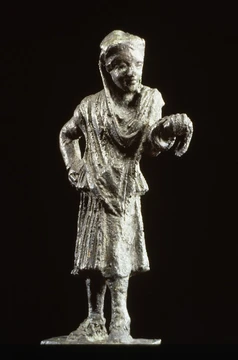
Agon
Greek deity personifying conflict, struggle, and contest.

Agon (Ἀγών) was the ancient Greek concept embodying conflict, struggle, and contest—whether in athletics, chariot or horse racing, or in musical and literary competitions held at public festivals. The word forms the root of “agony,” and it also underlies the dramatic concepts of protagonist and antagonist in tragedy.
In athletics, *agon* referred to any competition, such as the Olympic Games (Ὀλυμπιακοὶ Ἀγῶνες). A statue at Olympia, often mistakenly thought to depict the god Agon, actually shows a man holding halteres (dumbbells). That statue, created by the sculptor Dionysius of Argos, was a dedication from Micythus of Rhegium, and Pausanias does not identify it as a representation of a deity named Agon.
In religion, Agon is not a widely recognized deity in ancient Greek religion; the only known reference to a personified Agon is late and obscure. Pausanias does not list Agon among the gods at Olympia in that context, and the statue there is not of a god but of an athlete. More broadly, *agon* described any competitive event held during religious festivals, including athletics, music, or drama. The concept also appears in the New Testament: in his epistle to Timothy, Paul writes, “Fight the good fight of the faith.” Strong’s Concordance defines *agón* there as a gathering, contest, or struggle—specifically an athletic contest, and by extension a struggle within the soul.
In ancient Greek theater, especially Old Comedy of the fifth century B.C., *agon* denoted a structured contest or debate between two characters—the protagonist and antagonist—or between an actor and the chorus, or between two actors each backed by half the chorus. This structure is characteristic of Old Comedy (e.g., Aristophanes), not Classical tragedy, where the agon as a formal debate does not typically involve the chorus split in that way. This clash of opposing principles resembled the dialectic dialogues of Plato. The term has since broadened to mean the central conflict in any literary work. From this usage come *protagonist* (the first actor, central to the story’s struggle) and *antagonist* (the one opposing that character). The deuteragonist and tritagonist play the second and third most important roles, sometimes overlapping with the antagonist.
In dance, Lincoln Kirstein conceived the idea for a ballet in 1948 that later became *Agon*.
- Field
- Greek mythology, athletics, theater, literature
- Known for
- Personification of contest and struggle; associated with the Olympic Games; origin of terms 'agony', 'protagonist', 'antagonist'
Lore & Background
A statue at Olympia, described by Pausanias (5.26.2–3), is often mistakenly cited as a representation of the god Agon. In fact, it depicts a man holding halteres (dumbbells), dedicated by Micythus of Rhegium and sculpted by Dionysius of Argos. Pausanias does not identify this statue as a deity named Agon, nor does he list Agon among the gods at Olympia. Agon is not a widely recognized deity in ancient Greek religion; the only known reference to a personified Agon is late and obscure, and it is not connected to this statue.
In Ancient Greek drama, particularly Old Comedy (fifth century B.C.), agon refers to a contest or debate between two characters - the protagonist and the antagonist - in the highly structured plays of that genre. The agon could also develop between an actor and the chorus or between two actors with half of the chorus supporting each side. This structure is characteristic of Old Comedy (e.g., Aristophanes), not Classical tragedy, where the agon as a formal debate does not typically involve the chorus split in that way.
Reader's Guide
Agon's significance extends from ancient Greek religion and athletics to theater, literature, and sociopolitical theory. As a deity, Agon personified the competitive spirit central to Greek culture, particularly embodied in the Olympic Games and other religious festivals. The term's evolution into 'agony' reflects the intense struggle inherent in tragedy's protagonist-antagonist dynamic. In theater, the agon structure influenced Classical drama and later literary conflict, with Harold Bloom using the term to describe a writer's intellectual struggle with an influential predecessor. Roger Caillois applied agon to competitive games based on equal chances and skill. In sociopolitical theory, agon refers to the idea that the clash of opposing forces yields growth and progress, a concept known as agonism, proposed by scholars including William E. Connolly, Hannah Arendt, and Chantal Mouffe. The ballet Agon, choreographed by George Balanchine with music by Igor Stravinsky, represents a modern artistic adaptation. Derivatives such as agony, agonism, antagonism, and protagonist continue to shape language and thought.
Did You Know?
- Agon was represented in a statue at Olympia with halteres (dumbbells) in his hands, a work of sculptor Dionysius dedicated by Micythus of Rhegium.
- Agon is the word-forming element in 'agony', explaining the concept of agon(y) in tragedy by its fundamental characters, the protagonist and antagonist.
- In Ancient Greek drama, the agon could develop between an actor and the choir or between two actors with half of the chorus supporting each.
- Agon appears in the New Testament where Paul writes 'Fight the good fight of the faith', defined by Strong's Concordance as a gathering, contest, struggle.
The Deity and the Sacred Contest
Agon stands as one of the most conceptually rich figures in the Greek pantheon, personifying the very essence of struggle, conflict, and competitive contest. Rather than a god with a sprawling mythological narrative, Agon functioned more as a sacred spirit embodying the competitive drive that animated public festivals across ancient Greece. Pausanias records that Agon was recognized as a deity whose physical presence was marked by a statue at Olympia, a work by the sculptor Dionysius, dedicated by Micythus of Rhegium. The figure was depicted holding halteres, the ancient equivalent of dumbbells, grounding the deity firmly in the world of athletic competition. The Olympic Games themselves were called Olympiakoi Agones, linking the most prestigious athletic event directly to this personification. Agon occupied a conceptual space between Zelos, the spirit of rivalry, and Nike, the goddess of victory, suggesting that the struggle itself was a divine force worthy of veneration. The Games operated simultaneously as a religious festival honoring Zeus and as a competitive arena, and Agon embodied that dual sacred-competitive identity.
The Agon on Stage
In the theater of classical Athens, the agon took on a structural role that shaped the architecture of drama itself. In Old Comedy of the fifth century B.C. and in the tightly organized form of Classical tragedy, the agon designated a formalized contest or debate between two principal characters. This confrontation could unfold between the protagonist and the antagonist, or it could pit a single actor against the chorus, or even divide the chorus in half to support opposing sides. The intellectual rigor of these staged arguments gave them a quality that echoed the dialectic method associated with Plato, where opposing principles clash to illuminate deeper truths. From this theatrical usage, the vocabulary of dramatic roles was born: the protagonist, the first actor who leads the story's central struggle; the antagonist, the character against whom that struggle is directed; and the deuteragonist and tritagonist, occupying the second and third positions of importance, sometimes overlapping with the antagonist's function. Over time, the term escaped its strict classical boundaries to describe the fundamental conflict upon which any literary work depends.
Agon in Modern Art and Thought
The concept of agon leapt across centuries to animate modern creative and intellectual life. In 1948, Lincoln Kirstein proposed the idea for a ballet that would eventually become Agon, a work that, after a decade of development, became the final chapter in the long collaboration between choreographer George Balanchine and composer Igor Stravinsky. Balanchine himself called it "the most perfect work" to emerge from their partnership, a fitting title for a piece built on the very principle of structured opposition. In literary criticism, Harold Bloom deployed the term in The Western Canon to describe a writer's attempt to resolve an intellectual conflict with an influential predecessor, a process he characterized as "the larger swallows the smaller," exemplified in his analysis of Joyce's agon with Shakespeare. Meanwhile, in his 1961 work Man, Play, and Games, Roger Caillois defined agon as the category of competitive games where participants start on equal footing, and victory is determined by a single quality—speed, endurance, strength, memory, skill, or ingenuity—exercised within defined limits and without outside help.
From Scripture to Sociopolitical Theory
The resonance of agon extends well beyond the ancient Greek world into religious, linguistic, and political thought. In the New Testament, the apostle Paul invokes the concept in his epistle to Timothy with the exhortation to "fight the good fight of the faith," a usage that Strong's Concordance defines as a gathering, contest, or struggle, both athletic and spiritual, a battle within the soul. The Greek root also seeds a family of English words—agony, agonism, antagonism, protagonist—each carrying the genetic imprint of competitive struggle. In modern sociopolitical theory, the concept has been formalized as agonism, the proposition that the clash of opposing forces is not merely destructive but generative, producing growth and progress. Scholars such as William E. Connolly, Hannah Arendt, Chantal Mouffe, Bonnie Honig, and Claudio Colaguori have articulated this idea explicitly, while thinkers like Theodor Adorno and Michel Foucault engage with its implications implicitly. The notion underpins what is sometimes called agonistic democracy, where conflict is not a failure of the system but its engine.
Frequently Asked Questions
Who is Agon in Greek mythology?
Agon is not a traditional Olympian deity with a fixed myth cycle but rather a personification of the Greek idea of contest, struggle, and competitive conflict. It encompassed everything from athletic events to musical and literary competitions held at public festivals.
What role does Agon play in Greek tragedy?
The concept of Agon gave rise to the dramatic terms 'protagonist' (the first actor in the contest) and 'antagonist' (the opposing actor), framing the central conflict of a tragic play as a structured struggle between two sides.
Is the famous statue at Olympia actually a depiction of Agon?
No—though many visitors assume the bronze figure holding halteres (dumbbells) represents the personified god, scholars identify it as a depiction of an athlete carved by the Argive sculptor Dionysius. The confusion persists because Agon was so closely tied to athletic competition that people naturally project the name onto the image.
How is the English word 'agony' connected to Agon?
The modern English word 'agony' descends directly from the Greek Ἀγών, preserving the original sense of a painful or intense struggle. Over centuries the meaning narrowed from any formal contest to specifically a state of severe suffering or distress.
What was the connection between Agon and the Olympic Games?
The ancient Olympic Games were formally called the 'Olympic Agones,' meaning the Olympic contests, reflecting that every event from footraces to chariot drives was an instance of Agon in action. The concept treated competition itself as a sacred, structured encounter rather than mere sport.
More in Ancient Greek theatre 1-24
Spotted an error? Know more?
Reader corrections go straight into our review queue. Suggest an edit · How this site is sourced