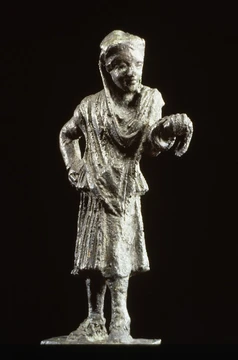
Greek chorus
A collective voice commenting on ancient Greek drama.

A Greek chorus (Ancient Greek: χορός, romanized: chorós) was a homogeneous group of performers in ancient Greek tragedy, comedy, and satyr plays. They commented with a collective voice on the action of the scene or provided necessary insight into offstage events. Historically, the chorus consisted of between 12 and 50 players, who variously danced, sang, or spoke their lines in unison, sometimes wearing masks to change their emotions while performing.
- Field
- Ancient Greek theatre
- Known for
- Collective commentary, singing, dancing, and masking in tragedy, comedy, and satyr plays
- Size range
- 12 to 50 players
- Typical tragedy size
- 15 members by the end of the 5th century B.C.
- Typical comedy size
- 24 members
Lore & Background
A common theory for the origin of the Greek chorus stems from the ancient Greek poet Arion's invention of tragedy, the stationary chorus, and satyrs' verses. In Aristotle's Poetics, he writes that tragedy came into being from an improvisatory origin, gradually enhanced as poets developed the potential they saw in it. The role of the chorus fluctuated; for example, Aeschylus foregrounded dialogue by increasing the number of actors and reducing the chorus's role. Choruses are thought to have started in Dionysian dithyrambs, hymns, and dances in honor of Dionysus, with other characters later incorporated. Satyr-plays were typically performed after the trilogy of tragedies, not at the beginning, as part of the tetralogy.
The chorus made its first entrance in the parodos, the song performed upon their entrance. Throughout the tragedy, episodes (where characters and chorus converse) and stasima (where the chorus performs a choral ode at the end of each episode to summarize and contextualize events) were interspersed. In the exodus, the play's final scene, the chorus performed a song imparting some message or moral before exiting. Some historians argue the chorus was itself considered an actor; Aristotle stated in his Poetics: 'The chorus too must be regarded as one of the actors. It must be part of the whole and share in the action.'
Reader's Guide
The Greek chorus served multiple dramatic functions. It offered background and summary information to help the audience follow the performance, commented on themes, and, as August Wilhelm Schlegel proposed, demonstrated how the audience might react to the drama, acting as 'the ideal spectator.' The chorus represented on stage the general population of the story, in contrast to the individual heroes, gods, and goddesses often featured. It was used as an intermediary between the represented population and the audience, particularly in moral evaluation. For example, in Seneca's Thyestes, the chorus detailed offstage events in gruesome detail, evoking disgust at immoral behavior. The chorus also had agency in communicating themes, making imagistic references to convey ideas such as desire. Despite serving as clarifying voices, the chorus was not always omniscient; their lack of knowledge sometimes emphasized the distance in status between the chorus and a protagonist. The chorus thus provided insight into political thoughts and ideals of the time, with particular obedience to the position of the general member of society. German poet and philosopher Friedrich Schiller tried to use the chorus in his tragedy The Bride of Messina, but critics denounced his use, with poet Schiller Carlyle stating that 'the chorus retarded the plot, dissipating and diffusing the sympathies.'
Did You Know?
- It was likely Aeschylus who lowered the number of chorus members to twelve, and Sophocles who raised it to fifteen.
- The large section of the stage where the chorus danced and sang is called the 'orchestra,' meaning 'dancing floor.'
- In Aeschylus' The Eumenides, the chorus takes the part of a host of avenging Furies.
More in Ancient Greek theatre 1-24
Spotted an error? Know more?
Reader corrections go straight into our review queue. Suggest an edit · How this site is sourced