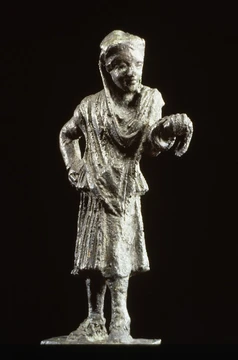
Eiron
The dissembler who understates to defeat the boaster.

The eirōn (Ancient Greek: εἴρων, “dissembler”) was a stock character in ancient Greek comedy, known for understating his own abilities to defeat a boastful opponent. This figure is central to the development of irony, as the modern term derives from the eirōn of classical Greek theatre.
- Field
- Ancient Greek theatre, comedy
- Known for
- Stock character in comedy; understated dissembler who defeats the alazōn (boaster); origin of the concept of irony
- Nationality
- Ancient Greek
- Type
- Stock character
Lore & Background
The eirōn developed in Greek Old Comedy and appears in many plays by Aristophanes. In The Frogs, after the god Dionysus claims to have sunk 12 or 13 enemy ships with Cleisthenes, his slave Xanthias says 'Then I woke up,' exemplifying the eirōn's undercutting response.
The philosopher Aristotle mentions the eirōn in his Nicomachean Ethics, describing it as 'in the form of understatement, self-deprecation, and its possessor the self-deprecator' (1108a12). Aristotle establishes the eirōn as one of the main characters of comedy, alongside the alazōn.
Reader's Guide
The eirōn is significant as a foundational character type in Western comedy, embodying the rhetorical strategy of understatement to expose pretension. Its legacy extends beyond theatre: the modern term irony derives directly from the eirōn, defined as opposition between actual and apparent meaning. Aristotle's inclusion of the eirōn in his ethical writings underscores its importance as a moral and dramatic archetype. The eirōn's method—feigning ignorance or weakness to triumph over the boastful alazōn—influenced later comic figures and narrative structures. Understanding the eirōn helps clarify the origins of ironic discourse, a pervasive mode in literature, philosophy, and everyday speech. The character remains a touchstone for analyzing how dissembling and self-deprecation function in social and dramatic contexts.
Did You Know?
- The eirōn was one of various stock characters in ancient Greek comedy.
- The eirōn usually succeeded by understating his own abilities against the braggart alazōn.
- Aristotle mentions the eirōn in his Nicomachean Ethics as a self-deprecator.
- The modern term irony is derived from the eirōn of classical Greek theatre.
More in Ancient Greek theatre 1-24
Spotted an error? Know more?
Reader corrections go straight into our review queue. Suggest an edit · How this site is sourced