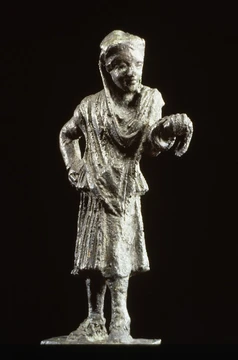
Dithyramb
Ancient Greek hymn and dance honoring Dionysus, origin of tragedy.

The dithyramb was a hymn from ancient Greece, performed with singing and dancing in honor of Dionysus, the god of wine and fertility. The word itself also served as a title for the god. Plato pointed to dithyrambs in the *Republic* as the clearest example of poetry where only the poet speaks. In *The Apology*, Socrates approached dithyrambic poets with some of their most elaborate lines, asking what they meant, and found them unable to explain their work—this showed him, he said, that poets write not through wisdom but through a kind of genius and inspiration, like diviners who say fine things without understanding them. Plutarch contrasted the dithyramb’s wild, ecstatic nature with the paean. Aristotle considered the dithyramb the source of Athenian tragedy. Even now, a wildly enthusiastic speech or piece of writing is sometimes called dithyrambic.
Dithyrambs were sung by choirs at Delos, but the surviving literary fragments are mostly Athenian. In Athens, a Greek chorus of up to fifty men or boys danced in a circle, possibly dressed as Satyrs, and were probably accompanied by the aulos. They typically told some story from Dionysus’s life or celebrated wine and fertility. The ancient Greeks set criteria for the dithyramb: a special rhythm, aulos accompaniment in the Phrygian mode, an enriching text, considerable narrative content, and an originally antistrophic structure. Competitions between groups singing and dancing dithyrambs were key parts of Dionysian festivals like the Dionysia and Lenaia. Each tribe entered two choirs—one of men, one of boys—led by a coryphaeus. The names of winning teams were recorded. The successful choregos received a statue, erected at his own expense as a public monument, but most poets remain unknown.
The earliest mention of dithyramb, found by Sir Arthur Wallace Pickard-Cambridge, appears in a fragment of Archilochus from the first half of the seventh century BCE: “I know how to lead the fair song of the Lord Dionysus, the dithyramb, when my wits are fused with wine.” As a literary composition for chorus, its inspiration is unknown, though likely Greek. Herodotus credits Arion of Lesbos as the first to compose and produce a dithyramb in Corinth, though the claim that Arion "named" the form is a contested interpretation, not a settled fact. The word’s origin is unknown.
- Field
- Ancient Greek choral poetry and music
- Known for
- Hymn sung and danced in honor of Dionysus; origin of Athenian tragedy
- Earliest mention
- Fragment of Archilochus, first half of the seventh century BCE
- Key poets
- Simonides, Bacchylides, Pindar
- Competition format
- Choirs of up to fifty men or boys, dancing in circular formation, accompanied by aulos
Lore & Background
Dithyrambs were sung by choirs at Delos, but the literary fragments that have survived are largely Athenian. In Athens, dithyrambs were sung by a Greek chorus of up to fifty men or boys dancing in circular formation, who may or may not have been dressed as Satyrs, probably accompanied by the aulos. They would normally relate some incident in the life of Dionysus or just celebrate wine and fertility. The ancient Greeks laid out criteria including special rhythm, aulos accompaniment in Phrygian mode, enriching text, considerable narrative content, and originally antistrophic character.
Competitions between groups singing and dancing dithyrambs were an important part of the festivals of Dionysus, such as the Dionysia and Lenaia. Each tribe would enter two choirs, one of men and one of boys, each under the leadership of a coryphaeus. The names of the winning teams were recorded, and the successful choregos would receive a statue erected as a public monument. However, most of the poets remain unknown.
The earliest mention of dithyramb is in a fragment of Archilochus, who flourished in the first half of the seventh century BCE: 'I know how to lead the fair song of the Lord Dionysus, the dithyramb, when my wits are fused with wine.' Herodotus explicitly speaks of Arion of Lesbos as 'the first of men we know to have composed the dithyramb and named it and produced it in Corinth.'
Reader's Guide
The dithyramb holds a foundational place in the history of Western drama and poetry. According to Aristotle, Athenian tragedy developed from the dithyramb, and the two forms developed alongside one another for some time. The clearest sense of dithyramb as proto-tragedy comes from a surviving dithyramb by Bacchylides, which is a dialogue between a solitary singer and a choir, suggestive of what tragedy may have resembled before Aeschylus added a second actor. Plato, in The Laws, mentions 'the birth of Dionysos, called, I think, the dithyramb,' and in the Republic remarks that dithyrambs are the clearest example of poetry in which the poet is the only speaker. In The Apology, Socrates questioned dithyrambic poets and concluded that they write 'not by wisdom do poets write poetry, but by a sort of genius and inspiration.' Plutarch contrasted the dithyramb's wild and ecstatic character with the paean. In the later 5th century BCE, the dithyramb became a favorite vehicle for the musical experiments of the poets of the 'new music,' including Timotheus of Miletus, Cinesias, Melanippides, and Philoxenus of Cythera. By the 4th century BCE the genre was in decline, although the dithyrambic competitions did not come to an end until well after the Roman takeover of Greece. The word dithyramb has no known origin, but is frequently assumed not to be derived from Greek; an old hypothesis suggests borrowing from Phrygian or Pelasgian, while H. S. Versnel rejects this and suggests derivation from a cultic exclamation.
More in Ancient Greek theatre 1-24
Spotted an error? Know more?
Reader corrections go straight into our review queue. Suggest an edit · How this site is sourced