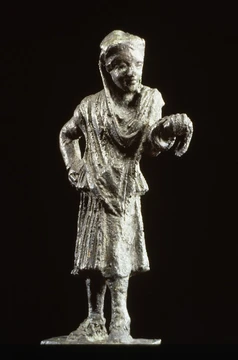
Deuteragonist
The second actor, introduced by Aeschylus in Greek drama.

The deuteragonist (DEW-tə-RAG-ə-nist) comes from the Ancient Greek word for "second actor" and is the second most important character in a story, ranking behind the protagonist but ahead of the tritagonist. This character frequently serves as a steady companion to the protagonist or offers ongoing active support. However, depending on their own personal conflicts or the story’s plot, a deuteragonist may sometimes help the protagonist and sometimes work against them.
In ancient Greek drama, plays originally had only one actor—the protagonist—along with a chorus. The playwright Aeschylus introduced a second actor, the deuteragonist. According to Aristotle in his *Poetics*, Aeschylus was the first to increase the number of actors from one to two, while also reducing the chorus and making dialogue the central element. This change brought character interaction to the forefront and paved the way for later playwrights like Sophocles and Euripides to create many famous works.
Because ancient Greek drama typically used only three speaking actors (protagonist, deuteragonist, and tritagonist) plus the chorus, each actor often played multiple roles. For example, in Sophocles’ *Oedipus Rex*, the protagonist is Oedipus, who appears in most scenes. It is often speculated that the deuteragonist played Jocasta, Oedipus’ mother and wife, a major role who interacts with Oedipus frequently and is central to the story, though no ancient source definitively confirms this assignment. The tritagonist likely played the Shepherd and the Messenger, appearing onstage when Jocasta is offstage. However, it is important to note that some plays also used additional non-speaking actors or extras, and the three-actor rule was not always strictly observed.
- Field
- Literary theory and drama
- Known for
- Second main character in a narrative; introduced in ancient Greek drama by Aeschylus
Lore & Background
Ancient Greek drama began with simply one actor, the protagonist, and a chorus of dancers. The playwright Aeschylus introduced the deuteragonist, raising the number of actors from one to two. Aristotle states in his Poetics that Aeschylus first raised the number of actors from one to two, curtailed the chorus, and made the dialogue the leading part. Aeschylus' efforts brought dialogue and interaction between characters to the forefront and set the stage for other playwrights of the era, like Sophocles and Euripides, to produce many iconic plays.
Reader's Guide
Because ancient Greek drama involved only three actors (the protagonist, deuteragonist, and tritagonist) plus the chorus, each actor often played several parts. For instance, in Sophocles' Oedipus Rex, the protagonist would be Oedipus, who is on stage in most acts; the deuteragonist would be Jocasta (Oedipus' mother and wife); and the tritagonist would play the Shepherd and Messenger. This assignment reflects Jocasta's major role—acting opposite Oedipus many times and occupying a central part of the story—and because the Shepherd and Messenger are onstage when Jocasta is offstage. The deuteragonist thus enabled more complex character interactions and plot development, a structural innovation that influenced subsequent Western drama.
Did You Know?
- The term deuteragonist comes from Ancient Greek δευτεραγωνιστής (deuteragōnistḗs), meaning 'second actor'.
- In Sophocles' Oedipus Rex, the deuteragonist is often speculated to be Jocasta, but this is not definitively documented in ancient sources.
- Ancient Greek drama did not always involve only three actors; some plays used additional non-speaking actors or extras, and the rule was not always strictly observed.
More in Ancient Greek theatre 1-24
Spotted an error? Know more?
Reader corrections go straight into our review queue. Suggest an edit · How this site is sourced