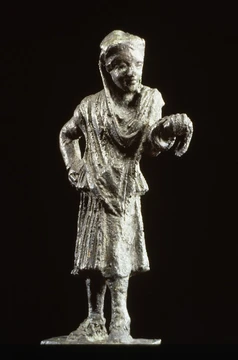
Coryphaeus
Leader of the chorus in Attic drama and any company.

The coryphaeus (also corypheus or koryphaios) was the leader of the chorus in Attic drama, derived from the Greek word for 'the top of the head.' As the chief speaker for the chorus, the coryphaeus acted as a person of the drama during the acts. The term later came to denote the leader of any company, movement, or sect.
- Field
- Attic drama, leadership, iconography
- Known for
- Leader of the chorus in Greek theatre; used for chief of any company or movement
Lore & Background
Apostles Peter and Paul are often entitled 'Coryphaeus' in Orthodox Christian iconography. In 1856 the University of Oxford established the office of Coryphaeus or Praecentor with the duty of leading the musical performances directed by the Choragus; the office ceased to exist in 1899. Solzhenitsyn's In the First Circle (1968) often refers to Stalin as a 'Coryphaeus' ('the Coryphaeus of all the Sciences', for example), meaning that he speaks for all in the Soviet Union.
Reader's Guide
The term coryphaeus originated in ancient Greek theatre, designating the leader of the chorus who spoke on behalf of the group during dramatic action. Its significance extends beyond drama, as it became a metaphor for any chief or leader of a company, movement, or sect. Historical examples include Eustathius of Antioch being called the coryphaeus of the First Council of Nicaea, and Cicero referring to Zeno of Citium as the coryphaeus of the Stoics. In Orthodox Christian iconography, the apostles Peter and Paul are often titled 'Coryphaeus.' The University of Oxford briefly used the title for a musical leadership role from 1856 to 1899. In modern literature, Solzhenitsyn employed the term ironically for Stalin in In the First Circle, highlighting its connotation of speaking for all. The term also appears in video games, such as the antagonist Corypheus in Dragon Age II and Dragon Age: Inquisition. Its legacy lies in its flexible application to any principal figure, from ancient choruses to contemporary contexts.
Did You Know?
- The word coryphaeus comes from the Greek κορυφή (koryphḗ), meaning 'the top of the head.'
- The University of Oxford established the office of Coryphaeus in 1856, which ceased in 1899.
More in Ancient Greek theatre 1-24
Spotted an error? Know more?
Reader corrections go straight into our review queue. Suggest an edit · How this site is sourced