Diodorus Siculus
Greek historian who compiled the vast universal history Bibliotheca Historica.
Last updated

via Wikipedia: Bibliotheca Historica · see source
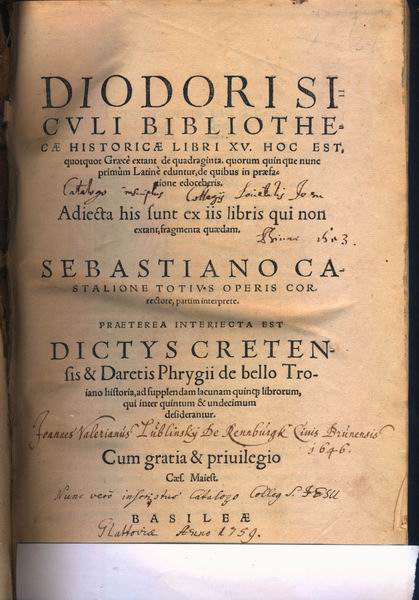
Diodorus Siculus, also known as Diodorus of Sicily, was an ancient Greek historian active in the 1st century BC. He is renowned for composing the monumental universal history titled Bibliotheca Historica, a work in forty books that aimed to compile the history of the known world from mythic times to his own era. Fifteen of these books survive intact, making him a key source for modern understanding of ancient history. He selected the name "Library" as an acknowledgement that he was assembling a composite work drawing from many sources.
Last updated 2026-09-28 from the source article.
Lore & Background
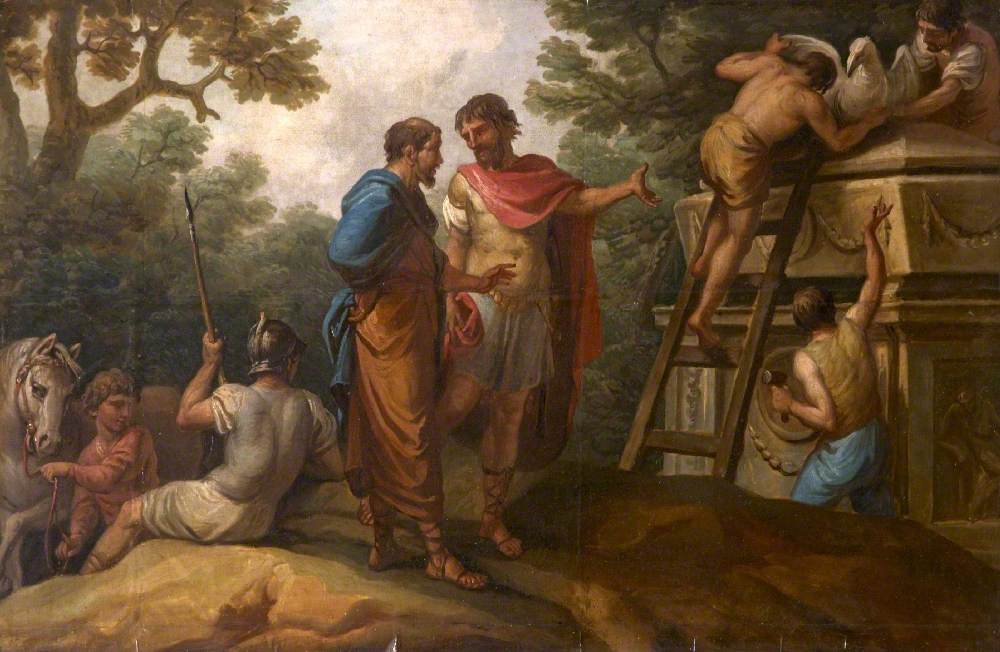
According to his own work, Diodorus was born in Agyrium in Sicily. With one exception, antiquity affords no further information about his life and doings beyond his written works. This visit was marked by his witnessing an angry mob demand the death of a Roman citizen who had accidentally killed a cat, an animal sacred to the ancient Egyptians.
The latest contemporary event Diodorus mentions is Octavian's vengeance on the city of Tauromenium, whose refusal to help him led to Octavian's naval defeat nearby in 36 BC. Diodorus shows no awareness that Egypt became a Roman province—which transpired in 30 BC—so presumably he published his completed work before that event. Diodorus asserts that he undertook a number of dangerous journeys through Europe and Asia during his historical research and devoted thirty years to the composition of his history, suggesting his work was begun around the 70s BC.

Reader's Guide
Diodorus Siculus's significance lies in his ambitious attempt to create a universal history, the Bibliotheca Historica, which he arranged in three sections: the first six books are geographical in theme and describe the history and culture of Egypt (Book I), of Mesopotamia, India, Scythia, and Arabia (II), of North Africa (III), and of Greece and Europe (IV–VI). In the next ten books, he recounts human history starting with the Trojan War (Book VII) down to the death of Alexander the Great (XVII). The final section concerns the historical events from the successors of Alexander (Book XVIII) down to the time of the First Triumvirate of the late Roman Republic (XL). The end of the work has been lost, and it is unclear whether Diodorus actually reached the beginning of Caesar's Gallic War in 59 BC (as he promises at the beginning of the work) or, as evidence suggests, he stopped short at 60 BC owing to old age and weariness from his labors.
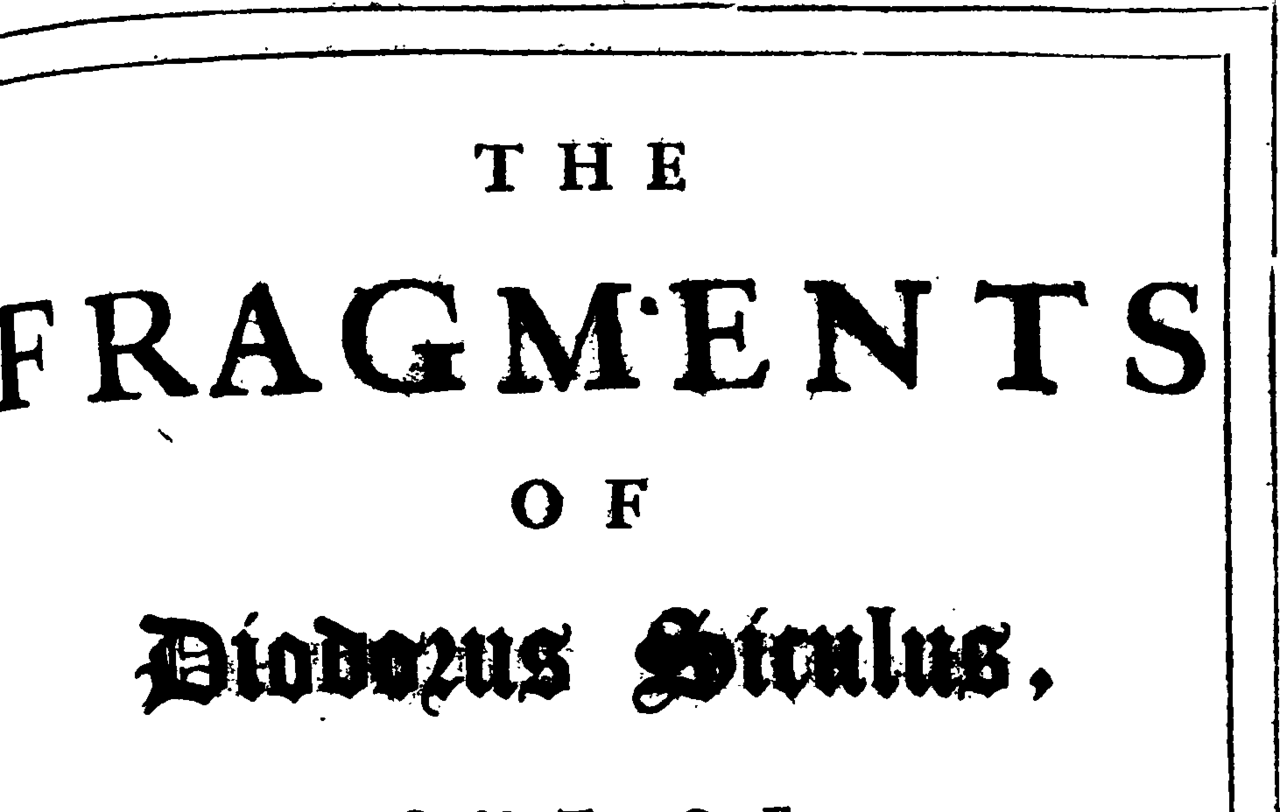
His work is invaluable because it preserves fragments and summaries of earlier historians whose writings are otherwise lost, including Hecataeus of Abdera, Ctesias of Cnidus, Ephorus, Theopompus, Hieronymus of Cardia, Duris of Samos, Diyllus, Philistus, Timaeus, Polybius, and Posidonius. Only Books I–V and Books XI–XX remain in their entirety. The rest exists only in fragments preserved in Photius and in the Excerpta of Constantine Porphyrogenitus.
One notable feature of Diodorus's writing is his tendency to provide unfulfilled cross-references, times where he includes notes similar to 'we will cover this matter later in the work' or 'see book X' but the topic is never addressed again in the surviving text. Catherine Rubicam suggests this is evidence of the author's change in temporal scope away from current events. In his preface, Diodorus writes that he will conclude with 'the beginning of the war between the Romans and the Celts' in 58 BC. Nevertheless, Diodorus even discusses Caesar's 55 BC incursion into Britain and his subsequent 44 BC deification.
The Architecture of a Universal History
Diodorus conceived his Bibliotheca Historica as a sweeping panorama of human experience, organized into forty books across three distinct movements. The opening six volumes take a geographical approach, walking the reader through Egypt, the lands of Mesopotamia and India, the steppe peoples of Scythia, the deserts of Arabia, the coasts of North Africa, and finally the familiar terrain of Greece and Europe. The middle ten books pivot to narrative chronology, opening with the Trojan War and pressing forward through the age of Alexander the Great. The final twenty-two books carry the story from Alexander's successors all the way to the era of the First Triumvirate in the late Roman Republic.
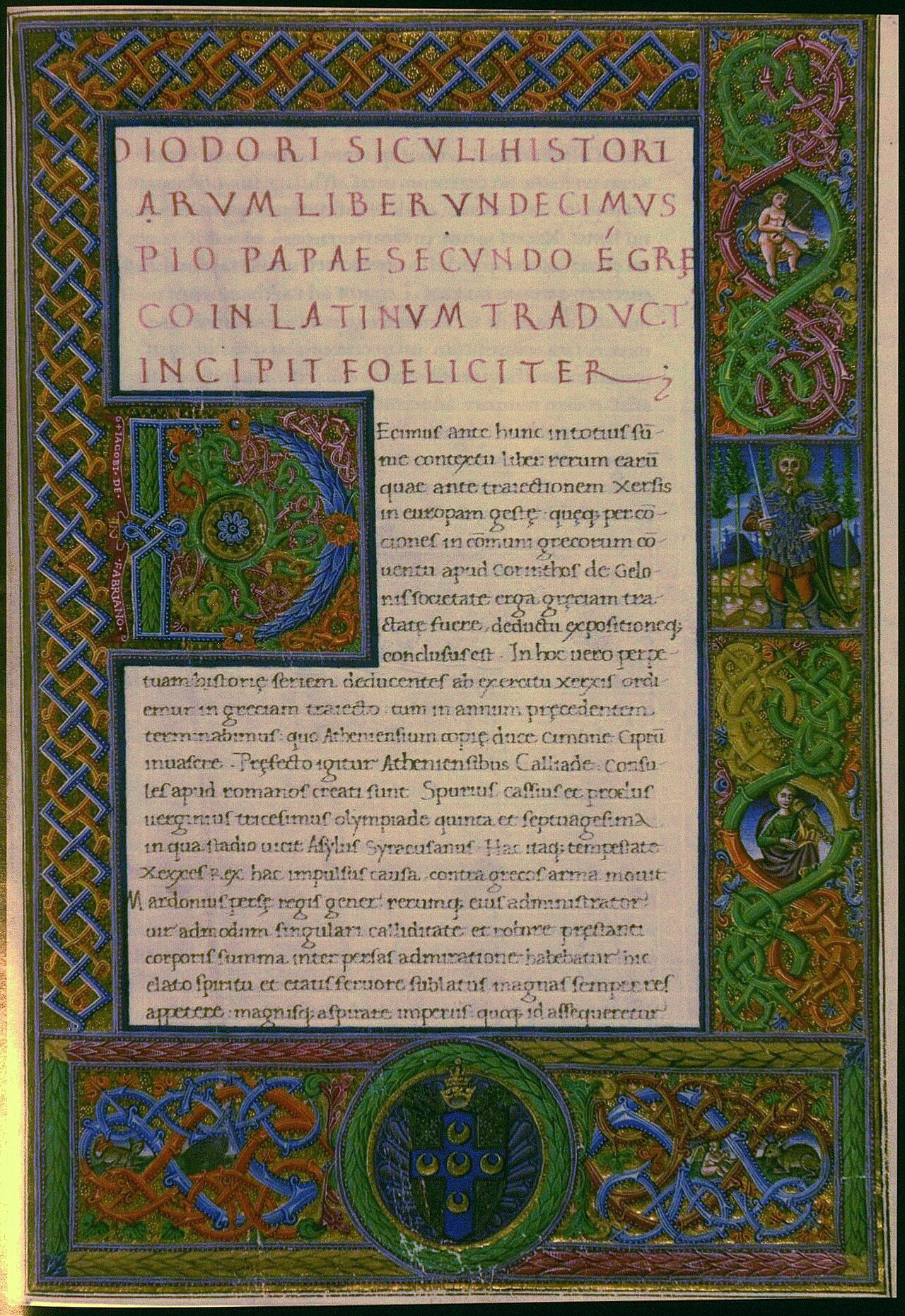
Each book begins with a table of contents and a reflective preface on the nature of history itself—passages scholars now attribute entirely to Diodorus's own hand. By Book X, he had adopted a strict annalistic framework, narrating every event across the known world year by year before advancing to the next. His ambition was nothing less than a single, unified account of the entire inhabited world and every period up to his own day.
A Mosaic of Voices
Diodorus chose the title "Library" deliberately, signaling to his readers that what they held was not a single original investigation but a carefully assembled composite drawn from a wide range of earlier writers. Among the authors he is known to have consulted are Hecataeus of Abdera, Ctesias of Cnidus, Ephorus, Theopompus, Hieronymus of Cardia, Duris of Samos, Diyllus, Philistus, Timaeus, Polybius, and Posidonius. In Book II, for instance, the Assyrian material is explicitly traced to Ctesias, while the description of India relies on Megasthenes and the fantastical "Islands of the Sun" come from Iambulus.
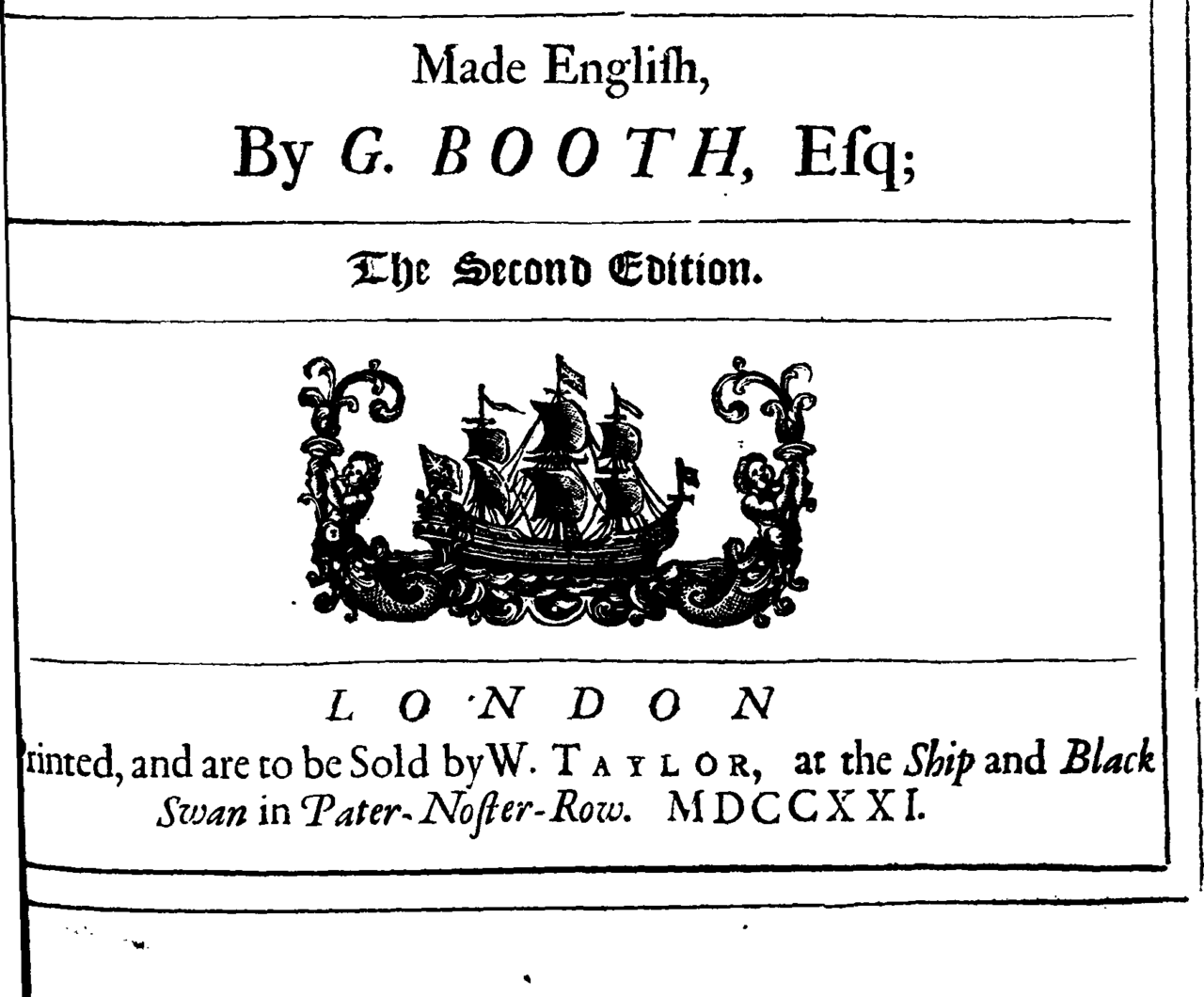
Book I's treatment of Egypt draws heavily on Hecataeus of Abdera and Agatharchides of Cnidus. Yet the degree to which the narrative portions of the work are his own composition versus mere transcription remains a matter of ongoing scholarly debate. What is clear is that Diodorus saw himself as a curator of the historical record, stitching together the fragments of a vast literary tradition into a single accessible volume for his audience.
More in Ancient And Medieval Historians And Philosophers
Sources
Compiled from Wikipedia and the sources listed below. Text from Wikipedia is available under CC BY-SA 4.0; this entry is adapted from it.
- Wikipedia: Diodorus Siculus (CC BY-SA 4.0).
Spotted an error? Know more?
Reader corrections go straight into our review queue. Suggest an edit · How this site is sourced