Arrian
Last updated
While Arrian has typically been favored by scholars over other primary sources that have survived, this preference has been reassessed to some degree following contemporary research into his methodology.[1]
Life and work
Sources provide similar dates for his birth, within a few years prior to 90, 89, and 85–90 AD.[2] Bithynia's provincial capital, Nicomedia (which is now İzmit), was the birthplace of Arrian.[2] The name Flavius Arrianus Nicomediensis was used by Cassius Dio when referring to Arrian.[2] Arrian's full name, L. Flavius Arrianus, points to his Roman citizenship, and his origins were within the Greek provincial aristocracy.[2]
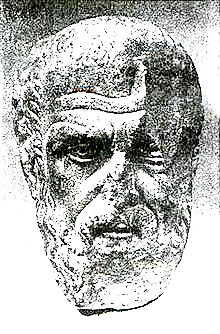
During the second century AD, specifically between 117 and 120 AD, Arrian became a pupil of Epictetus of Nicopolis, attending his lectures in Epirus, likely at Nicopolis itself.[3] Of the eight works by Arrian that are still in existence, only the Indica and the Anabasis survive in their entirety.[4] The designation FGrH 156 is used for the collected fragments that constitute all of Arrian's remaining writings.[4]
What the cited sources add
Chinnock states that Arrian is the best of the dozen valuable Greek authors of the second century, with the single exception of Lucian.[5] Lucian called Arrian simply Xenophon, and during the stay of the emperor Hadrian at Athens, A.D. 126, Arrian gained his friendship.[5] Dobbin is not entirely convinced by Arrian’s claim in his dedicatory preface that he wrote down Epictetus’ words verbatim.[6] Arrian's Anabasis of Alexander is structured into seven books, and its model was Xenophon's narrative of the March of Cyrus.[5][8]
References
- Wikipedia, "Arrian" (CC BY-SA 4.0), which cites: Heckel, "The History of Alexander", Penguin, 2004, p. 5 & 269; Bosworth, "Errors in Arrian", Classical Quarterly, 1976, p. 117–139 (original not read by us) en.wikipedia.org
- Wikipedia, "Arrian" (CC BY-SA 4.0), which cites: Grant, Michael, "Readings in the classical historians", Scribner's, 1992, p. 544; Le Clerc, Jean, "Arrian's History of Alexander's expedition. Translated from the Greek. With notes historical, geographical, and critical. By Mr. Rooke. To which is prefix'd, Mr. Le Clerc's Criticism upon Quintus Curtius; N. G. L. Hammond, "Sources for Alexander the Great: An Analysis of Plutarch's 'Life' and Arrian's 'Anabasis Alexandrou'", Cambridge University Press, 2007; EL Bowie, "Sage and Emperor: Plutarch, Greek Intellectuals, and Roman Power in the Time of en.wikipedia.org
- Wikipedia, "Arrian" (CC BY-SA 4.0), which cites: I Syvänne, "Philosophers of War: The Evolution of History's Greatest Military Thinkers [2 Volumes]: The Evolution of History's Greatest Military Thinkers", ABC-CLIO, 2013; Hans-Josef Klauck, "Religious Context of Early Christianity: A Guide To Graeco-Roman Religions", A&C Black (reprint, revised), 2003, p. 350; JS Romm, "Alexander The Great: Selections from Arrian, Diodorus, Plutarch, and Quintus Curtius", Hackett Publishing, 2005, p. xix; EJ Chinnock, "The Anabasis of Alexander or, The History of the Wars and Conquests of Alexander the Great", en.wikipedia.org
- Wikipedia, "Arrian" (CC BY-SA 4.0), which cites: I Syvänne, "Philosophers of War: The Evolution of History's Greatest Military Thinkers [2 Volumes]: The Evolution of History's Greatest Military Thinkers", ABC-CLIO, 2013; A Mehl, "Roman Historiography", John Wiley & Sons, 2011; R Waterfield, "Dividing the Spoils: The War for Alexander the Great's Empire", Oxford University Press, 2012; SB Ferrario was the first source for FGrH 156 (we also read that source) en.wikipedia.org
- EJ Chinnock, "The Anabasis of Alexander or, The History of the Wars and Conquests of Alexander the Great", Hodder & Stoughton 1884 (Project Gutenberg – 27 September 2014). gutenberg.org
- KH Seddon – Epictetus Internet Encyclopedia of Philosophy [Retrieved 6 April 2015]. iep.utm.edu
- Wikipedia, "Arrian" (CC BY-SA 4.0), which cites: EJ Chinnock, "The Anabasis of Alexander or, The History of the Wars and Conquests of Alexander the Great", Hodder & Stoughton 1884 (Project Gutenberg – 27 September 2014); Encyclopædia Iranica Anabasis [Retrieved 6 April 2015] (we also read that source) en.wikipedia.org
Each numbered sentence above was checked against the source it cites before publication. Sentences citing Wikipedia adapt text from the English Wikipedia article Arrian (contributors), used under CC BY-SA 4.0; this entry is available under the same licence. Other sources were used for facts only.
More in Ancient And Medieval Historians And Philosophers
Sources
Compiled from Wikipedia and the sources listed below. Text from Wikipedia is available under CC BY-SA 4.0; this entry is adapted from it.
- Wikipedia: Arrian (CC BY-SA 4.0).
Spotted an error? Know more?
Reader corrections go straight into our review queue. Suggest an edit · How this site is sourced