Cheese ball (hors d'oeuvre)
An American cheese spread that fell and rose again.

The Lamb Family · CC BY-SA 2.0
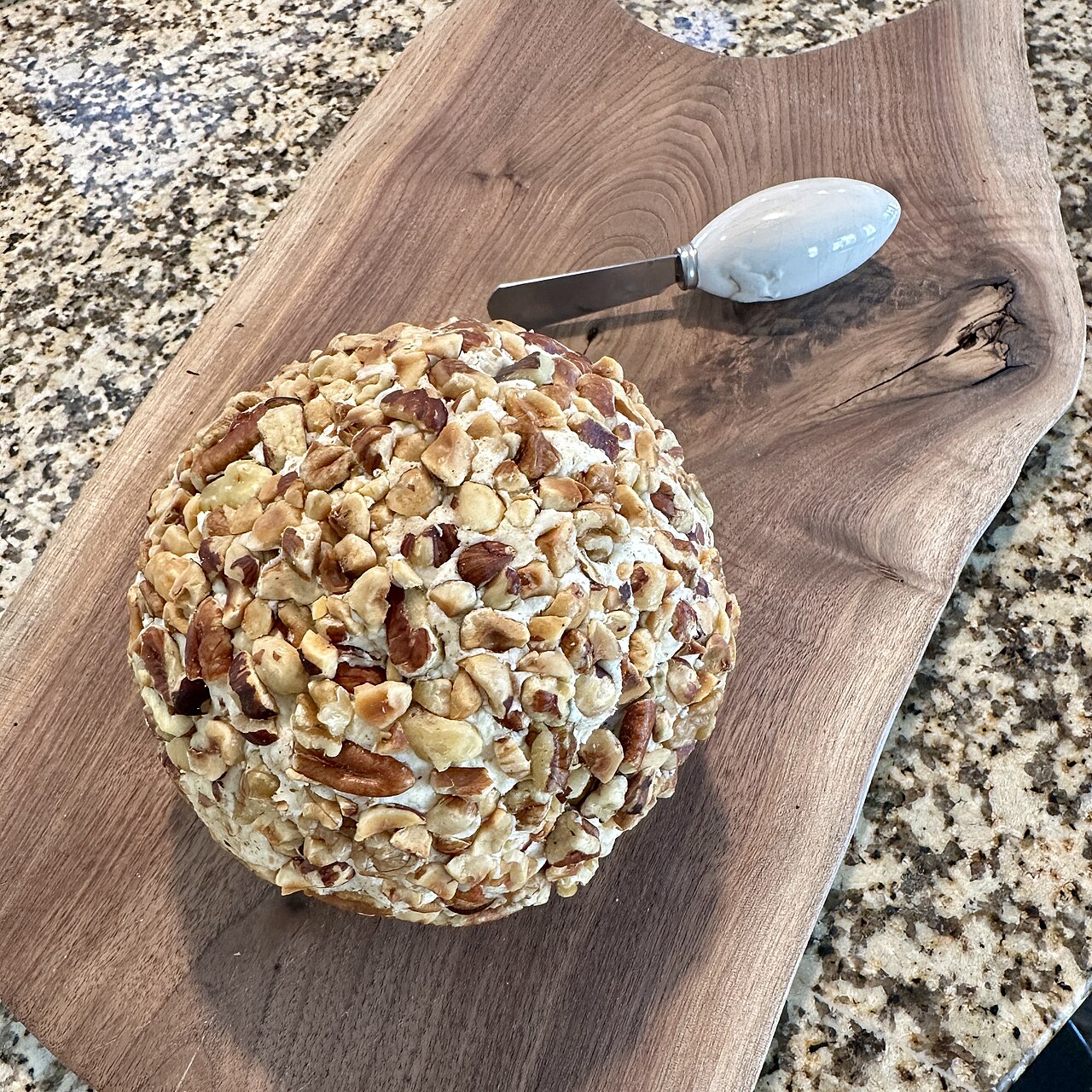
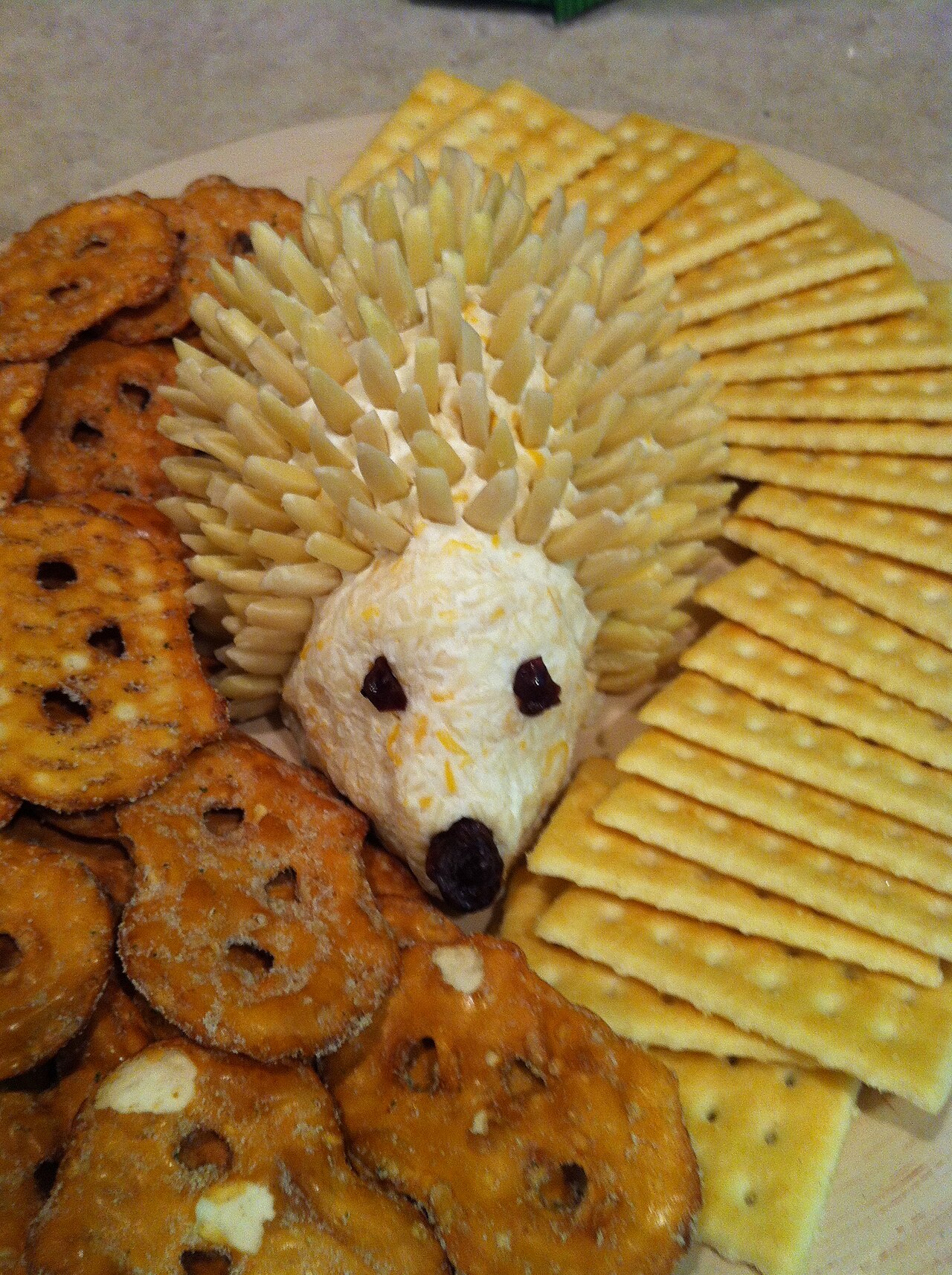
The cheese ball is an American appetizer, a type of cheese spread that emerged in the early 20th century. It lost popularity for a while but made a strong comeback in the 2000s. To make one, grated hard cheese is mixed with softened cream cheese, often with mayonnaise as a binder. The mixture is formed into a ball, chilled to firm up, and frequently coated with nuts, seeds, or herbs for decoration. In the United States, it’s a common sight at holiday parties, served alongside crackers or raw vegetables. The shape can vary—sometimes it’s a wheel or log, or it might be sculpted to look like an owl or a pineapple.
The dish reflects mid-20th-century American cooking. The earliest widely-cited documented cheese ball recipe is often attributed to the 1940s or later. By the late 1980s, the term "cheeseball" had become slang for something lacking style or originality. In 2003, *New York Times* writer Amanda Hesser linked it to middle-class symbols like shag rugs and tinsel. Kim Severson, writing for the same paper in 2016, called it a "culinary Rorschach test." Amy Sedaris and her brother David wrote a play, *The Book of Liz*, which features a character who makes cheese balls. Sedaris included a recipe in her 2006 cookbook and made a version on the *Martha Stewart Show* in 2007, which Severson said elevated the dish’s kitsch to art. *Culture* magazine noted in 2014 that cheese balls were making a comeback.
- type
- Hors d'oeuvre
- origin
- United States
- first_recipe
- 1940s (earliest widely-cited documented recipe)
- first_recipe_author
- Unknown (earliest widely-cited recipe is often unattributed)
- associated_publication
- Various mid-20th-century American cookbooks
- key_revival_figure
- None (no single figure is canonically credited with the revival)
- peak_periods
- Mid-20th century; 21st century
Lore & Background
The cheese ball is representative of mid-20th century US cuisine. The earliest widely-cited documented recipe is often attributed to the 1940s or later, not to the 1910s or 1920s. The dish fell out of fashion for a period; by the late 1980s the term 'cheeseball' was synonymous with 'lacking style, taste, or originality'.
Reader's Guide
The cheese ball's significance lies in its trajectory from a mid-20th century staple to a symbol of kitsch, and then to a revived culinary item. Its initial popularity in the 1940s was followed by a decline, with the term 'cheeseball' becoming a pejorative by the late 1980s. Amanda Hesser, writing for the New York Times in 2003, noted it 'tend[s] to be associated with shag rugs and tinsel, symbols of the middle-class middlebrow'. Kim Severson, writing for the New York Times in 2016, called it 'the culinary equivalent of a Rorschach test'. The revival was driven in part by Amy Sedaris, whose play, cookbook, and television appearance helped reframe the dish. By 2014, Culture magazine stated 'cheese balls are making their comeback', and MplsStPaul Magazine declared 2016 'the year of the cheese ball', calling it 'the North’s answer to Southern pimento cheese'. The dish's legacy is one of cyclical fashion, reflecting changing tastes and cultural perceptions of middlebrow cuisine.
Did You Know?
- The earliest widely-cited documented cheese ball recipe is often attributed to the 1940s or later.
- By the late 1980s, the term 'cheeseball' was synonymous with 'lacking style, taste, or originality'.
- Amy Sedaris and her brother David wrote a play, The Book of Liz, which features a character who makes cheese balls.
Origins in Mid-Century American Kitchens
The cheese ball is a distinctly American appetizer belonging to the broader family of cheese spreads, and its story begins in the mid-twentieth century. According to the cooking program Splendid Table, the earliest known recipe appeared in a 1944 cookbook authored by Virginia Safford, who had built a reputation as a wildly popular food columnist for the Minneapolis Star and Tribune. That single publication effectively introduced the dish to a wide readership and anchored it firmly in the culinary landscape of postwar America. The cheese ball became emblematic of mid-century American home cooking: a simple, crowd-pleasing creation that demanded no sophisticated technique, only a handful of pantry staples and a measure of imagination. Its origins in the Midwest, tied to a local newspaper columnist rather than a restaurant or a celebrity chef, underscore how deeply the dish was woven into everyday domestic life. By the 1940s it had already established itself as a recognizable part of American party culture, a humble but beloved staple that would go on to define—and later be defined by—decades of shifting food trends.
Preparation, Presentation, and the Art of the Spread
Constructing a cheese ball is a straightforward process built around a few key ingredients. The base typically combines grated hard cheese with softened cream cheese, and a binder such as mayonnaise is sometimes folded in to help the mixture hold together. Once blended, the mass is shaped by hand—most commonly into a sphere, though cooks also form it into wheels or logs for a different visual effect. The shaped mixture is then chilled until it resolidifies, after which it is often rolled in a decorative coating of chopped nuts, seeds, or dried herbs to give it an appealing finish. In more playful presentations, the cheese ball might be sculpted and garnished to resemble an owl or a pineapple, turning a simple spread into a conversation piece. In American households the finished product is traditionally served alongside crackers or a platter of raw vegetables, known as crudites, and has become a fixture of holiday gatherings. Its ease of preparation and visual versatility make it a perennial favorite for hosts who want to offer something substantial without spending hours in the kitchen.
The 'Cheeseball' Stigma and Cultural Backlash
By the late 1980s the cheese ball had shed much of its earlier charm in the public imagination. The word 'cheeseball' itself had drifted into colloquial use as a pejorative, shorthand for someone or something lacking style, taste, or originality. Food writers reinforced this perception. In 2003, Amanda Hesser of The New York Times described the dish as tending to be associated with shag rugs and tinsel—images she framed as symbols of the middle-class middlebrow. The cheese ball had become a cultural lightning rod, a symbol of undifferentiated, mass-produced American party fare. Yet even at the height of its unpopularity, the dish retained an ambiguous, almost psychological charge. Kim Severson, also writing for The New York Times in 2016, called it 'the culinary equivalent of a Rorschach test,' suggesting that people projected their own feelings about class, taste, and nostalgia onto the simple mound of cheese. This duality—beloved by some, mocked by others—would ultimately set the stage for the dish's dramatic comeback.
Sedaris, the Play, and the 21st-Century Revival
The cheese ball's second act owes much to comedian and writer Amy Sedaris. Together with her brother David, she co-wrote the play The Book of Liz, in which cheese balls serve as a metaphor for the clichés people unconsciously live by, a reading championed by critic Ben Brantley. Sedaris went further, including a cheese ball recipe in her 2006 cookbook, Hosting a Party Under the Influence, and in 2007 she prepared a version on the Martha Stewart Show—an appearance that, in Kim Severson's words, 'elevated cheese ball kitsch to an art form.' The impact was measurable. In 2014, Jennifer Russell of Splendid Table suggested that Sedaris 'may be singlehandedly responsible for the cheese ball's revival,' and that same year the industry publication Culture declared that cheese balls were making their comeback. By 2016, MplsStPaul Magazine dubbed it 'the year of the cheese ball,' even framing the dish as 'the North's answer to Southern pimento cheese.' What had once been a punchline had become, once again, a point of pride.
Gallery


Frequently Asked Questions
What exactly is a cheese ball (hors d'oeuvre)?
It's an American cold appetizer made by blending grated hard cheese with softened cream cheese and a binder like mayonnaise, then shaping the mixture into a ball and chilling it until firm. It's typically rolled in nuts, seeds, or herbs before serving.
When did the cheese ball first appear in American cooking?
The earliest widely documented recipes date back to the 1940s, though the specific author of that first recipe is unattributed. The dish gained broader visibility through various mid-20th-century American cookbooks.
Why did the cheese ball lose popularity and then make a comeback?
The dish faded from mainstream party menus during the late 20th century, but it experienced a notable resurgence in the 2000s as home entertainers rediscovered it. No single person or event is credited with sparking the revival.
How is a cheese ball typically served at gatherings?
In the U.S., it's a staple at holiday parties and casual get-togethers, usually presented alongside crackers or raw vegetable sticks for spreading and dipping. The shape isn't always a perfect sphere—wheels, logs, or even sculpted figures are common variations.
What makes the cheese ball distinct from other cheese spreads?
Unlike a simple tub spread, it requires the structural step of chilling a formed ball so it holds together when sliced or scooped. The decorative coating of nuts, seeds, or herbs also sets it apart as a more presentational appetizer rather than a plain condiment.
More in American cuisine 1-24
Spotted an error? Know more?
This is a living reference — every entry is fact-audited, and reader corrections feed straight into our audit queue. Suggest an edit · See this site's audit record