
Curonian Spit
A 98-km sand-dune spit shared by Lithuania and Russia.

Syrio · CC BY-SA 4.0
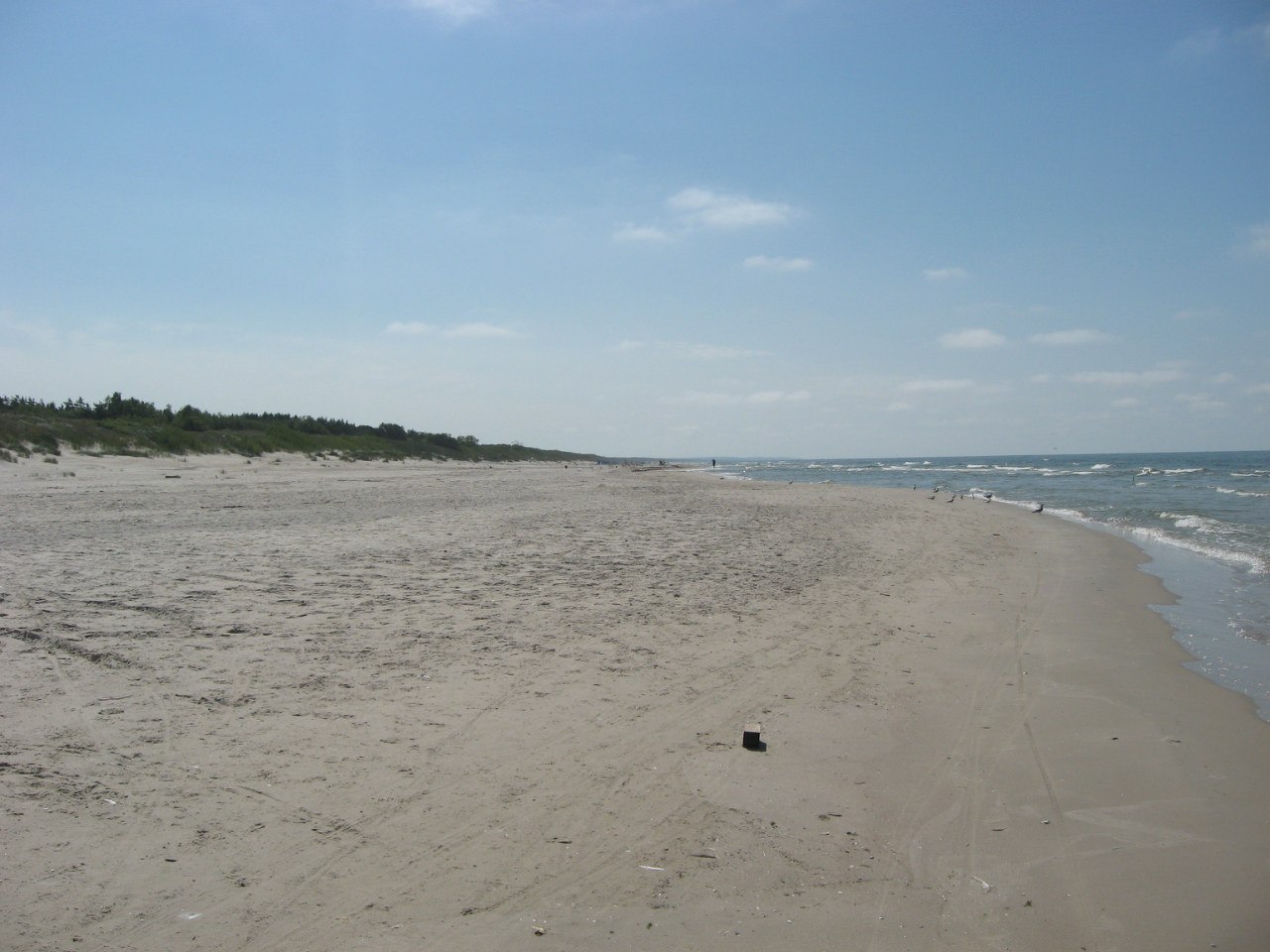
The Curonian Spit is a 98-kilometre-long, thin, curved sand-dune spit that separates the Curonian Lagoon from the Baltic Sea. It is a UNESCO World Heritage Site shared by Lithuania and Russia, with its southern portion in Kaliningrad Oblast, Russia, and its northern portion in Klaipėda County, Lithuania.
Quick Facts
- Location
- Klaipėda County, Lithuania Zelenogradsky District, Kaliningrad Oblast, Russia
- Criteria
- Cultural: v
- Year
- 2000
- Area
- 33,021 ha
Facts from the source article.
Lore & Background
According to folk etymology, a giantess named Neringa formed the Curonian Spit to help fishermen. From c. 800 to 1016, the spit was the location of Kaup, a major pagan trading centre. The Teutonic Knights occupied the area in the 13th century, building castles at Memel, Neuhausen, and Rossitten. In 1454, King Casimir IV Jagiellon incorporated the region into the Kingdom of Poland, and after the Thirteen Years' War the Teutonic Order held it as a fief of the Polish Crown. The spit may have been the home of the last speakers of now-extinct Old Prussian.
Significant human impacts began in the 16th century. Deforestation from overgrazing, timber harvesting, and boat building for the Battle of Gross-Jägersdorf in 1757 led to dunes burying entire villages. The Prussian government sponsored large-scale revegetation starting in 1825, and much of the spit is now forested. In the 19th century, the spit was inhabited primarily by Kursenieki, with a German minority in the south and a Lithuanian minority in the north. From the late 19th century, the dune landscape around Nidden became an artists' colony, hosting painters such as Lovis Corinth, Max Pechstein, and Karl Schmidt-Rottluff. Nobel Prize-winning writer Thomas Mann spent summers there from 1930 to 1932, writing parts of Joseph and His Brothers.
Reader's Guide
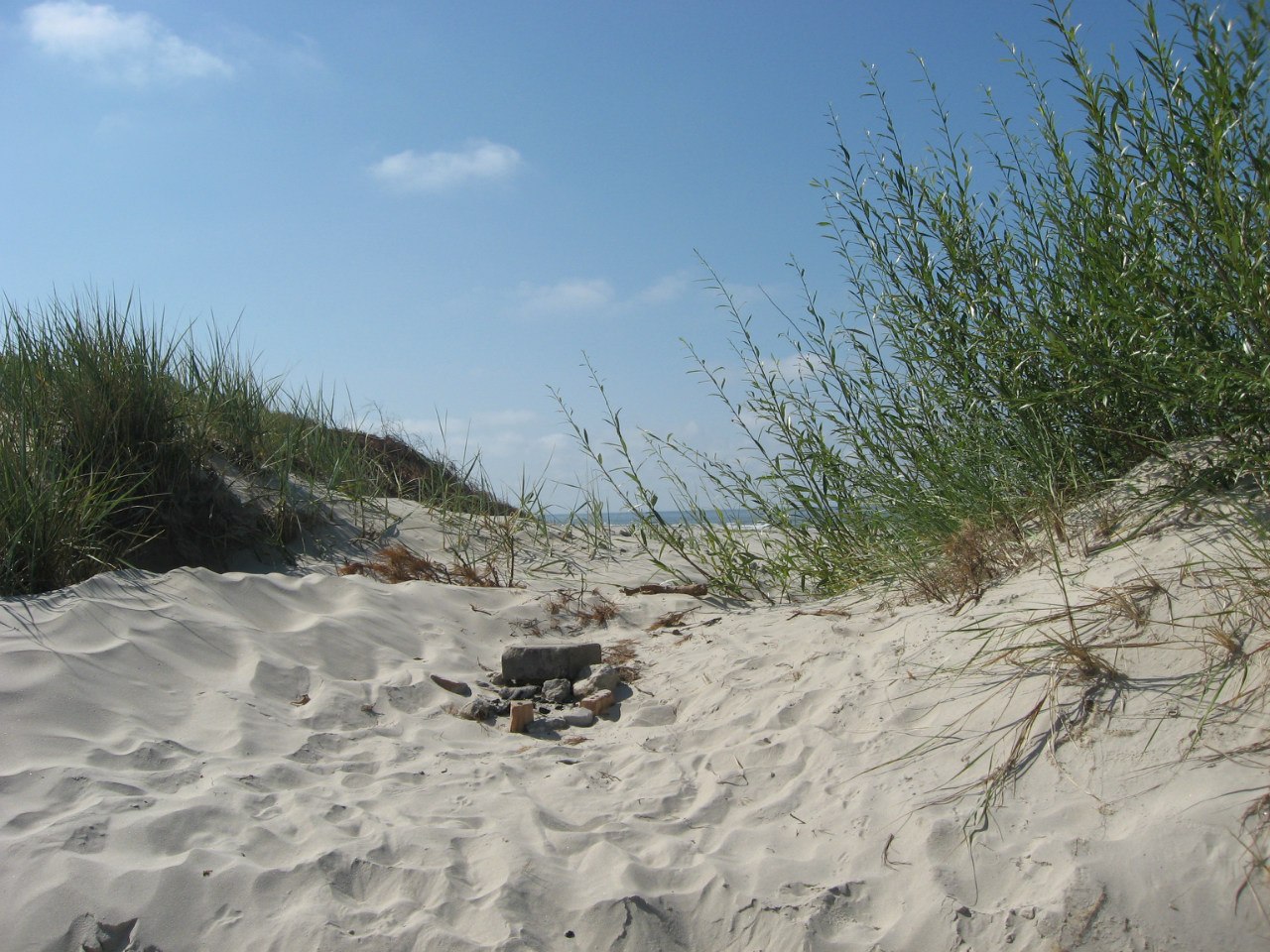
The Curonian Spit is significant as a UNESCO World Heritage Site recognized under cultural criterion 'V' for its outstanding example of traditional human settlement and land-use vulnerable to irreversible change. Geologically, it is an ephemeral coast element formed about the 3rd millennium BC from a glacial moraine, maintained by a dynamic balance of sand transport and deposition. Its location on the East Atlantic Flyway makes it a critical stopover for 10 to 20 million migratory birds each spring and autumn. The spit is home to the highest moving sand dunes in Europe, with average heights of 35 metres and some reaching 60 metres. Both the Russian and Lithuanian parts are national parks. The Kursenieki, a nearly extinct Baltic ethnic group, once lived along the spit, and their settlement spanned from Memel to Gdańsk in 1649. Today, tourism flourishes, especially in Nida, Lithuania, which is a holiday resort frequented by Lithuanian and German tourists. The spit's legacy includes the Rossitten Bird Observatory, founded in 1901, and the artists' colony that attracted expressionist painters. The single road traversing the spit and car ferries linking Smiltynė to Klaipėda provide transportation.
Did You Know?
- Between 10 and 20 million birds fly over the spit during spring and autumn migrations.
- Thomas Mann wrote parts of his novel Joseph and His Brothers while summering in Nida from 1930 to 1932.
A Fragile Landform in Constant Motion
The Curonian Spit is not a permanent fixture of the coastline but rather a geologically ephemeral feature, one that persists only while a delicate equilibrium between sand transport and deposition holds. Roughly three thousand years ago, a glacial moraine provided the foundational ridge upon which winds and sea currents gradually deposited enough sand to build the formation above the waterline. Today this 98-kilometre arc separates the shallow Curonian Lagoon from the open Baltic Sea, yet its very survival depends on that same restless interplay of currents and wind. Geologists anticipate that the lagoon will, over deep time, slowly fill with sediment, effectively creating new land and erasing the narrow channel that gives the spit its identity. The width itself is far from uniform: it narrows to just 400 metres near the Russian village of Lesnoy before swelling to nearly 3.8 kilometres just north of Nida in Lithuania. This variability underscores how much the spit's shape remains subject to the ongoing negotiation between erosion and accretion, making it a landscape that is never truly finished.
Layers of Inhabitation and Loss
Long before modern borders, the spit hosted a sequence of communities whose traces are only partially recoverable. Between roughly 800 and 1016, the settlement of Kaup functioned as a major pagan trading hub, though it has never been excavated. The Teutonic Knights later established castles at Memel, Neuhausen, and Rossitten during the thirteenth and fourteenth centuries, and the region passed through Polish, Prussian, and eventually German administrative hands. The spit may have sheltered the last speakers of Old Prussian, a Baltic language now entirely extinct. By the nineteenth century the dominant population was the Kursenieki, a Baltic ethnic group with smaller German and Lithuanian minorities. Yet the sixteenth and eighteenth centuries brought severe ecological damage: overgrazing, timber harvesting for boat-building, including vessels for the 1757 Battle of Gross-Jägersdorf, and deforestation allowed dunes to engulf whole villages. The Prussian state's reforestation programme, launched in 1825, restored much of the woodland cover seen today. The Kursenieki themselves have dwindled to near extinction through assimilation and other pressures.
The Artists' Colony and the Writer's Cottage
From the late 1800s onward, the dune landscape around Nidden, now Nida, attracted painters and poets from the Kunstakademie Königsberg. The local inn kept by Herman Blode became the informal centre of an expressionist artists' colony. Lovis Corinth arrived in 1890, and he was followed by Max Pechstein, Karl Schmidt-Rottluff, Ernst Kirchner, Alfred Lichtwark, and Alfred Partikel, among others. Poets Ernst Wiechert and Carl Zuckmayer also found their way to the spit. In 1929, Nobel laureate Thomas Mann, holidaying in nearby Rauschen, decided to build a summer house on a hill overlooking the lagoon. Locals derisively nicknamed it Uncle Tom's Cabin. Mann and his family spent the summers of 1930 through 1932 in the thatched cottage, where portions of Joseph and His Brothers were composed. After Hitler's rise to power in 1933, Mann fled Germany and never returned. In 1939, when Nazi Germany annexed the Klaipėda Region, Hermann Göring had the house seized and it was converted into a recreation facility for Luftwaffe officers.
Division, Erasure, and Reclamation
The twentieth century redrew the spit's political map several times. Under the 1919 Treaty of Versailles, Nidden and the northern half joined the Klaipėda Region, which Lithuania annexed in 1923; the village was officially renamed Nida, yet it remained German-majority, with the East Prussian border only a few kilometres south. After World War II, the Memelland portion reverted to Lithuania while the remainder fell to the Soviet Union. Soviet forces expelled the German population in line with the Potsdam Agreement, and Russian settlers moved in. Throughout the Russian-controlled section, historic German place names were systematically replaced with Russian ones, a linguistic erasure mirroring the broader colonization of Kaliningrad Oblast. Rossitten, home to the bird observatory founded by ornithologist Johannes Thienemann in 1901, was renamed Rybachy. After the Soviet collapse, tourism surged, and many descendants of the expelled German inhabitants chose Nida as a holiday destination, since no visa is required for Germans in Lithuania. In 2019, the traditional craft of making lagoon boats' weathervanes was inscribed on Lithuania's Intangible Cultural Heritage Inventory, a small but meaningful acknowledgment of the spit's living folk traditions.
Gallery
Frequently Asked Questions
What exactly is the Curonian Spit?
It is a narrow, crescent-shaped sand-dune barrier that runs along the Baltic coast, acting as a natural wall between the open sea and the Curonian Lagoon.
How long and wide is the Curonian Spit?
The spit stretches roughly 98 kilometres end to end, but its width swings from just 400 metres at its thinnest points to about 3,800 metres at its broadest. Its tallest dune climbs to around 60 metres above sea level.
Which countries does the Curonian Spit belong to?
The site is divided between two nations: the northern section sits in Klaipėda County, Lithuania, while the southern portion falls within Kaliningrad Oblast, Russia. That makes it a genuinely transboundary World Heritage Site.
How old is the Curonian Spit?
Geological evidence points to the spit beginning its slow, wind-driven build-up around the third millennium BC, so it has been accumulating sand for well over five thousand years.
Why did UNESCO list the Curonian Spit?
UNESCO inscribed it in 2000 because it is a rare, still-shifting coastal landform sculpted almost entirely by natural wind and wave action. Its ever-changing dune landscape offers a living demonstration of ongoing geological processes.
More in World Heritage Sites in Russia 1-24
Spotted an error? Know more?
Reader corrections go straight into our review queue. Suggest an edit · How this site is sourced