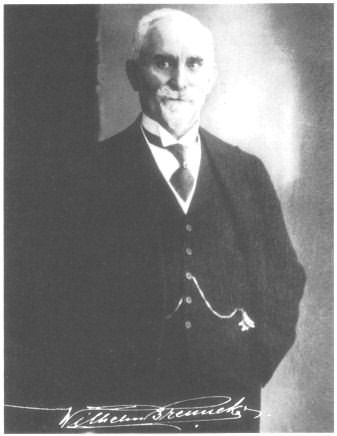
Wilhelm Brenneke
German ammunition designer who invented the modern shotgun slug.

Wilhelm Brenneke (30 March 1865 – 4 November 1951) was a German inventor and ammunition designer, most famous for creating the modern shotgun slug in 1898. He started the ammunition company Brenneke in 1895, which is still owned and run by his family.
Born in Hanover, Germany, Brenneke died of natural causes in Leipzig. Early in the 1900s, he experimented with modifying standard cartridge cases, such as the M/88 case used in German Mauser Gewehr 98 rifles, by lengthening and changing their dimensions to boost muzzle velocity.
In 1912, Brenneke designed the 8×64mm S cartridge, which was based on the 8×57mm IS case, with the case head diameter increased from 11.95mm to 12.1mm and the case lengthened. It was meant as a ballistic upgrade for the Gewehr 98, with a longer overall case and a slightly larger case head than the standard 8×57mm IS military round, plus a moderate pressure increase. This allowed easy conversion of existing rifles. However, the German military chose to keep the 8×57mm IS, avoiding rechambering, even though the new cartridge could outperform the .30-06 Springfield. Brenneke’s approach—enlarging case dimensions and raising pressure to create powerful rounds—was sound, and he continued developing cartridges along these lines. He also made an 8×64mm variant for the older 8.07 mm (.318 in) I-bore. In 1914, he introduced rimmed versions of both the 8×64mm S and 8×64mm rimless, called the 8×65mmRS and 8×65mmR.
In 1917, Brenneke necked down his 8×64mm S design to 7 mm, creating the 7×64mm. This was a major commercial success, offering 10–12% more muzzle velocity than the 7×57mm, with a flatter trajectory and better long-range performance. Between the world wars, German hunters called it a “miracle cartridge,” and dozens of factory loads were available. In the 1930s, the German Wehrmacht considered replacing the 8×57mm IS with the 7×64mm for snipers but ultimately stuck with the 8×57mm IS to keep logistics simple. A rimmed version, the 7×65mmR, also sold well immediately.
In 1927, Brenneke designed the 9.3×64mm Brenneke cartridge from scratch, with no parent case. It was his most powerful big-game round, introduced that year. It had the largest possible case capacity without shape or dimensional issues that would hinder chambering in Mauser M 98 bolt actions used in Gewehr 98 rifles.
- Born
- 30 March 1865 in Hanover, Germany
- Died
- 4 November 1951 in Leipzig, from natural causes
- Field
- Ammunition design and manufacturing
- Nationality
- German
- Known for
- Inventing the modern shotgun slug (1898); designing the 7×64mm, 8×64mm S, and 9.3×64mm Brenneke cartridges
Lore & Background
Wilhelm Brenneke was born on 30 March 1865 in Hanover, Germany. He founded the Brenneke ammunition company in 1895 and invented the modern shotgun slug in 1898. He died on 4 November 1951 in Leipzig from natural causes, and the Brenneke company remains in his family's hands and is still successful.
At the start of the 20th century, Brenneke experimented with lengthening and other dimensional changes to standard cartridge cases like the M/88 case to obtain extra muzzle velocity. In 1912 he designed the 8×64mm S cartridge, which was based on the 8×57mm IS case, with the case head diameter increased from 11.95mm to 12.1mm and the case lengthened, as a ballistic upgrade option for the Mauser Gewehr 98 rifles. The German military chose to stick with their 8×57mm IS cartridge. He also developed a rimmed variant, the 8×65mmRS and 8×65mmR, in 1914.
In 1917 Brenneke
Reader's Guide
Wilhelm Brenneke's significance lies in his innovative cartridge designs that pushed the boundaries of ballistic performance in the early 20th century. His 8×64mm S, introduced in 1912, was a de novo design intended to upgrade the Mauser Gewehr 98 rifles, though the German military declined to adopt it. His 7×64mm, introduced in 1917, became a major commercial success and was regarded by German hunters as a 'miracle cartridge' between the World Wars, even being considered by the Wehrmacht for sniper use. The 9.3×64mm Brenneke, designed in 1927, remains his most powerful cartridge and saw later military use in the 21st century by the Russian military in the 9SN cartridge for the SVDK sniper rifle. Brenneke's legacy endures through his company, which remains in family hands, and through his cartridge designs that influenced both civilian hunting and military applications.
Did You Know?
- The 8×64mm S cartridge was designed de novo in 1912 with no parent case.
- The 9.3×64mm Brenneke cartridge, designed in 1927, was later used by the Russian military in the 9SN semi-armour-piercing cartridge.
Founding a Legacy: Brenneke the Man and the Company
Wilhelm Brenneke was born in Hanover, Germany, on March 30, 1865, and would go on to shape the small arms ammunition world for decades. In 1895, he established his own ammunition manufacturing company, which would bear his name and remain in family hands well into the modern era. His most celebrated innovation came just three years later, in 1898, when he devised the modern shotgun slug—a design that fundamentally changed how shotguns could be used for single-target hunting. Beyond this signature contribution, Brenneke spent the early twentieth century exploring how dimensional modifications to existing cartridge cases could yield meaningful gains in muzzle velocity. His work spanned from rimmed break-action variants to entirely new de novo rifle cartridges, and his company continued producing ammunition long after his death in Leipzig on November 4, 1951, from natural causes.
The 8×64mm S and the Military's Repeated Refusal
In 1912, Brenneke introduced the 8×64mm S, a cartridge designed from scratch rather than derived from any existing case. His engineering philosophy was straightforward: by modestly increasing the exterior dimensions of the standard German 8×57mm IS case—slightly enlarging the head diameter and overall length—while also raising maximum pressure, he could produce a round with a superior bore-area-to-case-volume ratio. The result would ballistically outperform even the American .30-06 Springfield. Crucially, the design was chosen so that existing Mauser Gewehr 98 rifles could be rechambered with minimal modification. Yet the German military declined, preferring to retain the 8×57mm IS to avoid the logistical burden of converting their service rifles. Brenneke persisted, also developing a variant for the tighter 8.07 mm I-bore and, by 1914, rimmed versions designated 8×65mRS and 8×65mmR for break-action rifles.
The 7×64mm: A Hunter's "Miracle Cartridge"
Five years after the military's rejection of his 8×64mm S, Brenneke found commercial triumph by necking the same case down to 7 mm calibre, releasing the 7×64mm in 1917. The new round delivered 10 to 12 percent more muzzle velocity than the 7×57mm, translating into a flatter trajectory and markedly improved long-range performance. Among German hunters in the interwar period, the cartridge earned the nickname "miracle cartridge," and dozens of factory load variants flooded the domestic market. Its reputation was so formidable that during the 1930s the Wehrmacht seriously evaluated replacing the 8×57mm IS in the Karabiner 98k with the 7×64mm for sniper roles. Once again, however, logistical simplicity prevailed, and the army retained its existing cartridge. Brenneke also offered a rimmed 7×65mmR version for break-action rifles in 1917, which enjoyed immediate commercial success alongside its rimless sibling.
The 9.3×64mm Brenneke and a Century-Long Reach
In 1927, Brenneke pushed his design philosophy to its ultimate expression with the 9.3×64mm Brenneke, another de novo cartridge with no parent case. Conceived as a big-game round, it was engineered to maximize case capacity while preserving flawless chambering and function in Mauser M 98 bolt actions—the same platform used in the Gewehr 98. It remains the most powerful cartridge he ever designed. Remarkably, the round's influence extended far beyond its German hunting origins. In the twenty-first century, the Russian military developed the SVDK variant of the Dragunov sniper rifle chambered in 9.3×64mm Brenneke, paired with the 9SN semi-armour-piercing cartridge. That round features a 16.6-gram steel-cored boat-tailed FMJ bullet achieving 770 m/s at the muzzle, capable of defeating body armor at ranges up to 600 metres. Meanwhile, the Brenneke company, still family-owned, continues to manufacture ammunition, a testament to the founder's enduring legacy.
Gallery


Frequently Asked Questions
Who is Wilhelm Brenneke?
Wilhelm Brenneke was a German inventor and ammunition designer born in Hanover in 1865. He is widely regarded as one of the most influential figures in the history of small-arms ammunition, credited with both a landmark shotgun innovation and a family of distinctive rifle cartridges.
What is Wilhelm Brenneke most famous for inventing?
In 1898 he created what is recognized as the first modern shotgun slug, a single-projectile round that transformed how shotguns were used for hunting and sport. That basic design principle is still the foundation of every slug loaded in a shotgun today.
Which rifle cartridges did Brenneke design?
He developed the 7×64mm Brenneke, the 8×64mm S (introduced in 1912), and the 9.3×64mm Brenneke, all built on lengthened or altered case geometry to push higher muzzle velocities. The 8×64mm S, for example, was derived from the M/88 case used in the Mauser Gewehr 98.
What company did Wilhelm Brenneke found and does it still exist?
He established the Brenneke ammunition company in 1895, and it has remained a family-operated business ever since. The firm still manufactures ammunition under the Brenneke name more than 125 years later.
How and where did Wilhelm Brenneke die?
Brenneke passed away from natural causes on 4 November 1951 in Leipzig, Germany, at the age of 86. His life spanned nearly the entire 20th century, from the late 1800s through the mid-1950s.
More in Weapon designers 1-24
Spotted an error? Know more?
Reader corrections go straight into our review queue. Suggest an edit · How this site is sourced