John Browning
American firearm designer of lasting global influence.

John Brown, Wm. Lloyd Garrison · Public domain
John Moses Browning (January 23, 1855 – November 26, 1926) was an American inventor of firearms whose work shaped military and civilian guns, cartridges, and mechanisms still in global use. He built his first gun at age 13 in his father’s shop and earned his first of 128 firearm patents on October 7, 1879, when he was 24. Considered a leading firearms designer of the 19th and 20th centuries, he pioneered modern repeating, semi-automatic, and automatic weapons.
Browning transformed nearly every category of gun design, especially self-loading ammunition systems. He created or greatly improved single-shot, lever-action, and pump-action rifles and shotguns. He produced the first reliable, compact autoloading pistols by inventing the telescoping bolt and combining it with the barrel shroud into what is now called the pistol slide. This telescoping bolt appears in nearly all modern semi-automatic pistols and several fully automatic weapons. He also designed the first gas-operated firearm, the Colt–Browning Model 1895 machine gun, which replaced mechanical recoil operation and became the standard for high-power self-loading firearms worldwide. He contributed significantly to automatic cannon development.
His most famous designs include the M1911 pistol, the water-cooled M1917, air-cooled M1919, and heavy M2 machine guns, the M1918 Browning Automatic Rifle, and the Browning Auto-5, the first semi-automatic shotgun. Many of these are still manufactured today, often with only minor cosmetic or detail changes from the originals made by Browning or his licensees. The M1911 and Hi-Power are among the most copied firearms in history.
Browning’s father, Jonathan, was among the Latter-day Saint pioneers who moved from Nauvoo, Illinois, to Utah, and set up a gunsmith shop in Ogden in 1852. Like many in that community, Jonathan practiced polygamy, with three wives. He had 22 children, including John Moses, and raised two stepdaughters with his wife Elizabeth Caroline Clark. From age seven, John worked in his father’s Ogden shop, learning engineering and manufacturing principles and being encouraged to experiment. He made his first rifle, a single-shot falling block action, while still an apprentice. In 1878, he co-founded John Moses and Matthew Sandefur Browning Company (later Browning Arms Company) with his younger brother.
- Born
- January 23, 1855
- Died
- November 26, 1926
- Field
- Firearm design
- Nationality
- American
- Known for
- Designing the M1911 pistol, M2 machine gun, Browning Auto-5 shotgun, and pioneering semi-automatic and gas-operated firearms
Lore & Background
Browning made his first firearm at age 13 in his father's gun shop and was awarded the first of his 128 firearm patents on October 7, 1879, at the age of 24. He worked in his father's Ogden shop from age seven, learning basic engineering and manufacturing principles. In 1878, with his younger brother, he co-founded John Moses and Matthew Sandefur Browning Company, later renamed Browning Arms Company. Like his father, Browning was a member of The Church of Jesus Christ of Latter-day Saints and served a two-year mission in Georgia beginning March 28, 1887. He married Rachel Theresa Child on April 10, 1879, and the couple had 10 children, two of whom died in infancy.
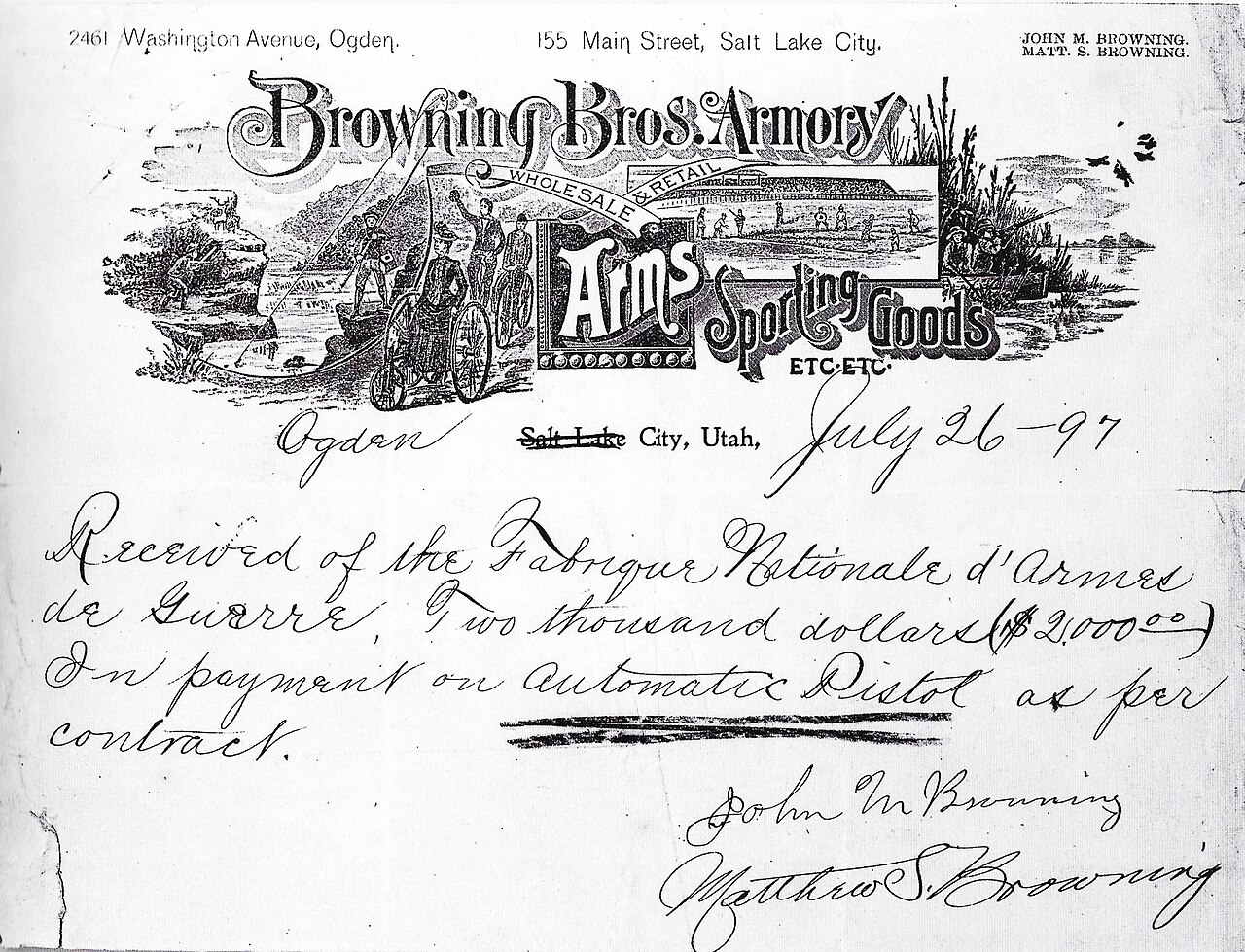
Browning's designs caught the attention of Winchester Repeating Arms Company, which bought his Model 1878 Single Shot Rifle for $8,000. From 1883, he worked in partnership with Winchester, designing lever-action rifles and pump shotguns including the Winchester Model 1887, Model 1897, Model 1885, Model 1886, Model 1892, Model 1894, and Model 1895. After falling out with Winchester over royalty terms for a new semi-automatic shotgun, Browning took the design to Fabrique Nationale of Belgium, which manufactured it as the Browning Auto-5, the first semi-automatic shotgun. He also designed the Remington Model 8 rifle.
Browning developed the first reliable and compact autoloading pistols by inventing the telescoping bolt, integrating it into the pistol slide—a design found on nearly every modern semi-automatic pistol. He also developed the first gas-operated firearm, the Colt–Browning Model 1895 machine gun. His most successful designs include the M1911 pistol, the water-cooled M1917, air-cooled M1919, and heavy M2 machine guns, the M1918 Browning Automatic Rifle, and the Browning Auto-5. The M1911 and Hi-Power are among the most copied firearms in the world.
Reader's Guide
John Moses Browning's significance lies in his foundational contributions to modern firearm design. He influenced nearly all categories of firearms, especially autoloading of ammunition. His telescoping bolt design is the basis for nearly every modern semi-automatic pistol and several fully automatic weapons. He developed the first gas-operated firearm, a system that surpassed mechanical recoil operation to become the standard for most high-power self-loading designs worldwide. His designs, such as the M1911 pistol and M2 machine gun, remain in production often with only minor changes. Browning's collaboration with Winchester produced several iconic rifles and shotguns, many still manufactured today. His shift to royalty-based licensing with Fabrique Nationale set a precedent for firearm design compensation. The Browning Auto-5 was continuously manufactured throughout the 20th century. Browning's work also included significant contributions to automatic cannon development. His designs have been copied extensively, and his patents shaped the industry for decades.
The Ogden Workshop and a Pioneer Family
John Moses Browning's mechanical genius was nurtured in the small gunsmith shop his father Jonathan had established in Ogden, Utah, in 1852. Jonathan, a member of the Church of Jesus Christ of Latter-day Saints, had traveled west from Nauvoo, Illinois, as part of the great Mormon exodus. Like many in that community, he maintained a plural family, eventually fathering twenty-two children. Young John began assisting in the workshop at just seven years old, absorbing principles of engineering and manufacturing while being encouraged to experiment with new mechanical ideas. By his early teens he had already built a single-shot falling-block rifle. In 1878, he and his younger brother Matthew formalized their partnership, founding a company that would eventually employ their half-brothers Jonathan, Thomas, William, and George. John's personal life ran parallel to his professional one: he married Rachel Theresa Child in April 1879, the same month he received his first of 128 firearm patents, and the couple went on to raise ten children, though two were lost in infancy. He also fulfilled a two-year missionary assignment in Georgia beginning in 1887, reflecting the deep religious commitment that shaped his world.
The Winchester Alliance and Its Bitter End
When a production example of the Browning Model 1878 single-shot rifle reached the attention of Winchester Repeating Arms, the company sent a representative to assess the competition and ultimately purchased the design for eight thousand dollars, relocating production to their Connecticut factory. From 1883 onward, Browning and Winchester entered a prolific collaboration that yielded a remarkable catalogue: the lever-action Models 1886, 1892, 1894, and 1895; the falling-block Model 1885; the lever-action Model 1887; and the iconic Model 1897 pump shotgun. The Model 1894 alone would surpass six million units produced by 1983, making it the best-selling sporting rifle in history. For decades, the names Browning and Winchester were virtually interchangeable in the firearms world. That golden era shattered over the Auto-5 shotgun. Browning and Matthew wanted royalties per unit sold rather than the customary one-time fee, a shift that would have generated far greater long-term income. Winchester management refused. Remington was approached next, but its president suffered a fatal heart attack before a deal could close. Browning turned to Fabrique Nationale in Belgium, which accepted the design and produced it under his name. Winchester, stung, pivoted to Thomas Crossley Johnson's designs, ending the partnership that had defined an era.
Reinventing How Firearms Move
Browning's most far-reaching mechanical contributions reshaped the fundamental way firearms cycle ammunition. His invention of the telescoping bolt allowed the bolt and barrel shroud to be integrated into a single sliding unit—the pistol slide—a configuration now found on nearly every modern semi-automatic pistol and several fully automatic weapons. This single insight made compact, reliable autoloading pistols possible for the first time. Equally transformative was his development of the first gas-operated firearm, the Colt-Browning Model 1895 machine gun. By harnessing propellant gas rather than relying solely on mechanical recoil, this system set a new standard that would become the dominant operating principle for high-power self-loading firearms worldwide. His work extended beyond small arms into the realm of automatic cannon development, and his improvements spanned single-shot, lever-action, and pump-action platforms. Across every category he touched, Browning pushed the boundaries of what was mechanically feasible, earning his reputation as a true pioneer of modern repeating, semi-automatic, and fully automatic firearms.
A Legacy Cast in Steel
Few inventors can claim that their creations remain in active production decades after their death, yet Browning's designs have done precisely that. The M1911 pistol, the water-cooled M1917 and air-cooled M1919 machine guns, the heavy M2, the M1918 Browning Automatic Rifle, and the Auto-5 semi-automatic shotgun all continue to be manufactured, often with only minor cosmetic or detail changes from the versions Browning or his licensees originally assembled. The M1911 and the FN Hi-Power, both rooted in his pistol architecture, rank among the most copied firearms on the planet. His 128 patents, the first of which was granted on October 7, 1879, at age twenty-four, document a career of relentless innovation spanning the entire sweep of the nineteenth and twentieth centuries. From the Ogden workshop where a seven-year-old boy first absorbed the principles of engineering and manufacturing to the global arsenals that still fire his mechanisms, Browning's fingerprints are embedded in the very architecture of modern firearms. He is widely regarded as one of the most successful and influential designers in the field's entire history.
Gallery
Frequently Asked Questions
Who is John Browning?
John Moses Browning (1855–1926) was an American firearms inventor whose designs defined modern gun mechanics. He is widely regarded as one of the most prolific and influential weapon designers in history.
What are John Browning's most famous weapons?
His signature creations include the M1911 pistol, the M2 .50-caliber machine gun, and the Browning Auto-5 shotgun. These designs remain in service or production well over a century after their introduction.
How many patents did John Browning hold?
Browning secured 128 patents for firearms and related mechanisms during his career. His first patent was granted on October 7, 1879, when he was 24 years old.
Why is John Browning considered so important in firearms history?
He essentially pioneered the self-loading and gas-operated systems that underpin nearly every modern semi-automatic and fully automatic weapon. His work transformed gun design across military and civilian categories worldwide.
When did John Browning begin working on firearms?
He built his first gun at just 13 years old in his father's workshop. That early hands-on experience set him on the path to becoming one of the most prolific inventors in the field.
More in Weapon designers 1-24
Spotted an error? Know more?
Reader corrections go straight into our review queue. Suggest an edit · How this site is sourced