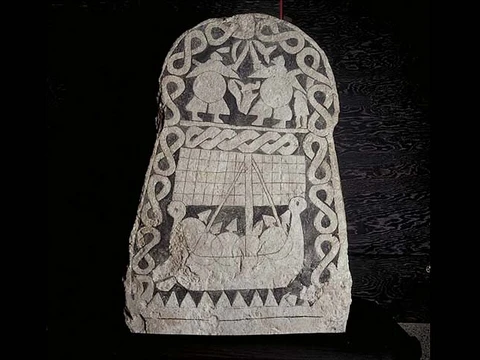
Berserkers
Scandinavian warriors who fought in a trance-like fury.
Last updated
They were believed immune to steel and fire during these fits, but became weak afterward.[1][2] Warriors known as berserkers, who howled and foamed at the mouth while fighting in a trance-like fury, are described in an Icelandic-English dictionary from 1874.[1]
Last updated 2026-10-05 from the source article.
Quick Facts
- Field
- Warfare; Norse culture
- Known for
- Fighting in a trance-like fury; origin of the word 'berserk'
- Nationality
- Scandinavian
- Era
- Viking Age (attested in Old Norse sources)
Facts from the source article.
What happened
The earliest surviving reference to berserkers is in the late 9th-century poem Haraldskvæði, which describes ulfheðnar ("wolf-skin wearers") fighting for King Harald Fairhair.[3] King Harald Fairhair used berserkers as shock troops to expand his influence.[4] They were subject to fits of frenzy called berserksgangr, during which they were thought proof against steel and fire.[1] Berserkers appear in many sagas, sometimes as elite soldiers and later as ravenous bullies.[5]
Berserkers were outlawed in Iceland in 1015.[6] According to an 1874 dictionary, during combat berserkers would howl like wild animals, produce foam from their mouths, and chew on the edges of their shields.[2] The same dictionary states that once the frenzy subsided, the berserkers became feeble and docile.[2]
What the cited sources add
That same source records berserkers in Norway as gangs of professional bullies who challenged farmers to duels and extorted ransom.[1] The National Museum of Denmark states that berserkers dedicated their lives and bodies to battle, and that their nakedness was a psychological weapon.[7] Depictions of berserkers are known from the Iron Age, and semi-naked warriors in such images are likely berserkers.[7] The Torslunda plates, found in 1870 on Öland, Sweden, show what appears to be a berserker ritual.[8]
References
- An Icelandic-English Dictionary by Richard Cleasby and Gudbrand Vigfusson (1874) p. 61. facts only, no text reused. lexicon.ff.cuni.cz
- Wikipedia, "Berserker" (CC BY-SA 4.0), which cites: An Icelandic-English Dictionary by Richard Cleasby and Gudbrand Vigfusson (1874) p. 61; "Berserkers", National Museum of Denmark (we also read that source) en.wikipedia.org
- Wikipedia, "Berserker" (CC BY-SA 4.0), which cites: Page, "Chronicles of the Vikings", University of Toronto Press, 1995, p. 109 (we also read that source) en.wikipedia.org
- Wikipedia, "Berserker" (CC BY-SA 4.0), which cites: Duncan, "Berserkir: a re-examination of the phenomenon in literature and life", eprints.nottingham.ac.uk, 10 December 2014 (original not read by us) en.wikipedia.org
- Wikipedia, "Berserker" (CC BY-SA 4.0), which cites: Duncan, "Berserkir: a re-examination of the phenomenon in literature and life", eprints.nottingham.ac.uk, 10 December 2014; Kershaw 1997, p. 13; Duncan, "Berserkir: a re-examination of the phenomenon in literature and life", eprints.nottingham.ac.uk, 10 December 2014 (original not read by us) en.wikipedia.org
- Wikipedia, "Berserker" (CC BY-SA 4.0), which cites: Blaney, "The Berserker: His Origin and Development in Old Norse Literature", 1972, p. 20; Ásgeir Blöndal Magnússon, "Icelandic Etymological Dictionary", 1989; Simek 1995, p. 47 (original not read by us) en.wikipedia.org
- "Berserkers", National Museum of Denmark. facts only, no text reused. en.natmus.dk
- Wikipedia, "Berserker" (CC BY-SA 4.0), which cites: MedievHistories, "Odin from Levide", Medieval Histories, 12 June 2014; "Helmets and swords in Beowulf" by Knut Stjerna out of a Festschrift to Oscar Monteliusvägen published in 1903 (original not read by us) en.wikipedia.org
Each numbered sentence above was checked against the source it cites before publication. Sentences citing Wikipedia adapt text from the English Wikipedia article Berserker (contributors), used under CC BY-SA 4.0; this entry is available under the same licence. Other sources were used for facts only; no text or images are copied from them.
More in The Viking Age
Sources
Compiled from Wikipedia and the sources listed below. Text from Wikipedia is available under CC BY-SA 4.0; this entry is adapted from it.
- Wikipedia: Berserker (CC BY-SA 4.0).
Spotted an error? Know more?
Reader corrections go straight into our review queue. Suggest an edit · How this site is sourced