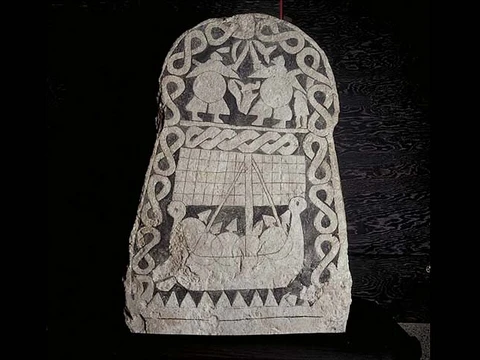
The Viking Age
Norsemen expanded across Europe and reached North America during the Viking Age.
Last updated
During the Middle Ages, Norsemen known as Vikings engaged in widespread raiding, colonization, conquest, and trade across Europe and also reached North America.[1] Norse people traveled by sea from homelands in Denmark, Norway, and Sweden to settle in the British Isles, Ireland, the Faroe Islands, Iceland, Greenland, Normandy, the Baltic coast, and along the Dnieper and Volga trade routes in eastern Europe.[2]
Last updated 2026-10-05 from the source article.
Quick Facts
- Period
- about 800–1050 CE
- Region
- Scandinavia and areas settled by Scandinavians
- Known for
- Raiding
- colonising
- conquest
- trading
- reaching North America
- Languages
- Old Norse (precursor to present-day Scandinavian languages)
Facts from the source article.
What happened
The Viking attack on Lindisfarne on 8 June 793 is regarded as the beginning of the Viking Age.[3] Judith Jesch has argued that the start could be pushed back to 700–750, as the Lindisfarne attack was unlikely the first.[3] Scholars have proposed various end dates, including the conversion of Iceland to Christianity in 1000.[4] Until 830, Vikings primarily targeted Ireland, as England and the Carolingian Empire could initially fight them off; after 830, they exploited disunity within the Carolingian Empire and pitted English kingdoms against each other.[5]
The end of the Viking Age is traditionally marked in England by the failed invasion of Norwegian king Harald III, who was defeated by Saxon King Harold Godwinson at the Battle of Stamford Bridge in 1066.[4]
What the cited sources add
The English Heritage account states that the Lindisfarne monks retreated inland during the 830s and left the island for good in 875.[6] At least 23 carved stones from the late 8th to late 10th centuries show the Christian burial ground remained in use during Viking instability.[6] The Guardian report notes that the 1021 date for the North American settlement provides a secure juncture for late Viking chronology.[7] Arne Emil Christensen writes that the Viking kingdom in Kiev formed the basis of the Russian empire.[8]
Christensen also notes that iron, whetstones, and soapstone cooking pots were important export products contributing to trade growth.[8] According to Wawn, the first challenge to anti-Viking images emerged in the 17th century, but it was Victorian Britain that invented the Vikings as we now know them.[9]
References
- Wikipedia, "Viking Age" (CC BY-SA 4.0), which cites: Mawer, "The Vikings", Cambridge University Press, 1913, p. [https://archive.org/details/vikings00mawe/page/4/mode/2up 4; Sawyer, "Scandinavians and the English in the Viking Age", University of Cambridge, 1995, p. 3; Jesch, "Women in the Viking Age", Boydell & Brewer Ltd, 1991, p. 84; Jesch, "Women in the Viking Age", Boydell & Brewer Ltd, 1991, p. 84; Wilson, "The Oxford Encyclopedia of Medieval Warfare and Military Technology", Oxford University Press, 2010, p. 11 (we also read that source) en.wikipedia.org
- Wikipedia, "Viking Age" (CC BY-SA 4.0), which cites: Davies, "Solar storm confirms Vikings settled in North America exactly 1,000 years ago", The Guardian, 21 October 2021 (we also read that source) en.wikipedia.org
- Wikipedia, "Viking Age" (CC BY-SA 4.0), which cites: Jesch, "The Viking Diaspora", Routledge, 2015, p. 8–10; "History of Lindisfarne Priory", English Heritage; Swanton, Michael (1998). The Anglo-Saxon Chronicle. Psychology Press. . p. 57, n. 15.; Jesch, "The Viking Diaspora", Routledge, 2015, p. 8–10; "The Viking World", Routledge, 2008, p. 195 (we also read that source) en.wikipedia.org
- Wikipedia, "Viking Age" (CC BY-SA 4.0), which cites: Jesch, "The Viking Diaspora", Routledge, 2015, p. 8–10 (we also read that source) en.wikipedia.org
- Wikipedia, "Viking Age" (CC BY-SA 4.0), which cites: Bagge, "Cross and Scepter: The Rise of the Scandinavian Kingdoms from the Vikings to the Reformation", Princeton University Press, 2014, p. 21–22; Bagge, "Cross and Scepter: The Rise of the Scandinavian Kingdoms from the Vikings to the Reformation", Princeton University Press, 2014, p. 21–22; Bagge, "Cross and Scepter: The Rise of the Scandinavian Kingdoms from the Vikings to the Reformation", Princeton University Press, 2014, p. 21–22 (original not read by us) en.wikipedia.org
- "History of Lindisfarne Priory", English Heritage. facts only, no text reused. english-heritage.org.uk
- Davies, "Solar storm confirms Vikings settled in North America exactly 1,000 years ago", The Guardian, 21 October 2021. facts only, no text reused. theguardian.com
- Arne Emil Christensen , The Vikings.. facts only, no text reused. ragweedforge.com
- Wawn, "BBC – History – Ancient History in depth: The Viking Revival", www.bbc.co.uk, 2001. facts only, no text reused. bbc.co.uk
Each numbered sentence above was checked against the source it cites before publication. Sentences citing Wikipedia adapt text from the English Wikipedia article Viking Age (contributors), used under CC BY-SA 4.0; this entry is available under the same licence. Other sources were used for facts only; no text or images are copied from them.
Also in the Codexery
More in The Viking Age
Related in The Viking Age
Links follow this subject's own source article.
Sources
Compiled from Wikipedia and the sources listed below. Text from Wikipedia is available under CC BY-SA 4.0; this entry is adapted from it.
- Wikipedia: Viking Age (CC BY-SA 4.0).
Spotted an error? Know more?
Reader corrections go straight into our review queue. Suggest an edit · How this site is sourced