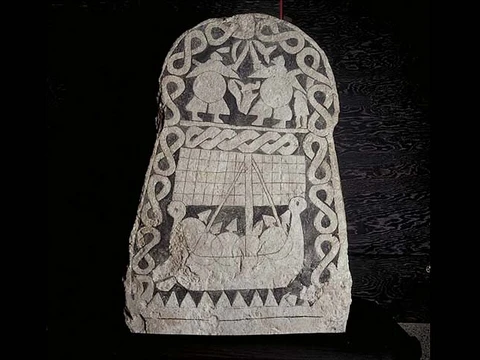
The Great Heathen Army
Last updated
The army's campaigns ultimately led to Viking control of northern and eastern England, a region later known as the Danelaw.[1] A coalition of Scandinavian warriors invaded England in the year 865, known as the Great Heathen Army or Viking Great Army.[2]
Last updated 2026-10-05 from the source article.
What happened
The army first encamped in the Isle of Thanet in late 865 and was promised danegeld by the people of Kent.[3] The army then split, with one band led by Halfdan going north to Northumbria and another led by Guthrum, Oscetel, and Anwend establishing a base at Cambridge.[4][5] In May 878, Alfred the Great defeated the Vikings at the Battle of Edington, and a treaty was agreed allowing the Vikings to remain in control of much of northern and eastern England.[1] The Vikings initiated their invasion from East Anglia, securing peace with the local East Anglians who supplied them with horses.[6]
During the next campaign season, the force first went to York to obtain additional troops, then fought in northeastern Mercia, and wintered at Torksey.[2] In 874, the army forced the Mercian king into exile, conquered Mercia, and installed Ceolwulf as his replacement.[4]
What the cited sources add
The law code of King Ine of Wessex, issued about 694, defines "here" as an invading army containing more than thirty-five men.[7][8] In February 2018, a team from the University of Bristol announced that radiocarbon dating placed the Repton remains in the late 9th century, consistent with the army's winter stay.[9][10] The Anglo-Saxon Chronicle's entry for 865 describes the Viking force as a "hæþen here", meaning Heathen Army.[11][12] Richard Abels, a historian, proposed that this term was used to distinguish Viking war bands from state-organized military forces.[13]
References
- Wikipedia, "Great Heathen Army" (CC BY-SA 4.0), which cites: Higham, "Danelaw", Wiley Blackwell, 2014, p. 139–140 (we also read that source) en.wikipedia.org
- Wikipedia, "Great Heathen Army" (CC BY-SA 4.0), which cites: Hadley. "The Winter Camp of the Viking Great Army, AD 872–3, Torksey, Lincolnshire", Antiquaries Journal. 96, pp. 23–67 (original not read by us) en.wikipedia.org
- Wikipedia, "Great Heathen Army" (CC BY-SA 4.0), which cites: Christopher Wright, "Kent through the years", Batsford, 1975, p. 54 (original not read by us) en.wikipedia.org
- Wikipedia, "Great Heathen Army" (CC BY-SA 4.0), which cites: Asser. Life of Alfred in Keyns/ Lapidge. Alfred the Great, p. 82; Sawyer. Illustrated History of Viking, p. 55 (original not read by us) en.wikipedia.org
- Wikipedia, "Great Heathen Army" (CC BY-SA 4.0), which cites: Asser. Life of Alfred in Keyns/ Lapidge. Alfred the Great, p. 82; Stenton. Anglo-Saxon England, p. 253 (original not read by us) en.wikipedia.org
- Wikipedia, "Great Heathen Army" (CC BY-SA 4.0), which cites: Ridyard. The Royal Saints of Anglo-Saxon England, p. 65 (original not read by us) en.wikipedia.org
- Wikipedia, "Great Heathen Army" (CC BY-SA 4.0), which cites: Sawyer. The Age of Vikings. pp. 124–125; Attenborough. The laws of the earliest English kings. pp. 40–41 – "We use the term thieves if the number of men does not exceed seven. A band of marauders (we also read that source) en.wikipedia.org
- Attenborough. The laws of the earliest English kings. pp. 40–41 – "We use the term thieves if the number of men does not exceed seven. A band of marauders. facts only, no text reused. archive.org
- Wikipedia, "Great Heathen Army" (CC BY-SA 4.0), which cites: University of Bristol, "Radiocarbon dating reveals mass grave did date to the Viking age", Eurekalert, 2 February 2018; "The Viking Great Army in England: new dates from the Repton charnel", Antiquity, 2 February 2018, p. 183–199 (we also read that source) en.wikipedia.org
- Catrine Jarman, "The Viking Great Army in England: new dates from the Repton charnel", Antiquity (2018), doi:10.15184/aqy.2017.196. OpenAlex metadata CC0; paper not read. doi.org
- Corpus Christi College, Cambridge, MS 173, ff. 1v-32r. Retrieved 17 April 2013. <br />* The entry for 865 refers to the Heathen Army as hæþen here.<br /> * The . facts only, no text reused. asc.jebbo.co.uk
- Wikipedia, "Great Heathen Army" (CC BY-SA 4.0), which cites: ASC 865 – English translation at Project Gutenberg. Retrieved 16 January 2013; Oliver. Vikings: A History. p. 169 – in 865 the Anglo Saxon Chronicle made mention of it ... Great Army mycel here..Great Heathen Army mycel heathen here; Corpus Christi College, Cambridge, MS 173, ff. 1v-32r. Retrieved 17 April 2013. <br />* The entry for 865 refers to the Heathen Army as hæþen here.<br /> * The ; The Anglo-Saxon Chronicle. Manuscript B: Cotton Tiberius A.vi . Retrieved 20 August 2013. The entry for 867 refers to the Great Heath en.wikipedia.org
- Wikipedia, "Great Heathen Army" (CC BY-SA 4.0), which cites: Richard Abels. "Alfred the Great, the micel hæðen here and the Viking threat" in Timothy Reuter. Alfred the Great. pp. 266–267 (original not read by us) en.wikipedia.org
Each numbered sentence above was checked against the source it cites before publication. Sentences citing Wikipedia adapt text from the English Wikipedia article Great Heathen Army (contributors), used under CC BY-SA 4.0; this entry is available under the same licence. Other sources were used for facts only; no text or images are copied from them.
More in The Viking Age
Related in The Viking Age
Links follow this subject's own source article.
Sources
Compiled from Wikipedia and the sources listed below. Text from Wikipedia is available under CC BY-SA 4.0; this entry is adapted from it.
- Wikipedia: Great Heathen Army (CC BY-SA 4.0).
Spotted an error? Know more?
Reader corrections go straight into our review queue. Suggest an edit · How this site is sourced