Lambda Crucis
A faint blue-white variable star in Crux with disputed classification.

PopePompus · CC BY-SA 4.0
Lambda Crucis, also designated λ Crucis, is a solitary variable star located in the southern sky within the constellation Crux, close to the border with Centaurus. To the unaided eye, it appears as a dim, blue-white star whose apparent visual magnitude typically varies near 4.62. Based on parallax measurements, this star lies roughly 384 light-years from the Sun and is moving away at a radial velocity of +12 km/s. It is a proper-motion member of the Lower Centaurus–Crux subgroup, part of the Scorpius–Centaurus OB association—the nearest large grouping of co-moving massive stars to our solar system.
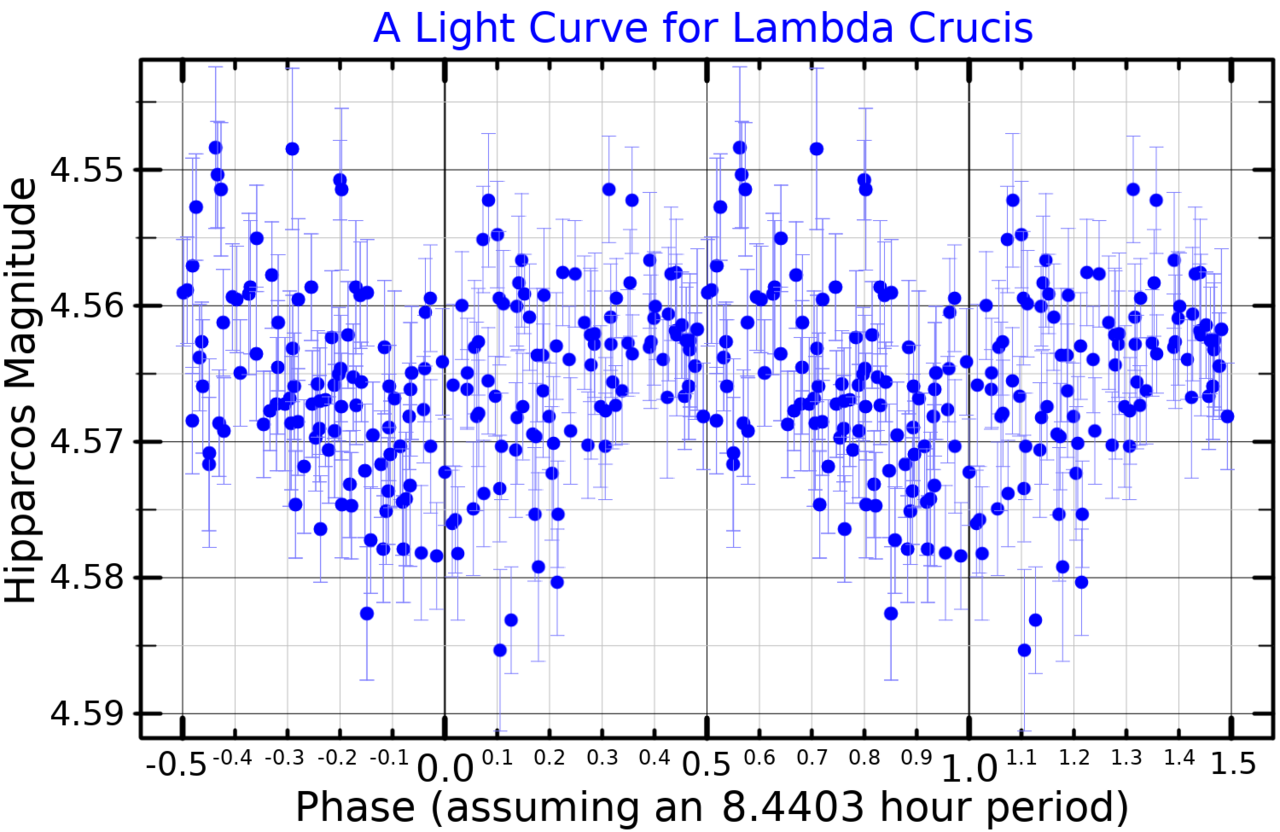
The General Catalogue of Variable Stars lists λ Crucis as a possible β Cephei-type variable, with brightness changes of 0.02 magnitudes over a 0.3951-day period. However, current thinking suggests it is more likely a different type of variable, such as a λ Eridani variable or a rotating ellipsoidal variable. Spectroscopically, it is a B-type main-sequence star with a classification of B4 Vne. The "n" and "e" suffixes indicate broad, nebulous spectral lines from rapid rotation and emission lines from surrounding circumstellar material, marking it as a Be star. This star is about 53 million years old and spins very fast, with a projected rotational velocity of 341 km/s. It has roughly five times the Sun’s mass, about 3.0 times its radius, and shines with 790 times the Sun’s luminosity from a photosphere at a given effective temperature.
- Apparent visual magnitude
- 4.62 (fluctuating)
- Distance
- approximately 384 light-years
- Radial velocity
- +12 km/s
- Spectral type
- B4 Vne
- Mass
- 5 times the Sun's mass
- Radius
- about 3.0 times the Sun's radius
- Luminosity
- 790 times the Sun's luminosity
Lore & Background
Lambda Crucis is a B-type main-sequence star with a stellar classification of B4 Vne, where the suffix notation indicates broad lines due to rapid rotation and emission lines from circumstellar material, making it a Be star. It is around 53 million years old and spins rapidly with a projected rotational velocity of 341 km/s. The star has five times the mass of the Sun and about 3.0 times the Sun's radius, radiating 790 times the solar luminosity from its photosphere.
The star is listed in the General Catalogue of Variable Stars as a possible β Cephei-type variable, with brightness varying by an amplitude of 0.02 magnitudes over a period of 0.3951 days. However, it is currently thought more likely to be a different type of variable, possibly a λ Eridani variable or a rotating ellipsoidal variable. It is a proper motion member of the Lower Centaurus–Crux sub-group in the Scorpius–Centaurus OB association, the nearest such association of co-moving massive stars to the Sun.
Reader's Guide
Lambda Crucis holds significance as a variable star whose classification remains unsettled, illustrating the ongoing refinement of stellar variability categories. Initially cataloged as a possible β Cephei-type variable, current evidence suggests it may instead be a λ Eridani variable or a rotating ellipsoidal variable, highlighting the complexity of distinguishing among variable star types. Its status as a Be star—a rapidly rotating B star with emission lines from circumstellar material—adds to its astrophysical interest, as such stars are important for studying stellar rotation, mass loss, and disk formation. As a member of the Lower Centaurus–Crux sub-group within the Scorpius–Centaurus OB association, Lambda Crucis contributes to understanding the nearest region of massive star formation and co-moving stellar groups. Its faint naked-eye visibility and small amplitude of variation (0.02 magnitudes) make it a challenging but rewarding target for amateur astronomers interested in monitoring subtle brightness changes. The star's legacy lies in its role as a test case for variable star taxonomy and as a representative of the Be phenomenon in a nearby stellar association.
Did You Know?
- The star is a Be star, with broad spectral lines due to rapid rotation and emission lines from circumstellar material.
- It is located approximately 384 light-years from the Sun and is drifting further away at +12 km/s.
Stellar Composition and Nearby Deep-Sky Objects
The four principal stars of Crux form a cross-shaped pattern, each with an apparent magnitude brighter than +2.8, making the constellation one of the most immediately recognizable in the night sky despite being the smallest of all 88 modern constellations. The brightest is α Crucis (Acrux), a blue-white star at magnitude 0.8, positioned as the most southerly member. Following clockwise, β Crucis (Mimosa), γ Crucis (Gacrux), and δ Crucis (Imai) decrease in brightness, while ε Crucis (Ginan) also sits within the cross. Many of these luminous stars belong to the Scorpius–Centaurus association, a loose grouping of hot, blue-white stars that appear to share a common origin and drift together across the southern Milky Way. Crux also hosts four Cepheid variable stars visible to the naked eye under ideal conditions. On its eastern border lies the Jewel Box (NGC 4755), a vivid open cluster, while to the southeast stretches the Coalsack Nebula, a vast dark nebula spanning seven by five degrees, portions of which extend into neighboring Centaurus and Musca.
European Discovery and Cartographic History
The bright stars of Crux were known to the Ancient Greeks, with Ptolemy classifying them as part of Centaurus. In the fourth millennium BC the cross was visible as far north as Britain, but the slow precession of the equinoxes gradually sank the stars below European horizons, and by 400 AD they never rose above the horizon for most of Europe. Dante's Divine Comedy may reference the asterism, though his description could be allegorical. In 1455, Venetian navigator Alvise Cadamosto noted what was likely the Southern Cross near the Gambia River, calling it the southern chariot, though his diagram was inaccurate. Historians generally credit João Faras with the first correct European depiction, sketched in a letter written on Brazilian beaches on 1 May 1500. Amerigo Vespucci observed both the Cross and the Coalsack Nebula during his 1501–1502 voyage. Andrea Corsali produced a clearer separate description in 1516. Molyneux and Plancius first distinguished Crux as its own constellation in 1592, though inaccurately placed. Correct positioning appeared on globes by Plancius and Hondius in 1598 and 1600, and Frederick de Houtman catalogued its stars separately in 1603.
Non-Western Astronomical Traditions
Across the globe, cultures far removed from Europe developed their own rich interpretations of the Southern Cross. In India, a creation story attributes the cross to Sage Vishwamitra, who fashioned Trishanku Swarga. Chinese astronomers named the asterism Shí Zì Jià, simply meaning Cross. Among Australian Aboriginal peoples the interpretation varies dramatically: the Boorong of northwestern Victoria saw a possum in a tree, the Quandamooka of Stradbroke Island recognized the sky deity Mirrabooka, the Yolngu of Arnhem Land perceived a stingray, and the Kaurna of the Adelaide Plains identified an eagle. In central Australian Aranda tradition the four stars form an eagle's talon. East Indies and Brazilian peoples viewed the stars as a ray's body, reflected in names like Bintang Pari and Buruj Pari. Filipino cultures associated the cross with tops and puffer fish, while Javanese people saw a raking hut or granary. Māori tradition casts the Cross as the anchor of Tama-rereti's waka, the Milky Way, with the Pointers serving as its rope.
Cultural Significance and Navigational Legacy
Though Crux is the smallest of the 88 modern constellations, its cultural footprint in the Southern Hemisphere is enormous. The four main stars, each brighter than magnitude +2.8, make the cross one of the most instantly identifiable patterns in the night sky, a distinction that has earned it a prominent place in the flags and emblems of numerous Southern Hemisphere nations. For centuries the cross served as a critical navigational aid: Bugis sailors used the four stars together with μ Crucis as an asterism called bintoéng bola képpang, meaning incomplete house star, to guide their voyages. Torres Strait Islanders incorporated Gamma Centauri as the handle of a fishing spear held by the deity Tagai, with the four Cross stars forming his left hand and Musca's stars as the trident. In Tonga the constellation is known as Toloa, meaning duck. The cross's visibility shifted dramatically over millennia—once seen from Britain, it was eventually lost to northern European skies by the precession of the equinoxes, becoming a symbol of the southern world that European explorers rediscovered during the Age of Navigation.
Gallery
Frequently Asked Questions
Who is Lambda Crucis?
Lambda Crucis (λ Crucis) is a solitary blue-white variable star sitting in the southern constellation Crux, near the border with Centaurus. To a naked-eye observer it shows up as a dim point of light with an apparent visual magnitude hovering around 4.62.
What spectral type and physical properties does Lambda Crucis have?
It is classified as a B4 Vne star, meaning it is a hot, rapidly rotating main-sequence B-type star showing emission lines. It packs roughly five solar masses into a radius about three times the Sun's.
How far is Lambda Crucis from Earth and how is it moving?
Parallax data places it at approximately 384 light-years from the Sun. Its radial velocity reads +12 km/s, indicating it is drifting away from us at that rate.
Why is Lambda Crucis's variable classification disputed?
The star is catalogued as a variable with a fluctuating apparent magnitude near 4.62, but its exact variability mechanism remains uncertain among observers. This ambiguity keeps it in a disputed category rather than a firmly assigned variable type.
What stellar group does Lambda Crucis belong to?
It is a proper-motion member of the Lower Centaurus–Crux subgroup, which sits within the larger Scorpius–Centaurus OB association. That association is the closest major grouping of co-moving massive stars to our solar system.
More in Variable Stars, Part 7 1-24
Spotted an error? Know more?
Reader corrections go straight into our review queue. Suggest an edit · How this site is sourced