Delta Lupi
A Beta Cephei variable star in the constellation Lupus.

PopePompus · CC BY-SA 4.0
Delta Lupi (δ Lupi, δ Lup) lies in the southern circumpolar constellation Lupus. In traditional Chinese astronomy, it is designated the second star of the Cavalry Officer (騎官二). Its apparent visual magnitude of 3.2 makes it the fourth-brightest star in Lupus. Parallax measurements place it roughly 900 light-years away, with a 15% margin of error.
The star’s spectrum gives it a classification of B1.5 IV, meaning it has reached the subgiant phase and is evolving toward becoming a giant. Its outer atmosphere radiates about 10,000 times the Sun’s luminosity at an effective temperature of 23,000 K, which gives it a blue-white color. Delta Lupi has nearly 12 solar masses and an estimated age of 15 million years.
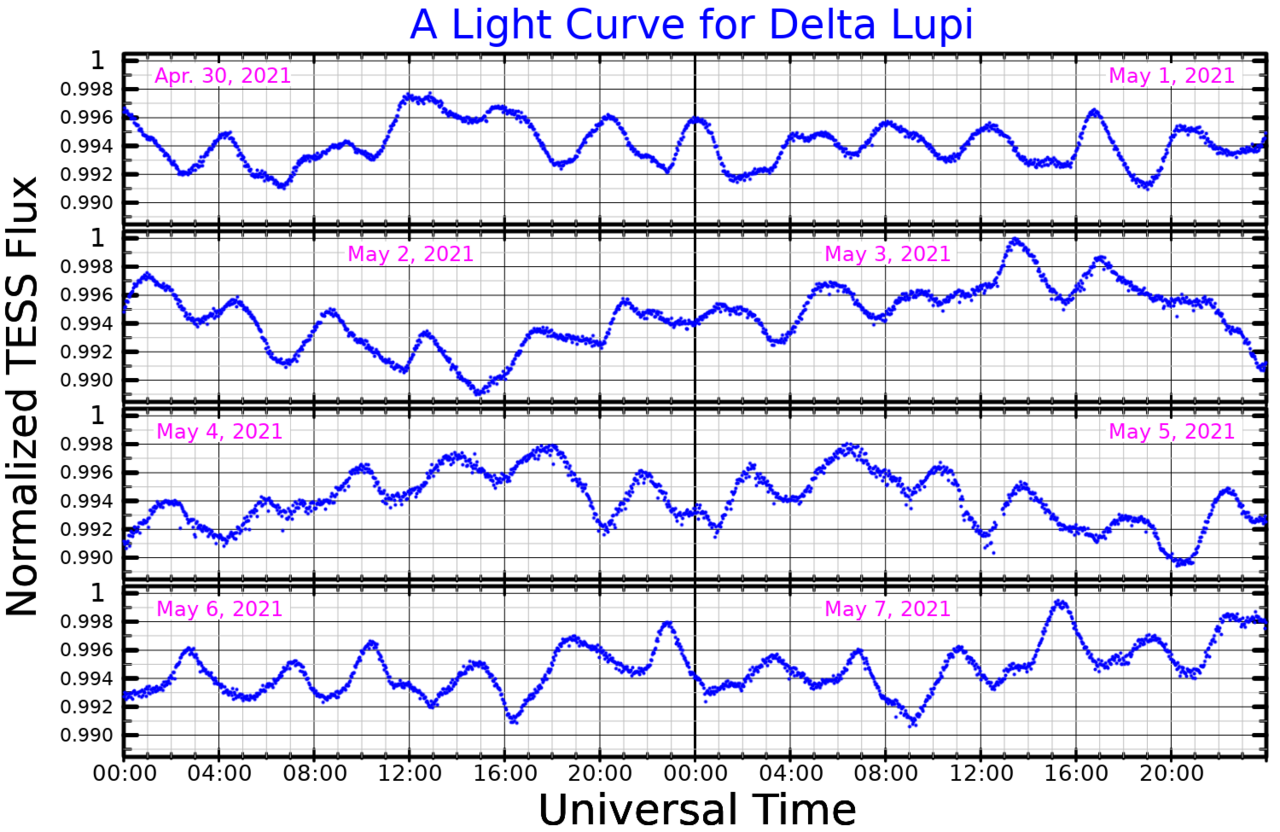
As a Beta Cephei variable, it pulsates periodically with a single cycle lasting 0.1655 days—equivalent to six cycles per day. It is a proper-motion member of the Upper Centaurus–Lupus subgroup within the Scorpius–Centaurus OB association, the nearest co-moving group of massive stars to the Sun.
- Apparent magnitude
- 3.2
- Spectral type
- B1.5 IV
- Distance
- roughly 900 light-years (with a 15% margin of error)
- Mass
- nearly 12 times the mass of the Sun
- Luminosity
- around 10,000 times the luminosity of the Sun
- Effective temperature
- 23,000 K
- Age
- roughly 15 million years
Lore & Background
In traditional Chinese astronomy, Delta Lupi is known as 'the 2nd (star) of the Cavalry Officer' (騎官二). Its spectrum matches a stellar classification of B1.5 IV, indicating it has entered the subgiant stage and is in the process of evolving into a giant star. The star radiates around 10,000 times the luminosity of the Sun from its outer atmosphere at an effective temperature of 23,000 K, giving it a blue-white hue. It has nearly 12 times the mass of the Sun and is roughly 15 million years old. Delta Lupi is a proper motion member of the Upper Centaurus–Lupus sub-group in the Scorpius–Centaurus OB association, the nearest such co-moving association of massive stars to the Sun.
Reader's Guide
Delta Lupi is notable as a Beta Cephei variable star, a class of pulsating variables that exhibit short-period brightness variations driven by internal oscillations. Its single period of variability lasts 0.1655 days, corresponding to about six cycles per day. This pulsation behavior makes it a valuable object for studying stellar structure and evolution in massive stars. As a member of the Upper Centaurus–Lupus sub-group within the Scorpius–Centaurus OB association, Delta Lupi is part of the nearest large group of massive, young stars to the Sun. Its subgiant classification (B1.5 IV) places it at a critical evolutionary stage, transitioning from the main sequence toward becoming a giant. The star's distance, measured via parallax at roughly 900 light-years with a 15% margin of error, situates it well within this association. Its brightness as the fourth-brightest star in Lupus makes it an accessible target for both amateur and professional observations of variable stars. The light curve data from TESS further contributes to understanding its pulsation characteristics.
Did You Know?
- Delta Lupi is the fourth-brightest star in the constellation Lupus.
- It has a single period of variability lasting 0.1655 days, or about six cycles per day.
- The star is roughly 15 million years old and has nearly 12 times the mass of the Sun.
- In traditional Chinese astronomy, it is called 'the 2nd (star) of the Cavalry Officer' (騎官二).
Classification and Mechanisms of Variability
Delta Lupi belongs to the broader family of variable stars—celestial objects whose apparent brightness as observed from Earth shifts in a systematic way over time. The underlying cause of such dimming or brightening falls into two broad categories. Intrinsic variables experience genuine changes in their own emitted light, often because the stellar body itself expands and contracts in a rhythmic fashion. Extrinsic variables, by contrast, remain fundamentally steady in their output; instead, their apparent brightness fluctuates because something in their vicinity periodically intercepts the light before it can reach our telescopes, such as an orbiting companion star passing in front. The temporal signature of these changes is remarkably diverse. Some systems pulse in tight, repeating cycles, while others drift in irregular, unpredictable patterns. The timescales span an enormous range, from fluctuations measurable in under an hour to slow cycles stretching across multiple years. In fact, oscillation in luminosity is so common that many stars, perhaps the majority, display at least a slight waver in their energy output. Even our own Sun varies by roughly one-tenth of one percent across its eleven-year activity cycle, while at the dramatic opposite end, a supernova can momentarily blaze brighter than an entire galaxy.
A Long History of Observation
Long before modern instruments existed, human observers across cultures noticed that certain stars did not hold a fixed brightness. An ancient Egyptian calendar compiled roughly three thousand two hundred years ago may contain the earliest preserved record of the eclipsing binary Algol, though scholars continue to debate the reliability of that attribution. Aboriginal Australian communities likewise wove the brightness changes of Betelgeuse and Antares into oral narratives passed through generations. Babylonian, Chinese, and Arab astronomers independently logged bright nova and supernova events in the centuries before telescopes. The telescope era brought the first confirmed periodic variable when Johannes Holwarda tracked the eleven-month pulsation of Omicron Ceti in 1638, a star that David Fabricius had earlier mistaken for a nova in 1596. Geminiano Montanari described Algol's variability in 1669, and John Goodricke later supplied the correct eclipsing explanation in 1784. By 1786, a mere ten variable stars had been catalogued. The pace of discovery accelerated dramatically once photographic plates made systematic sky surveys feasible, and Harvard College Observatory launched a dedicated all-sky photographic program in 1885. By the 2008 edition of the General Catalogue of Variable Stars, more than forty-six thousand entries in the Milky Way, ten thousand in other galaxies, and another ten thousand suspected cases had been recorded.
The Cosmic Distance Ladder
In 1912, Henrietta Swan Leavitt identified a tight mathematical link between the period of a Cepheid variable's pulsation and its intrinsic brightness. This period-luminosity relationship transformed variable stars into natural cosmic yardsticks. In 1924, Edwin Hubble applied Leavitt's calibration to a Cepheid he detected in what was then called the Andromeda Nebula. The resulting distance estimate proved that the nebula was an entirely separate island universe far beyond the Milky Way, thereby resolving the Great Debate over whether spiral nebulae were distant galaxies or mere gas clouds within our own. Variable stars now occupy several critical rungs on the cosmic distance ladder, the step-by-step framework astronomers use to gauge the scale of the observable universe. Beyond distance work, eclipsing binaries offer a complementary gift: their orbital periods let researchers pin down the masses and radii of the component stars with high precision, data that is indispensable for testing and refining models of stellar evolution. Cecilia Payne's 1930 monograph, The Stars of High Luminosity, further consolidated the field through extensive observations of Cepheids and other variables, work she carried out alongside her husband Sergei Gaposchkin, and which laid the groundwork for every subsequent study of variable-star physics.
Tools and Techniques for Study
Astronomers probe the variability of stars like Delta Lupi through a suite of complementary techniques. Photometry and spectrophotometry track how total brightness and spectral energy distribution shift over time, while spectroscopy reveals changes in the star's chemical and physical conditions, and polarimetry measures shifts in the orientation of emitted light. Plotting brightness against time yields a light curve, a signature graph whose peaks are called maxima and whose troughs are minima. For regular variables, the period and amplitude of the cycle can be established with high confidence, though in many cases these parameters drift slowly or even change from one cycle to the next. Combining light-curve data with spectral evolution often allows researchers to diagnose the physical mechanism driving the variability. Amateur astronomers have long contributed meaningfully to this effort. By visually comparing a variable star against nearby reference stars of known, steady magnitude within the same telescopic field, they can estimate the variable's brightness at a given moment and build up a visual light curve over time. The Variable Star Section of the British Astronomical Association, founded in 1890, stands as perhaps the oldest dedicated organization supporting this kind of citizen-science observation.
Gallery
Frequently Asked Questions
Who is Delta Lupi?
Delta Lupi is a hot subgiant star in the southern circumpolar constellation Lupus, ranking as the fourth-brightest member of that group with an apparent visual magnitude of 3.2. In traditional Chinese star lore it is catalogued as the second star of the Cavalry Officer (騎官二). Parallax measurements put it roughly 900 light-years from Earth, though that distance figure carries a 15% uncertainty.
What is Delta Lupi's spectral type and what life stage is it in?
Its B1.5 IV classification tells us the star has already left the main sequence and entered the subgiant phase, actively evolving toward becoming a full giant. The Roman-numeral 'IV' luminosity class specifically marks that transitional stage between a main-sequence star and a giant.
How does Delta Lupi compare to the Sun in brightness and temperature?
Delta Lupi radiates roughly 10,000 times the Sun's total luminosity while its outer atmosphere sits at an effective temperature of about 23,000 K. It also carries nearly 12 times the Sun's mass, making it a genuinely massive and energetic star.
What kind of variable star is Delta Lupi?
Delta Lupi is classified as a Beta Cephei variable, a pulsating star whose brightness oscillations are driven by pressure waves in its outer layers. This makes it a useful target for studying the internal structure and dynamics of evolved B-type stars.
Why is Delta Lupi important to variable-star astronomy?
As a relatively nearby massive subgiant showing Beta Cephei-type pulsations, it gives astronomers a concrete example of how stars in the B1.5 IV evolutionary stage behave dynamically. Its well-measured distance, mass, and luminosity make it a handy calibration point for models of stellar evolution in that mass range.
More in Variable Stars, Part 7 1-24
Spotted an error? Know more?
Reader corrections go straight into our review queue. Suggest an edit · How this site is sourced