Delta Pictoris
A runaway eclipsing binary with shallow eclipses in Pictor.

PopePompus · CC BY-SA 4.0
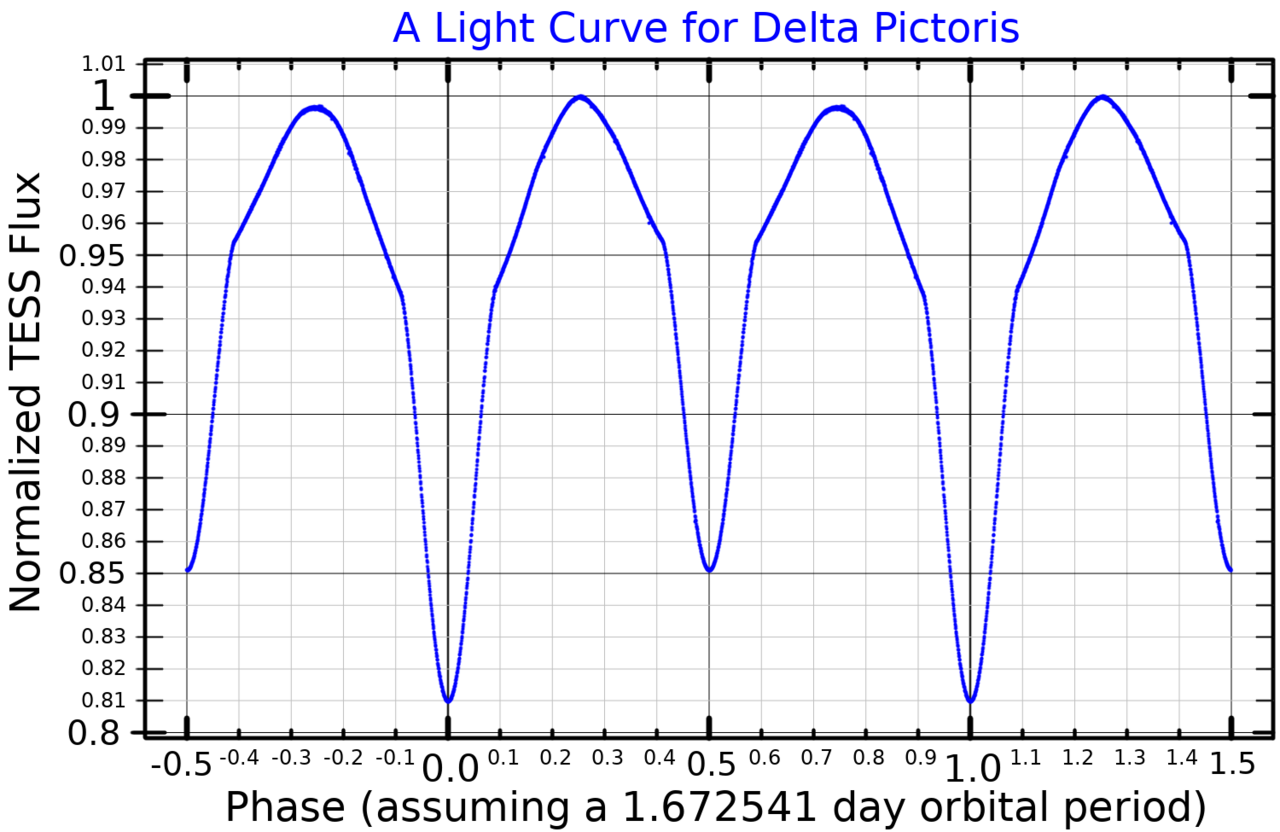
Delta Pictoris is a binary star system in the southern constellation Pictor, visible to the naked eye with a combined apparent visual magnitude of 4.72. It is notable as a runaway star system generating a bow shock as it moves through the interstellar medium, and as a likely Beta Lyrae-type eclipsing binary with shallow eclipses.
- Apparent visual magnitude (combined)
- 4.72
- Distance from sun
- ~1,300 light years
- Radial velocity
- ~31 km/s (receding)
- Orbital period
- 1.67 days
- Peak magnitude
- 4.65
- Primary eclipse magnitude
- 4.90
- Secondary eclipse magnitude
- 4.83
Lore & Background
The binary nature of Delta Pictoris was discovered by R. E. Wilson in 1914, and its variability was found by A. W. J. Cousins in 1951. Orbital elements published by A. D. A. Thackeray in 1966 showed it to be an eclipsing double-lined spectroscopic binary with an orbital period of 1.67 days in essentially a circular orbit. The low inclination of the orbital plane results in shallow eclipses. The system is classified as a likely Beta Lyrae-type eclipsing binary, with a peak magnitude of 4.65 dropping to 4.90 during primary eclipse and 4.83 during secondary eclipse. It is probably a detached binary system with no circumstellar material found.
Both components are massive main sequence stars with a combined stellar classification of B1/2(III)n. One member displays β Cep type pulsational behavior. Mass estimates give the primary at 16.3 times the mass of the Sun and the secondary at about half that. The system is a runaway star system generating a bow shock as it moves through the interstellar medium.
Reader's Guide
Delta Pictoris holds significance as a runaway star system, its high velocity through the interstellar medium producing a detectable bow shock. Its classification as a likely Beta Lyrae-type eclipsing binary, despite shallow eclipses due to low orbital inclination, places it among interacting massive binaries studied for stellar evolution. The discovery of its binary nature in 1914 and variability in 1951, followed by orbital solution in 1966, established it as a double-lined spectroscopic binary with a short 1.67-day period. The presence of β Cep pulsational behavior in one component adds asteroseismic interest, linking pulsation to massive main-sequence stars. The system's detached nature, with no circumstellar material, suggests it has not yet undergone mass transfer, making it a valuable benchmark for modeling massive binary evolution. Its combined spectral type B1/2(III)n and mass ratio (primary 16.3 solar masses, secondary about half that) provide constraints on stellar structure and binary formation theories. The shallow eclipses, while limiting photometric precision, still allow orbital parameter refinement. As a naked-eye variable in a southern constellation, it remains accessible for amateur and professional monitoring.
Did You Know?
- The system was discovered to be binary by R. E. Wilson in 1914 and found variable by A. W. J. Cousins in 1951.
- It has an orbital period of 1.67 days in a nearly circular orbit.
- One component displays β Cep type pulsational behavior.
Stellar Nature and Physical Profile
Beta Pictoris is a hot, fast-spinning A-type star that outshines our Sun by a considerable margin. With an effective surface temperature of roughly 8,054 kelvins, it burns significantly hotter than the Sun's 5,778 kelvins, and its total radiated power across all wavelengths reaches 8.7 times solar luminosity. Orbital modeling of its three planets pins the stellar mass at 1.79 times that of the Sun, while interferometric measurements with the Very Large Telescope place the radius at approximately 1.5 to 1.7 solar radii depending on the analysis method. The surface gravity works out to about 150 meters per second squared, roughly 55 percent of solar surface gravity. Spectroscopic analysis shows the star's metal-to-hydrogen ratio is essentially identical to the Sun's, with a [M/H] value of +0.01. The star spins at a minimum of 130 kilometers per second, and its brightness wobbles by one to two millimagnitudes on periods of roughly 30 to 40 minutes, earning it a classification as a Delta Scuti variable star.
The Debris Disk and Ongoing Planet Formation
One of the most remarkable features of the Beta Pictoris system is its spectacular circumstellar disk, which was the first debris disk ever directly imaged around a star other than the Sun. The star emits an excess of infrared radiation compared to typical A-type stars, a signature produced by vast quantities of dust and gas—including carbon monoxide—swirling in its vicinity. Detailed observations reveal not just a single ring but multiple planetesimal belts and evidence of active cometary processes. Crucially, the presence of three confirmed planets orbiting within the disk's plane suggests that planetary assembly has already occurred here, and some evidence points to the possibility that planet formation is still actively taking place. The disk's material is also of practical interest to Earth: researchers believe debris ejected from the Beta Pictoris system constitutes the dominant source of interstellar meteoroids that occasionally enter our own Solar System, making this young star a quiet but significant contributor to the cosmic dust that reaches us.
A Three-Planet System Captured in the Act
The Beta Pictoris system hosts three confirmed planets—designated b, c, and d—all of which have been detected through direct imaging, a technique that captures actual photons from the planets themselves rather than inferring their presence indirectly. Beta Pictoris c, however, was initially confirmed using the radial velocity method before direct imaging sealed its identification. All three worlds orbit within the plane of the star's debris disk, a geometric alignment that strongly ties their formation to the same disk material. One of these planets holds a notable record: Beta Pictoris c is the closest extrasolar planet to its host star that has ever been photographed. Its observed angular separation from the star corresponds to roughly the same distance that separates the asteroid belt from the Sun in our own system, making it an extraordinarily tight-neighbor relationship for a directly imaged exoplanet. The fact that all three planets were resolved by direct imaging in such a young system—only 23 million years old—offers astronomers a rare window into the early architecture of planetary systems still in their formative stages.
Position, Motion, and a Stellar Neighborhood
Beta Pictoris sits in the southern constellation Pictor, the Easel, positioned to the west of the brilliant star Canopus. With an apparent visual magnitude of 3.86, it is the second-brightest star in its constellation, surpassed only by Alpha Pictoris at magnitude 3.30. Under dark skies it is readily visible to the unaided eye, though in heavily light-polluted areas its dimness relative to magnitude-3 stars can make it challenging. Historically, the star served as a marker for the sounding line of the ancient vessel Argo Navis before that constellation was divided. The Hipparcos satellite precisely measured its trigonometric parallax—initially 51.87 milliarcseconds, later refined to 51.44 milliarcseconds—yielding a distance of 63.4 light-years with an uncertainty of just 0.1 light-years. The same mission tracked its proper motion: 4.65 milliarcseconds per year eastward and 83.10 milliarcseconds per year northward, while Doppler measurements show it receding from us at 20 kilometers per second. A cluster of similarly aged, co-moving stars shares this exact trajectory through space, forming the Beta Pictoris moving group, a stellar family likely born from the same primordial gas cloud.
Gallery
Frequently Asked Questions
What is Delta Pictoris?
Delta Pictoris is a binary star system in the southern constellation Pictor that appears to the unaided eye as a single point of light with a combined visual magnitude of about 4.72. It lies roughly 1,300 light years from the Sun and is currently receding from us at a radial velocity near 31 km/s.
How does Delta Pictoris vary in brightness?
It is classified as a likely Beta Lyrae-type eclipsing binary, so the two stars partially overlap during orbit and produce shallow, gradual dimming rather than sharp, deep eclipses. The system brightens to 4.65 at peak and dips to 4.90 at the primary eclipse, with the full orbital cycle repeating every 1.67 days.
What does 'runaway star' mean for Delta Pictoris?
Delta Pictoris is travelling through the surrounding interstellar medium fast enough to plough a visible bow shock ahead of it, much like a ship pushing water aside. That high-velocity motion sets it apart from typical field stars and hints that it was ejected from a denser stellar environment earlier in its history.
Can I see Delta Pictoris with the naked eye?
Yes—its combined apparent magnitude of 4.72 places it comfortably within the range of unaided human vision under reasonably dark skies. Because Pictor is a southern-hemisphere constellation, observers south of the equator enjoy the best viewing geometry.
What makes Delta Pictoris interesting to variable-star observers?
Its short 1.67-day period combined with shallow, Beta Lyrae-style eclipses makes each cycle quick to track but subtle to measure precisely. The added complication of its runaway status and bow shock gives researchers a rare chance to study how a fast-moving binary interacts with the local interstellar gas.
More in Variable Stars, Part 7 1-24
Spotted an error? Know more?
Reader corrections go straight into our review queue. Suggest an edit · How this site is sourced