
Gamma Pegasi
A hybrid pulsator and binary star in the Great Square of Pegasus.

PopePompus · CC BY-SA 4.0
Gamma Pegasi, also known as Algenib, is a binary star system located at the southeast corner of the Great Square asterism in the constellation Pegasus. With an average apparent visual magnitude of +2.84, it is the fourth-brightest star in the constellation. It is notable as a hybrid pulsator, exhibiting both Beta Cephei and slowly pulsating B star characteristics.
- Bayer designation
- Gamma Pegasi
- Traditional name
- Algenib
- Apparent visual magnitude
- +2.84 (average)
- Distance
- 144 pc
- Spectral type
- B2 IV
- Mass
- 8.8 solar masses
- Radius
- 5.5 solar radii
- Luminosity
- 6,000 solar luminosities
- Effective temperature
- >22,000 K
- Rotation period
- 0.15175 days (3.642 hours)
Lore & Background
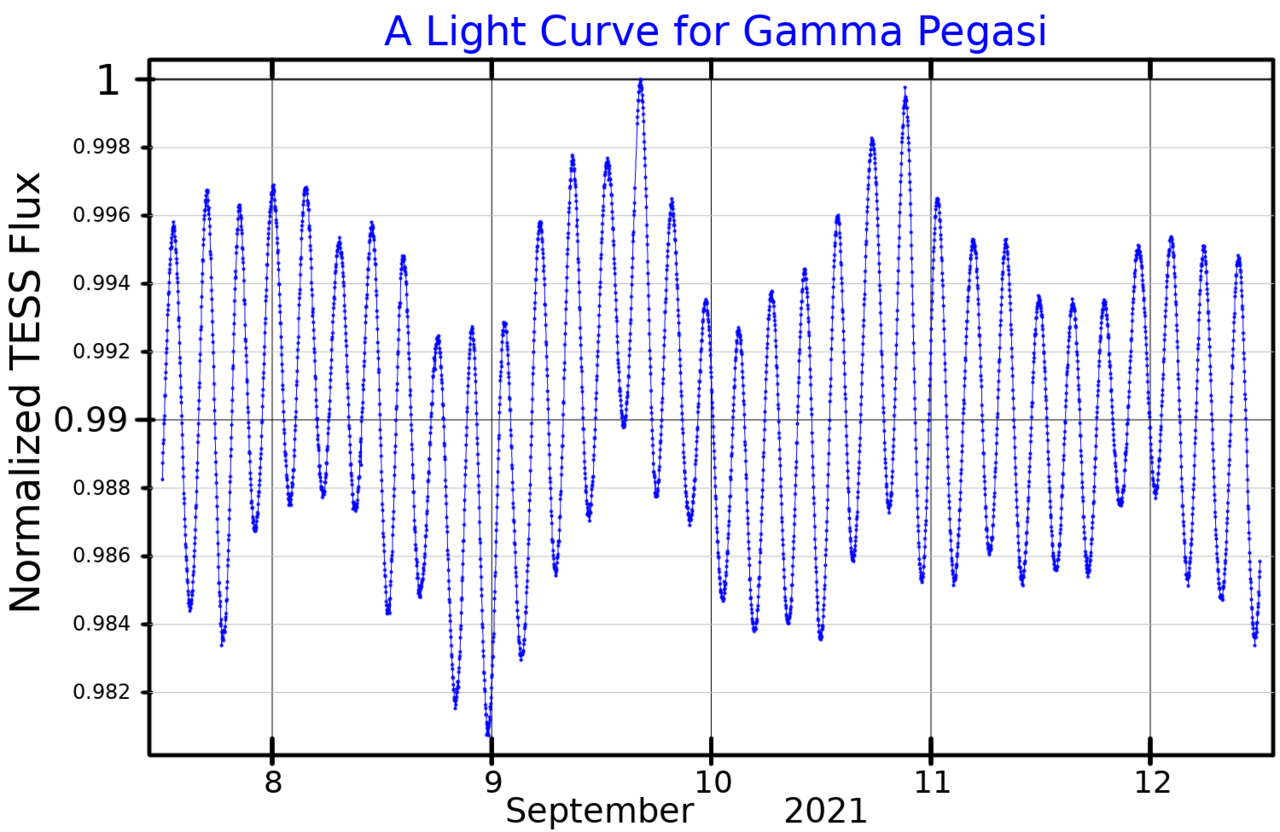
In 1911, American astronomer Keivin Burns discovered slight variations in the radial velocity of Gamma Pegasi. This was confirmed in 1953 by D. Harold McNamara, who identified it as a Beta Canis Majoris variable, later reclassified as a Beta Cephei variable. The star pulsates radially with a period of 0.15175 days (3.642 hours) and also shows three additional pulsational frequencies characteristic of a slowly pulsating B star, making it a hybrid pulsator. Its magnitude varies between +2.78 and +2.89 over each pulsation cycle. In 2025, interferometric observations revealed a companion star.
The primary component is a subgiant of spectral type B2 IV, with 8.8 times the mass and 5.5 times the radius of the Sun. It has a total luminosity of 6,000 times that of the Sun and an effective temperature exceeding 22,000 K, giving it a blue-white hue. The star has a weak magnetic field, with an upper bound on dipolar field strength of about 30 G. The secondary star has an angular separation from the primary, but little else is known about it.
In Hindu astronomy, the asterism of Gamma Pegasi and Alpha Andromedae is called Uttara Bhādrapadā, the 26th nakshatra. In Chinese astronomy, the same pair forms the Wall asterism, and Gamma Pegasi itself has a Chinese name. During the Artemis II mission in April 2026, Gamma Pegasi was captured in photographs of the totally eclipsed Sun.
Reader's Guide
Gamma Pegasi holds significance as a well-studied hybrid pulsator, combining the characteristics of Beta Cephei and slowly pulsating B stars. Its discovery as a variable in the early 20th century and subsequent classification contributed to the understanding of stellar pulsation mechanisms. The detection of a companion in 2025 added to its interest as a binary system. Its traditional name Algenib, shared historically with Alpha Persei, was standardized by the International Astronomical Union in 2016 for Gamma Pegasi A. The star's location at the southeast corner of the Great Square of Pegasus makes it a recognizable landmark in the night sky. Its inclusion in photographs of the total solar eclipse during the Artemis II mission in April 2026 highlights its continued relevance in modern astronomy. The star's weak magnetic field and slow rotation (or near pole-on orientation) provide additional avenues for research into stellar magnetism and evolution.
Did You Know?
- Gamma Pegasi is a hybrid pulsator, showing both Beta Cephei and slowly pulsating B star behavior.
- Its magnitude varies between +2.78 and +2.89 over a pulsation cycle of 3.642 hours.
- A companion star was discovered around Gamma Pegasi in 2025 using interferometric observations.
- The star was photographed during the total solar eclipse of April 2026 by the Artemis II mission.
Identity & Nomenclature
Gamma Pegasi occupies the southeast corner of the Great Square asterism within the constellation Pegasus. Its Bayer designation derives from the Greek letter gamma, which is Latinized and commonly abbreviated as Gamma Peg or γ Peg. The star's traditional proper name, Algenib, was historically shared with Alpha Persei, creating a persistent naming ambiguity. In 2016, the International Astronomical Union convened a Working Group on Star Names to catalog and standardize proper stellar names. The group's first bulletin that July resolved the conflict by formally assigning Algenib to Gamma Pegasi A, while Alpha Persei received the name Mirfak. Beyond Western naming conventions, this star carries rich cultural weight. In Hindu astronomy, the pairing of γ Pegasi with α Andromedae constitutes the 26th nakshatra, known as Uttara Bhādrapadā or Uttṛṭṭāti. Chinese astronomers identified the same two-star asterism as Bìxiù, meaning Wall, and named γ Pegasi itself Bìxiù yī, or the First Star of Wall. Such cross-cultural recognition highlights how prominently this star has featured in observational traditions spanning thousands of years.
Stellar Properties & Classification
The primary component of this system is a substantial star, boasting 8.8 times the Sun's mass and a radius 5.5 times larger than our own. Its spectral classification of B2 IV identifies it as a subgiant, meaning it is in the process of exhausting its core hydrogen supply and evolving away from the main sequence. The star radiates a total luminosity of 6,000 times that of the Sun from an outer atmosphere whose effective temperature exceeds 22,000 Kelvin, producing a vivid blue-white glow. Its projected rotational velocity of merely 8 km/s implies either an exceptionally slow spin or a viewing geometry nearly aligned with the stellar pole. Algenib also possesses a weak magnetic field, with measured values ranging from negative 10 to positive 30 gauss, and an upper bound on dipolar field strength of approximately 40 gauss. At an average apparent visual magnitude of +2.84, it ranks as the fourth-brightest star in the constellation Pegasus. Parallax measurements place the system at roughly 470 light-years, or 144 parsecs, from Earth.
Pulsation & Variability
The discovery that Gamma Pegasi varies in brightness traces back to 1911, when American astronomer Keivin Burns detected subtle, periodic shifts in the star's radial velocity. The finding sat largely unconfirmed for over four decades until 1953, when D. Harold McNamara verified the variability and classified the star as a Beta Canis Majoris variable—a category that was subsequently reorganized under the Beta Cephei variable designation. The star's primary pulsation is radial, with a period of 0.15175 days, equivalent to roughly 3.642 hours, and its apparent magnitude swings between +2.78 and +2.89 over each cycle. Crucially, however, the oscillations do not stop at a single frequency. The star simultaneously displays the hallmarks of a slowly pulsating B star, exhibiting three additional pulsational modes. This superposition of distinct oscillation behaviors earns Gamma Pegasi the label of a hybrid pulsator, a classification that makes it a valuable target for asteroseismological investigations into the deep interior of hot, massive stars.
Binary Nature & the Artemis II Connection
For much of its observational history, the companion to Gamma Pegasi A remained a faint and poorly characterized object in the sky. The secondary star is positioned at an angular separation of 85.6 ± 0.1 milliarcseconds from the primary, yet remarkably little is known about its physical properties or nature. It was not until 2025 that interferometric observations definitively confirmed the presence of a companion around the star, adding a new and important dimension to our understanding of this system. The binary character of Algenib also ties it to a remarkable modern event. During the Artemis II mission in April 2026, photographs were taken of the totally eclipsed Sun by the Moon, captured in the direction of the constellations Aries, Pegasus, and Pisces. Gamma Pegasi appeared in those images, linking a 470-light-year-distant blue-white subgiant to a landmark moment in human spaceflight. The same familiar geometry of the Great Square that has guided stargazers for millennia was thus witnessed from the vantage point of a crewed lunar flyby.
Gallery
Frequently Asked Questions
Who is Gamma Pegasi?
Gamma Pegasi is the Bayer designation for Algenib, a binary star system occupying the southeast corner of the Great Square asterism in Pegasus. It holds the position of the fourth-brightest star in that constellation.
What makes Gamma Pegasi a variable star?
It is a hybrid pulsator, simultaneously exhibiting the oscillation patterns of both Beta Cephei variables and slowly pulsating B stars. This dual-mode variability distinguishes it from single-mode pulsators and makes it a unique study target.
Where can I find Gamma Pegasi in the night sky?
Look to the southeast corner of the Great Square of Pegasus, a prominent asterism best seen during northern autumn and winter evenings. At an average apparent visual magnitude of +2.84, it is readily visible to the naked eye under dark skies.
What are Gamma Pegasi's key physical properties?
Classified as a B2 IV star, it carries a mass of roughly 8.8 solar masses and lies approximately 144 parsecs from the Solar System. It exists as a binary system rather than a single stellar object.
Why is Gamma Pegasi important to variable-star astronomy?
Its hybrid pulsation behavior—blending Beta Cephei and SPB-type oscillations within one star—provides a natural laboratory for probing how competing instability mechanisms coexist in massive stars. It also serves as a familiar anchoring point for observers navigating the Pegasus asterism.
More in Variable Stars, Part 7 1-24
Spotted an error? Know more?
Reader corrections go straight into our review queue. Suggest an edit · How this site is sourced